
 English
 Dutch
Dutch Japanese
 Hindi
Hindi Italian
 Spanish
 French
 German
 Chinese
 Korean
 Arabic
 Hebrew
 Russian
 Portuguese
 Danish
 Czech
Czech Polish
 Swedish
Have Questions?
+977 9767224414
Unmissable holidays deals - Save up to 20%
Short Manaslu Circuit Trek – 13 Days

Duration
13 Days

Trip Difficulty
Moderate

Max. Altitude
5,106m

Destination
Nepal

Group Size
1-16 People

Accommodation
Hotel, Teahouse

Transportation
Tourist Bus/jeep

Meals
B L D
Explore more facts about the trip
Overview of Short Manaslu Circuit Trek – 13 Days
The Short Manaslu Circuit trek route is one of the most spectacular and yet less traveled trekking routes in Nepal, where the trekkers are awed by the breathtaking landscape, cultural diversity, and adventurous nature around the eighth-highest mountain in the world, Mt. Manaslu (8,163m).
This is a 13-day trekking tour where the walk ventures deep in the restricted area of Manaslu, offering the wild Himalayas and a glimpse of Tibetan villages, steep mountain passes, and the beauty of nature that is yet to be snatched by commercial trekking.
The short Manaslu Circuit trek starts with a beautiful drive journey from Kathmandu to Soti Khola and progressively proceeds through the beautiful lowlands, forest, and across the aromatic river Budi Gandaki that has suspension bridges zigzagging all along.
Upwards, the scenery is changed with alpine meadow and holds of snow, most especially above Namrung and Sama Gaun. In Short Manaslu Circuit Trek, trekkers are able to soak in the Tibetan-Buddhist culture and experience ancient monasteries as they also get to interact with locals who have a traditional way of life that is influenced by the nearby inhabitants of Tibet.
The highlight of Short Manaslu Circuit Trek is to cross the dramatic Larkya La Pass (5,160m), which is difficult but worth it, as one can get panoramic views of the surrounding mountains like Himlung Himal, Cheo Himal, Kangguru, and Annapurna II. The downhill takes you through the scenic valleys to Besisahar for another complete Himalayan circuit, which is extremely experiential.
The Manaslu Circuit Trek can provide peace, solitude, and authenticity as compared to other major tourist trails such as Everest or Annapurna. It is also in restricted territory, hence it requires special permission to be there, which makes it even more exclusive and helps keep the region intact.
As trekkers will be fewer, therefore, the trail is also in its pristine condition in terms of exciting the visitors with a veritable wilderness experience who want to get remote and enriching on the cultural front as well.
The short Manaslu Circuit Trek is ideal and catered towards average hikers with moderate trekking experience, and anyone with reasonable fitness, as the trek is equal parts adventure and equal parts culture and natural beauty. Be it the majesty of the mountains, the friendliness of the people, or the virility of the Himalayas, Short Manaslu Circuit Trek remains etched in the heart of every traveler.

Price starts
US$ 1400
US$ 1500
- Safety first, always
- Best prices guaranteed
- Expert travel team
- Easy booking, no extras
- Customize your journey
Based on 10 reviews

Trip Highlights
- Panoramic views of Mt. Manaslu (8,163m) and surrounding peaks
- Crossing the breathtaking Larkya La Pass (5,160m)
- Exploring remote and culturally rich Tibetan-influenced villages
- Less crowded and off-the-beaten-path compared to popular treks
- Scenic drive through the Budi Gandaki Gorge
- Opportunity to visit ancient monasteries in Sama Gaun and Lho
- Close encounters with diverse flora and fauna in the Manaslu Conservation Area
- Experience an authentic Himalayan lifestyle and warm hospitality
- Stunning alpine landscapes, waterfalls, and rivers along the trail
- A unique combination of cultural immersion and high-altitude adventure
Photo and Video Gallery


Short Manaslu Circuit Trek – 13 Days Detail Itinerary

Day 01: Drive from Kathmandu to Soti Khola (700m) – 7 to 8 hours
Your journey to the short Manaslu Circuit trek begins with an early morning drive from the bustling capital city of Kathmandu to the peaceful village of Soti Khola.
This scenic journey follows the Trishuli and Marsyangdi Rivers before diverging towards Arughat and onward to Soti Khola.
The road transitions from blacktop to rugged terrain, giving you a preview of the remoteness that awaits.
Along the way, you’ll pass through green hills, terraced fields, and villages set against a Himalayan backdrop.
Overnight stay at a local teahouse in Soti Khola.

Activity: 7-8 hrs drive

Meal: B L D

Accommodation: Teahouse
Day 02: Trek from Soti Khola to Machha Khola (870m) – 6 to 7 hours
The trek starts officially after breakfast. You will begin with a suspension bridge and get inside a thick sal forest. The path leads up and down slopes and down to waterfalls and rice terraces. You will trek on the Budi Gandaki River, cut across rocks, and through forested hills.
Reaching several villages of the Gurung and Magar people, you will come to the small riverside village named Machha Khola. The sound of the river and the breezy wind of the mountain gave a calm atmosphere to the evening.
Activity: 6-7 hrs trek

Max. Altitude: 870m/2,854ft. ()
Meal: B L D
Accommodation: Teahouse
Day 03: Trek from Machha Khola to Jagat (1,340m) – 6 to 7 hours
The trail today is full of ups and downs on weaving paths cut directly into the cliff. Crossing this river (Tharo Khola) and proceeding upstream, you will get to the town of Tatopani, where there is a hot spring. Spare a time-consuming dip when time is available.
The trail is gradual uphill through dense forest and suspension bridges to Jagat, where there is a checkpoint and entry point to the Manaslu Conservation Area. There is a change in the cultural landscape as the village streets are paved with stone, and the houses are traditional.
Activity: 6-7 hrs trek
Max. Altitude: 1,340m/4,396ft. ()
Meal: B L D
Accommodation: Teahouse
Day 04: Trek from Jagat to Deng (1,860m) – 6 to 7 hours
The trail goes through the terraced fields and villages such as Salleri and Sirdibas, where Tibetan influence can be seen through the presence of prayer flags and mani walls.
Turning along a long suspension bridge that leads to Philim, the trail forks – you take the trail on the left side that leads to Deng.
You will go through bamboo forests and waterfalls, isolated villages such as Ekle Bhatti, and reach a small village called Deng, which is also covered by pine forests and mountains with high cliffs. At higher elevations, the air tends to get cold.
Activity: 6-7 hrs trek
Max. Altitude: 1,860m/6,102ft. ()
Meal: B L D
Accommodation: Teahouse
Day 05: Trek from Deng to Namrung (2,630m) – 6 to 7 hours
This section of the short Manaslu circuit trek will provide an even more immersive exploration of the distant Himalayan countryside.
The trail ascends gradually through forests and passes through minor villages such as Rana and Bihi Phedi. Making your way to Namrung, the scenery gradually changes from subtropical to alpine.
Namrung is a significant village comprising traditional stone houses, some teahouses, and a gorgeous outlook of mountains such as Ganesh Himal and Himalchuli. Here, the culture of Tibetan Buddhism is very strong.
Activity: 6-7 hrs trek
Max. Altitude: 2,630m/8,629ft. ()
Meal: B L D
Accommodation: Teahouse
Day 06: Trek from Namrung to Sama Gaun (3,530m) – 6 to 7 hours
Cultural and scenic delights are present on this day. The trail expands towards Lihi and Lho villages, comprising mani walls and monasteries through alpine forests commencing at Namrung.
Experience a very spectacular view of Manaslu at Lho. Go beyond Shyala, which is another picturesque village and is surrounded by snowcapped mountains.
Eventually, you come to Sama Gaun, one of the biggest settlements in the area. It is a spot that gives you an opportunity to visit the Pungyen Gompa, a holy hermitage in the mountains, and view the majestic Manaslu in the distance.
Activity: 6-7 hrs trek
Max. Altitude: 3,530m/11,581ft. ()
Meal: B L D
Accommodation: Teahouse
Day 07: Acclimatization Day in Sama Gaun – Hike to Manaslu Base Camp or Birendra Lake
Today is a day of acclimatization, one of the important procedures prior to trekking at high altitudes.
You can either do a small hike to a glacial lake with turquoise water (Birendra Lake) or test your endurance and trek to Manaslu Base Camp (4,800m). Both of the possibilities can provide you with gratifying scenery and a better adaptation of your body.
The rest of the day can be spent in Sama Gaun or resting. There is a health post, and lots of local shops to buy basic necessities.
Max. Altitude: 4,800m/15,748ft. ()
Meal: B L d
Accommodation: Teahouse
Day 08: Trek from Sama Gaun to Samdo (3,860m) – 3 to 4 hours
Your body has more adjustment time with a shorter trek today. The trek is uphill, following the Budi Gandaki River on yak pastures along the primeval mani walls. The green cover gets scarce as the land becomes arid and windblown.
You will get to the last village before the pass, Samdo. It is a Tibetan refugee community that presents culture/social interaction experiences he or she has never had before, and excellent mountain views.
You may also hike to acclimatize and observe the Himalayan wildlife, such as blue sheep, up the hill.
Activity: 3-4 hrs trek
Max. Altitude: 3,860m/12,664ft. ()
Meal: B L D
Accommodation: Teahouse
Day 09: Trek from Samdo to Dharmasala (4,460m) – 4 to 5 hours
The trail goes on through the glacier juices and wilderness as you rise towards Dharmasala or Larkya Phedi. This is a small detour with not much accommodation and serves as a launch pad when crossing the Larkya La Pass.
There will be a sharp contrast in the landscape that will be arid, rocky, and windswept. Sleep early in order to have the big day tomorrow. Nighttime can be very rough, and you should dress warmly.
Activity: 4-5 hrs trek
Max. Altitude: 4,460m/14,633ft. ()
Meal: B L D
Accommodation: teahouse
Day 10: Over the Cross Larkya La Pass (5160m) and down to Bimthang (3590m) 8-9 hours
It is the most difficult, but satisfying day of the hike. The trail begins early in the morning before dawn and goes up through moraine and ice to the highest point of Larkya La Pass.
You will be able to observe fantastic views of Himlung Himal, Cheo Himal, Kangguru, and Annapurna II, which will be visible to you when you reach the top.
Once this magic moment has been caught, you can start the long descent on snowy slopes and rocky tracks to the picturesque alpine valley of Bimthang. After this adventurous day, you will get hot soup and a warm bed.
Activity: 8-9 hrs trek
Max. Altitude: 5,160m/16,929ft. ()
Meal: B L D
Accommodation: Teahouse
Day 11: Hiking Bimthang to Tilije (2,300m) 6 -7hrs
On the other side of the pass, the path now descends into green rhododendron and pine forests. You will go through Karche and Gho, which are small hamlets where the farming pursuits will be resumed.
The temperature is warmer, and there is more oxygen. They have greener landscapes, and the river has turned gentle. Welcome back to civilization. Tilije is a multi-ethnic village.
Activity: 6-7 hrs trek
Max. Altitude: 2,300m/7,546ft. ()
Meal: B L D
Accommodation: Teahouse
Day 12: Trek from Tilije to Dharapani (1,960m), then drive to Besisahar – 5 hours trek, 4 hours’ drive
Today marks the end of your trek. Descend gently through forests and farmlands to Dharapani, a key junction where the Manaslu and Annapurna Circuits meet.
From here, take a jeep ride to Besisahar, the administrative hub of the Lamjung District. It’s a long but scenic drive, passing waterfalls, villages, and hills.
Celebrate your successful journey with your team and guides in Besisahar.
Activity: 5hrs trek & 4hrs drive
Max. Altitude: 1,960m/6,430ft. ()
Meal: B L D
Accommodation: Teahouse
Day 13: Drive from Besisahar to Kathmandu – 6 to 7 hours
After breakfast, board a comfortable vehicle for the drive back to Kathmandu. You’ll pass through lush hills, rivers, and terraced landscapes, eventually returning to the vibrant capital.
Upon arrival, transfer to your hotel. The rest of the day is yours to explore the city or relax with a warm shower and a delicious meal.
Your Manaslu adventure ends here — but the memories will last a lifetime.
Activity: 6-7 hrs drive
Meal: B L D
Accommodation: Hotel
If our standard itinerary doesn't fully meet your needs, we are happy to tailor it to your specific preferences and requirements.

Includes and Excludes
What’s Included?
- Airport pickup and drop in Kathmandu
- Ground transportation from Kathmandu to Soti Khola and from Besisahar/Dharapani back to Kathmandu (local bus or private jeep as per package)
- Hotel accommodation in Kathmandu before and after the trek (standard category, twin sharing)
- Teahouse accommodation during the trek on a sharing basis
- Three meals a day during the trek (breakfast, lunch, dinner)
- Breakfast included at hotel in Kathmandu
- Licensed and experienced trekking guide
- Required number of porters according to group size
- Guide and porter salary, insurance, meals, accommodation, and transport
- All necessary trekking permits (Manaslu RAP, MCAP, ACAP as per itinerary)
- Manaslu Conservation Area and Annapurna Conservation Area entry fees
- Local government (Chumnubri) fee
- Basic first aid medical kit carried by the guide
- Sleeping bag, down jacket, duffel bag, and trekking poles if required (to be returned after trek)
- Trek completion certificate
- All government taxes and company service charges
What is not Included?
- International flight tickets to and from Nepal
- Nepal entry visa fee
- Lunch and dinner while staying in Kathmandu
- Personal expenses such as bottled drinks, snacks, hot shower, Wi-Fi, and charging
- Personal trekking equipment beyond what is provided
- Travel insurance (must include high-altitude trekking and helicopter rescue)
- Tips for trekking guide, porters, and drivers
- Extra hotel nights due to early arrival, late departure, or road delays
- Cost arising from natural disasters, road block, weather issues, political situation, or any situation beyond control
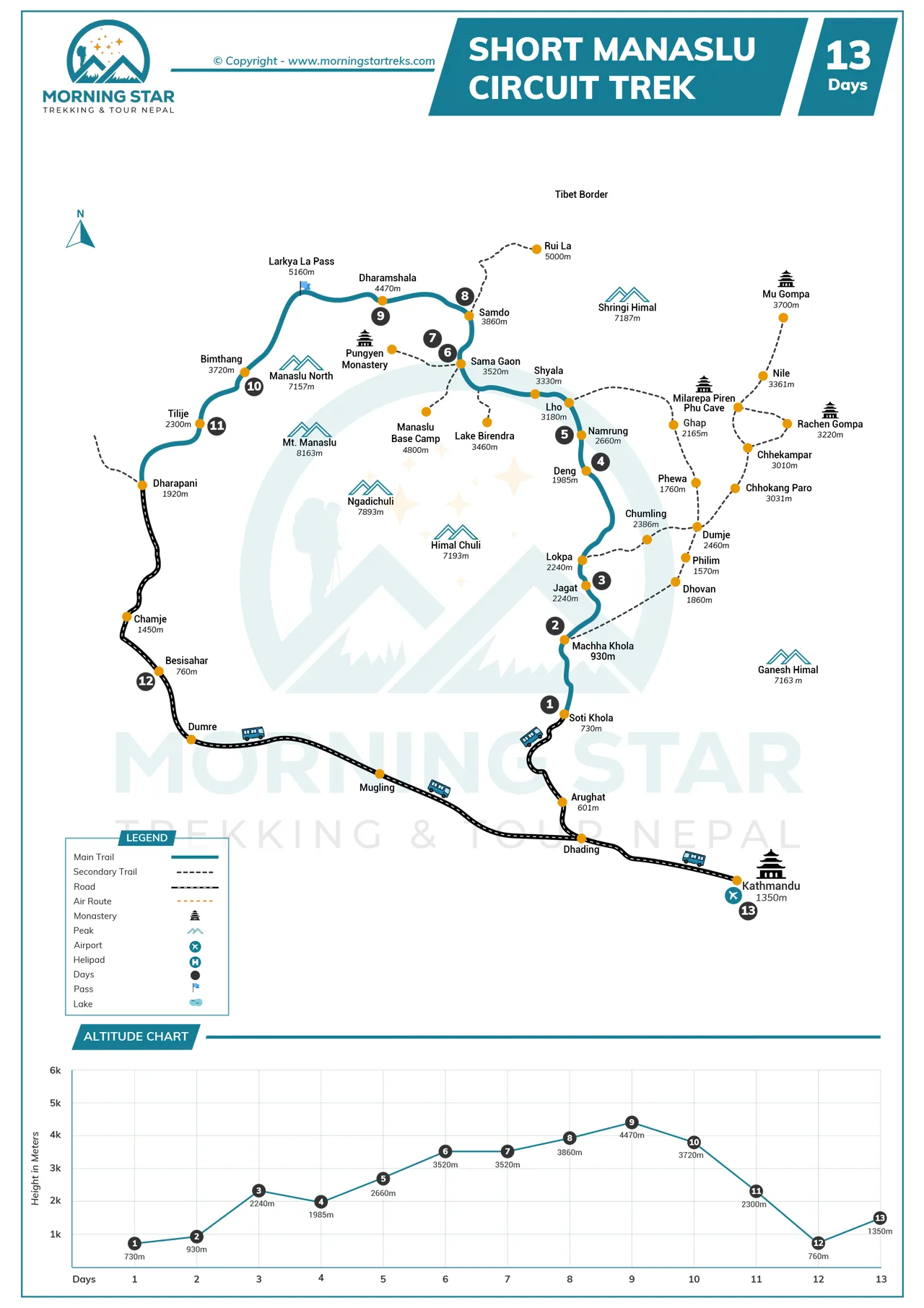
Route Map & Altitude Chart
Trip Information of Short Manaslu Circuit Trek – 13 Days
Best Season and Weather
Spring (March-May) and autumn (September-November) are the best times to do the short Manaslu Circuit Trek. The weather during these months is quite stable, dry, and clear, which makes it an ideal period to go on a trek.
Spring brings out the rockets of the rhododendron forest, mild weather, and a good view of the mountains. Autumn is crisp, and the skies are blue and vibrant. Cultural festivals (Dashain and Tihar) are held in local villages.
Other seasons, such as winter (December to February), are less favorable because it is very cold and also a lot of snow will form on the Larkya La Pass, which might be risky and sometimes not passing. The rainy season (June to August) makes the trails slippery; there are leeches at lower altitudes, and it rains heavily. Landslides tend to interfere with transportation as well.
Time of the year April and October are the most ideal months to plan your trek to the valley, as its temperature during daytime is 10 °C to 20 °C in the lower parts and -6 °C to 5 °C at high altitudes, and its precipitation is minimal during these months.
Difficulty
Short Manaslu Circuit Trek may be considered moderate to hard. It entails 5-8 hours of daily hiking on sloppy, steep, and even ice-covered terrains. The long distance of the journey, the impossibility of traveling by car in most places, and the high altitude require good physical and mental preparation.
The obstructive part of the trek comes with the crossing of Larkya La Pass (5,160m) that entails steep hikes and lows in the high altitude. It is advisable that one has previous trek experience, but not obligatory as long as you are fit and ready.
It is essential to have acclimatization days to adjust to the altitude, and the trail is not too steep, exposing the body to minimal altitude sickness risks. The Short Manaslu Circuit Trek can be successfully accomplished by those trekkers who have a positive attitude, good determination, and moderate fitness.
Altitude Sickness
Altitude sickness or Acute Mountain Sickness (AMS) is a very real possibility for trekkers on the short Manaslu Circuit trek since the trail goes through high elevation, especially during their visit to the Larkya La Pass, which is at 5,160 meters.
When you are in the higher altitudes, the pressure and oxygen content availability reduce, and this may create problems of adaptation in the body in terms of the rate of increase in elevation being too fast.
AMS usually manifests itself in such symptoms as a headache, nausea, dizziness, appetite loss, shortness of breath, fatigue, and sleeping difficulties. In case it is more severe, it may start to appear as High-Altitude Pulmonary Edema (HAPE) or High-Altitude Cerebral Edema (HACE), which are life-threatening conditions and demand immediate descent to the level.
In order to reduce the chances of altitude sickness, acclimatization is necessary during the journey of the short Manaslu Circuit Trek. Your body has to have acclimatization, and the short Manaslu Circuit Trek typically involves one or more acclimatization days near Sama Gaon (3,530m).
It is very important to hydrate, walk up slowly, not to drink alcohol, and listen to your body. It is advisable to go on a trek with a trained guide who will be able to identify the symptoms at an early stage and aid in making educated choices.
It is also recommended to carry some medications such as Diamox (Acetazolamide) under the advice of the doctor and make oneself aware of the evacuation plans in case of emergencies, because most of the places in the trail are remote without many medical care facilities.
Preparation and Fitness
Short Manaslu Circuit Trek could be described as a moderately or strenuously demanding trek either in physical stamina or mental endurance. Although experience with high altitude trekking is useful, it is unnecessary provided that the preparations are made.
The hike is more than 13-18 days, involves different walks and long walks daily of 5-8 hours, and may involve steep climbs and descents. The traversing of Larkya La Pass (5,160m) is particularly difficult, attributable to the altitude and the land topography.
In order to train physically, you would need to start practicing at least 8-12 weeks before. Combining an assortment of cardio exercises (running, swimming, biking), strength training (core, legs, back), and endurance hikes with a pack will prepare your body against the requirements of the trail. It is also advantageous to do hiking on uneven or mountainous surfaces to approximate the reality of hiking on the trails.
It is equally important to prepare mentally. Traveling is a long trip to the areas with simple conditions and necessities; it brings tolerance, flexibility, and courage. You will get through the most challenging parts by employing mindfulness, keeping a good attitude, and being motivated.
In case you are somehow medically challenged, seek out the advice of your doctor before going on the trek. The short Manaslu Circuit Trek is both safe and an immensely satisfying Himalayan endeavor with the right amount of fitness and preparation.
Food and Accommodation
The food and accommodation facilities in the Short Manaslu Circuit Trek are not as good as in some of the famous places of treks, such as Annapurna or Everest, but it is adequate to satisfy the trekkers. It is mostly Cambodian-owned teahouses-small, family-owned lodges with basic rooms that have twin-sized beds or blanket beds and one shared toilet.
A few of the teahouses at the lower altitudes might offer attached bathrooms, but on the higher altitudes, they are more primitive. It is advised that one carry a cold-weather sleeping bag, especially at higher altitudes.
The Short Manaslu Circuit trek mainly houses locally made food, which is carb-heavy to give energy. Dal Bhat is a typical Nepali dish of rice, lentil soup, vegetables, and meat (sometimes), and is most of the time the most common meal.
Other dishes are noodles, pasta, soups, fried rice and eggs, porridge, pancakes, and little bakery goods at a lower altitude. Meat can be obtained in some regions, but it is recommended that vegetarian food be taken in altitudes above 3,000 meters since meat cannot be fresh.
There is a plethora of hot beverages such as tea, coffee, and hot lemon, but bottled water costs more the higher you go. Bring water purification tablets or a SteriPen to treat tap or stream water, which is less expensive and prevents wastage.
Generally, the food and accommodation are not lavish but are real, welcoming, and offer a true cultural experience.
Transportation
The short Manaslu Circuit Trek is accessed by overland transport combined with hiking, since the area is remote and cannot be reached by air. It will usually start in Kathmandu, where you will base after getting a jeep or bus locally to Soti Khola or Machha Khola, the common points to commence with the trek.
The Kathmandu Arughat Road is partially paved and after that, the journey becomes rough and bumpy, sloppy, around the Kathmandu Arughat Road, and particularly harsh and muddy in the rainy season.
A privately chartered jeep is highly advisable both in terms of comfort and flexibility, and it also takes approximately 8-9 hours to reach Soti Khola, although there are local buses, which are not comfortable and may take more time.
Once you have completed the trek, usually in Dharapani or Besisahar, you will have to use another jeep or bus to return to Kathmandu, and this will also take 7-9 hours again, depending on the state of the road and traffic. Other trekkers opt to proceed further trekking to connect with the Annapurna Circuit trail, only to come out through Besisahar.
The Manaslu region does not have any direct flights, and the service by helicopter is not available and highly expensive. Hence, the ground transport is the sole means to reach the trailhead. You also need to give yourself some buffer days in your itinerary because landslides or roadblocks may slow you down in this rough corner of Nepal.
Communication
Communication in the short Manaslu Circuit Trek is quite low because the area is isolated, yet it is getting better with time. In larger centres like Arughat, Soti Khola, Samagaon, and Namrung, you will have basic mobile coverage available on the networks of NCELL and NTC, but the coverage can be hit or miss.
The mobile networks become very weak or have no coverage at all as you proceed further in your trek, especially up at higher altitudes like in Lho, Samdo, and even Dharamsala.
There are a lot of teahouses on the way which provide Wi-Fi connection at a fee, though the connection is slower and cannot be used to make video calls, among other activities. The surest alternative is to use a local SIM card and mobile data, especially with the National Telecom Corporation (NTC), which performs well in out-of-the-way places, or rent a satellite phone or gadget in case you have to be in consistent contact during your travels.
To avoid communication blackouts with their family members or friends, Trekkers are encouraged to inform family or friends that they are getting into the communication blackout region for several days.
The majority of trekking agencies and guides have communication equipment (walkie-talkies, etc.) and know how to communicate with each other or in case of emergency. On the whole, the communication can be provided in some zones, but it is not supposed to be greatly utilized during the trek.
Required Permits & Fees
- Manaslu Restricted Area Permit (RAP)
Valid for 7 days. Cost varies by season: USD 100 per person during peak season (September–November), or USD 75 in winter/spring/monsoon (December–August). Additional days incur extra daily charges—USD 15/day in peak, USD 10/day otherwise. - Manaslu Conservation Area Permit (MCAP)
Required year-round to enter the conservation zones. Approx. USD 30 (NPR 3,000) for non-SAARC nationals and USD 10 (NPR 1,000) for SAARC citizens. - Annapurna Conservation Area Permit (ACAP)
Needed when exiting via Dharapani/Besisahar through the Annapurna region. Same pricing as MCAP: USD 30 for non-SAARC nationals. - TIMS Card (Trekkers Information Management System)
Only required if you continue trekking into the Annapurna Circuit. Group card costs around USD 10–20, depending on whether it is issued as a group or individual - Chumnubri Rural Municipality Fee
A newer local fee of around NPR 1,000 per person (≈ USD 8–10) to support local services.
Regulations & Conditions
- Trekking solo is not permitted: you must trek in a group of at least two foreign nationals accompanied by a licensed guide.
- Your agency processes all permits using your passport, visa, and photos; independent trekking is prohibited.
- Permits are non-refundable and non-transferable; you can’t change group members mid trek or extend RAP on the trail.
- Permit checks occur at Jagat, Philim, Sama Gaun, and Dharapani; always carry both physical and digital copies with you
In summary, permit costs and rules are substantial but essential. All documentation must be secured in advance through a licensed agency—with a mandatory guide and partner—to comply with Nepal’s regulations for trekking in restricted areas.
Visa
Most travelers to Nepal are eligible for a Tourist Visa on Arrival at Tribhuvan International Airport or designated land border points. To apply, fill out the Arrival Card and tourist visa form—either pre-filled online within 15 days before arrival or via airport kiosks—and pay the fee at the bank counter in USD or major currency.
The current fees are:
- 15-day visa: USD 30
- 30-day visa: USD 50
- 90-day visa: USD 125
Gratis (free) visas are offered for children under 10, SAARC nationals (except Afghanistan) on their first visit each visa year, Chinese citizens, and NRN cardholders. Indian citizens enjoy visa-free entry with a passport or a voter ID
Your visa can be extended at immigration offices in Kathmandu or Pokhara for USD 3/day (minimum 15-day extension), with late fees applicable if overdue.
Travel Insurance
Travel insurance is essential for trekking in Nepal, especially in remote or high-altitude regions like the Everest or Annapurna regions. A good policy should cover emergency medical treatment, high-altitude evacuation (up to 6,000 meters), accidents, illness, trip cancellation, and baggage loss.
Many helicopter evacuations cost over $5,000 and are only accepted with proof of insurance. Be sure to verify with your insurer that high-altitude trekking is included. Popular providers include World Nomads, Allianz, and Safety Wing, but always compare terms before purchasing.
Without insurance, receiving emergency care in remote Nepal can be extremely costly and logistically difficult.
Extra Expenses
Most of your expenses during the short Manaslu Circuit Trek are usually taken care of by the trekking package fees, which include the permit fee, the fee to hire a guide and porters, accommodation, and food, but there are other incidental costs that you will need to make, so as to have a smooth and stress-free experience.
Hot showers are not normally included and can be found on request at some teahouses and cost between US dollars 2 and 4 per shower. They are very useful in cold as well as high altitude regions, where people can use them to keep themselves warm and fresh.
Internet services like Wi-Fi and charging gadgets are commonly provided at the lodges at a cost of usually between USD 1 to 5 per device, per session. The connection is slow and unreliable.
Tips to the guides and porters are the norm at the end of the visit. As a rule, you should tip approximately USD 5 and 10 per day per person for the quality of services.
It is also worthwhile considering that you might have to pay something extra in the form of snacks or beverages that cannot be included in the plan (soft drinks, tea, coffee, or bottled water), the higher you go. Souvenirs, local handicrafts, or donations at monasteries and villages may build up expenses too.
Remember that there are no ATMs on the trek, so you should change some cash (Nepali Rupees) in Kathmandu or Pokhara before the trek. In remote areas, there is no use of credit cards.
To prevent such experiences, it is better to plan against the extra expenses and make the trek more enjoyable.
Private vs. Group Trek
Whether to trek to the short Manaslu Circuit trek on a private or a group trek will depend on what you prefer, your budget, and how you would like to do this trek. Each option has its own benefits and pondering.
A personal trek is the most flexible and most individual. You will be able to choose your own pace, tailor the itinerary according to your fitness and your interests, and get more privacy and greater pleasure. Private treks are great for families, couples, or small groups of friends, where they enjoy a group-specific itinerary. A smaller group also offers a special guide and porter(s), which means the attention and support will be specific. Nevertheless, a privately organized trek may be more expensive as the expenses of guides, porters, permits, and transport are not shared.
On the contrary, group treks are cheaper and friendlier. You also mingle with other trekkers, and this can be exciting and helpful depending on whether you like to meet people and share the experience. Group treks have a fixed timeline and schedule and may not always be flexible. The average group size is 6-12 people, and logistics are also super expensive, split between group members, which makes it a lower-cost option. But you may not be able to choose speed and facilities as much.
All the private and group treks are accompanied by licensed guides, necessary permits, accommodation, and transportation. The decision will be made depending on the budget amount, how comfortable you want to be, and the extent of control that you want to have in your short Manaslu circuit trek.
Most Asked Questions
 General
How long is the short Manaslu Circuit Trek?
It typically takes between 13 and 18 days, depending on your pace and itinerary.
Is solo trekking allowed on the Manaslu Circuit trek?
No, trekking solo is not permitted; a licensed guide and at least two trekkers are mandatory.
Is the trek safe?
Yes, with an experienced guide and proper preparation, the trek is generally safe.
What is the total distance of the trek?
The circuit covers approximately 177 kilometers (110 miles).
Do I need previous trekking experience?
Prior trekking experience is helpful but not mandatory if you prepare well.
Are there any age restrictions?
Generally, children under 12 and seniors over 65 are discouraged due to physical demands.
Can I rent equipment locally?
Yes, basic trekking gear can be rented in Kathmandu and Pokhara.
 Preparation & Fitness
How fit should I be for the trek?
Moderate to good fitness with endurance for 5–8 hours of daily hiking is needed.
Should I train before the trek?
Yes, cardiovascular exercises and endurance hikes 6–8 weeks prior are recommended.
Is it suitable for beginners?
With good preparation and guidance, beginners can complete it.
Can altitude sickness be prevented?
Proper acclimatization and gradual ascent help prevent it.
 Insurance and Visa
Can I get a visa on arrival in Nepal?
Yes, most nationalities can obtain a tourist visa on arrival at Kathmandu airport.
What visa duration is recommended for the trek?
A 30-day tourist visa is usually sufficient for the Manaslu Circuit.
Is travel insurance compulsory?
Yes, insurance covering high-altitude trekking and emergency evacuation is mandatory.
Does insurance cover helicopter evacuation?
It should; check your policy to ensure helicopter evacuation up to at least 6000 meters is included.
Can I extend my visa in Nepal?
Yes, extensions can be processed at the Immigration Office in Kathmandu or Pokhara.
 Guides & Support Staff
Is a guide mandatory on short Manaslu Circuit trek?
Yes, a licensed guide is required due to restricted area regulations.
Can I hire a porter?
Yes, porters are available and recommended to ease your load.
How much weight can a porter carry?
Usually between 20 to 25 kilograms.
Are guides knowledgeable about altitude sickness?
Yes, licensed guides are trained to recognize and manage altitude sickness.
Do I need to tip my guide or porter?
Yes, tipping is customary and appreciated; plan USD 5–10 per day.
 Accommodation and Facilities
What are the accommodation standards?
Basic teahouses with twin or dormitory rooms and shared bathrooms.
Is hot water available?
Hot showers are available at some lodges for an extra fee.
Can I get Wi-Fi along the route?
Yes, some teahouses offer Wi-Fi for a small charge but it is often slow.
 Food and Drinks
Is vegetarian food available on short Manaslu Circuit trek?
Yes, vegetarian options are widely available at teahouses.
What type of food can I expect?
Typical meals include dal bhat, noodles, soups, pancakes, and Tibetan bread.
Are there Western food options?
Limited Western dishes like pasta and omelets may be offered in some teahouses.
 Weather & Seasons
When is the best time for short Manaslu Circuit Trek?
Spring (March–May) and autumn (September–November) are ideal.
Is trekking possible in winter?
Yes, but expect cold temperatures and snow, especially around Larkya La Pass.
How bad is the monsoon season?
Monsoon (June–August) brings heavy rain, slippery trails, and landslide risks.
What weather should I prepare for at high altitude?
Expect cold temperatures, strong winds, and sudden weather changes.
 Health & Safety
What should I do if I get altitude sickness?
Inform your guide immediately and descend to a lower altitude if symptoms worsen.
Are there medical facilities on the route?
Only basic health posts; serious cases require evacuation to Kathmandu.
Is clean drinking water available?
Yes, but it should be purified before drinking.
What vaccinations are recommended?
Routine vaccinations plus Hepatitis A, Typhoid, and Tetanus are advised.
 Booking & Payment
How do I book the Manaslu Circuit Trek?
Through registered trekking agencies in Nepal or abroad.
Is advance booking necessary?
Yes, especially during peak seasons due to permit and accommodation limits.
What is the cancellation policy?
Policies vary; generally, partial refunds are possible if cancelled well in advance.
Can I change dates after booking?
It depends on the agency and permit availability.
Are group bookings available?
Yes, many agencies offer group departures or private treks.
 Transportation & Flight
How do I get to the trailhead?
By jeep or bus from Kathmandu to Soti Khola or Arughat (7–9 hours).
Can I fly into the region?
No, there are no commercial flights to the Manaslu region.
How do I return from the trek?
Jeep or bus from Dharapani or Besisahar back to Kathmandu.
Are roads reliable?
Roads are rough and can be affected by landslides, especially during the monsoon.
Price starts
US$ 1400
US$ 1500
- Safety first, always
- Best prices guaranteed
- Expert travel team
- Easy booking, no extras
- Customize your journey
Based on 10 reviews
Have Questions?
+977 9767224414