
 English
 Dutch
Dutch Japanese
 Hindi
Hindi Italian
 Spanish
 French
 German
 Chinese
 Korean
 Arabic
 Hebrew
 Russian
 Portuguese
 Danish
 Czech
Czech Polish
 Swedish
Have Questions?
+977 9767224414
Unmissable holidays deals - Save up to 20%
Upper Dolpo Shey Gompa Trek

Duration
21 Days

Trip Difficulty
Difficult

Max. Altitude
5,348m

Destination
Nepal

Group Size
1-20

Accommodation
Hotel, Teahouse & Camp

Transportation
Flight

Meals
B L D
Explore more facts about the trip
Overview of Upper Dolpo Shey Gompa Trek
The Upper Dolpo Shey Gompa Trek is a 21-day trip in one of the most remote and culturally diverse parts of Nepal. This trek will bring the adventurers deep into the wilderness in Upper Dolpo, which is a remote high region of north-western Nepal, bordering Tibet, with ancient traditions and has never been influenced by development.
The trekkers take a flight to western Nepal (Nepalgunj) and proceed into Shey Phoksundo National Park, the location of the mind-boggling turquoise Phoksundo Lake and the signature Shey Gompa monastery.
On the way, the Upper Dolpo Shey Gompa Trek traverses a series of high passes between approximately 4,800 m and 5,350 m above sea level with breathtaking views of the Dhaulagiri range and severe trans-Himalayan sceneries.
The Dolpo Shey Gompa Trek, especially its upper part, is not a mere sightseeing journey. It is more of an immersion into culture. The places, such as Saldang and Dho Tarap, exhibit an insight into centuries-old Tibetan Buddhist and Bon traditions. Morning Star Treks will manage everything for you so that you can have a peaceful and hassle-free trek.
Trekkers can attend prayer services, get acquainted with people who are friendly and helpful, and observe yak grazing, adhering to the old salt trade routes.
The Upper Dolpo Shey Gompa Trek is physically rigorous but incredibly rejuvenating, so a person needs to be well-fitted since their daily walks will be of 5-7 hours of exploration across all types of terrain, including green valleys and rocky alpine deserts.
Sights of interest are the turquoise blue Phoksundo Lake, 3,611 meters, and the remote 11th-century Shey Gompa monastery under the dramatic crystal mountain. The nature includes wildlife of blue sheep, Himalayan musk deer, and, rarely, snow leopards, which are additional attractions in the trek.
The Upper Dolpo Shey Gompa Trek is a safe and unforgettable experience with expert guides, support staff, and acclimatisation. Whether in the busy streets of Kathmandu or the vast wilderness of Upper Dolpo, the Upper Dolpo Shey Gompa Trek is an adventure of a lifetime Himalayan trip that has provided the adventurers with the ultimate beauty, culture, and tranquillity.
- Safety first, always
- Best prices guaranteed
- Expert travel team
- Easy booking, no extras
- Customize your journey
Based on 10 reviews

Trip Highlights
- Explore the untouched Himalayan Dolpo Valley and outlying villages.
- Visit the 11th-century Shey Gompa (Crystal Monastery), the religious centre of Dolpo.
- Witness the deep Phoksundo Lake among the highest waterfalls in Nepal (167m)
- Cross the challenging mountain high passes of about 5,350m
- Experience Tibetan Buddhism culture in secluded monasteries and Bon villages.
- Camp in star-filled skies, sight blue sheep and other endangered Himalayan animals.
- Have an adventure of a lifetime without the crowd, with a professional local guide.
Photo and Video Gallery


Upper Dolpo Shey Gompa Trek Detail Itinerary

Day 01: Arrival in Kathmandu (1,400m)
The Upper Dolpo Shey Gompa trek starts on Day 1 when we land in Kathmandu at 1,400 meters.
When you are at Tribhuvan International Airport, a smiling representative of Morning Star Treks greets you and takes you to a hotel.
You can spend the free time resting or exploring the bustling streets of Thamel and absorbing the rich culture of the Nepalese capital.
Your guide takes you through an extensive trek briefing in the evening during the Upper Dolpo Shey Gompa Trek. It includes the routes, acclimatisation, and other safety measures.
Dinner will involve Nepali traditional food to get you ready for the adventure.

Activity: 30min Airport Transfer

Max. Altitude: 1,400m/4,593ft. ()

Meal: Dinner

Accommodation: Hotel
Day 02: Kathmandu Sightseeing and Trip Preparation
The 2nd day of the Trek to Upper Dolpo Shey Gompa will be spent sightseeing in Kathmandu and preparing for the trek. Breakfast, then set out on a guided sightseeing trip of the UNESCO World Heritage Sites of the city.
See panoramic views of Kathmandu at Swayambhunath Stupa (Monkey Temple), see antique palaces and temples at Kathmandu Durbar Square, and experience the spiritual ambience at Boudhanath Stupa.
Pay a visit to the temple of Pashupatinath at the sacred Bagmati River to witness the practices there.
Finalise the arrangements of the Upper Dolpo Shey Gompa Trek, arranging your gear and permits with your trek leader in the afternoon. Evening is at liberty to shop or to have a rest at the hotel.
Activity: Sightseeing
Max. Altitude: 1,400m/4,593ft. ()
Meal: Breakfast
Accommodation: Hotel
Day 03: Kathmandu Nepalgunj flight (150m)
The Upper Dolpo Shey Gompa Trek on this day starts with a one-hour Kathmandu Nepalgunj flight. The air tour gives scenic views of the Himalayan range.
On arrival, the climate will be humid and warmer in the Terai lowlands. Following the check-in at the hotel, have a short sightseeing in Nepalgunj, the local market, and Bageshwori Temple, the place where both Hindu and Muslim cultures have been merged.
Afternoon is free, and it is an ordinary rest and some last-minute arrangements for the mountain trip to Dolpo.
In the evening, there will be an early bedtime, which means that you will be prepared to have the adventure of the Upper Dolpo Shey Gompa Trek.
Activity: 1 hr flight
Max. Altitude: 1,400m/4,593ft. ()
Meal: B L D
Accommodation: Teahouse
Day 04: Take a flight from Nepalgunj to Juphal (2,475m), and Trek to Dunai (2,000m)
Day 4 of the Upper Dolpo Shey Gompa Trek begins with an exhilarating morning flight from Nepalgunj to Juphal at 2475m.
You arrive on a small airdrome mountain landing strip where you meet the trekking crew and get equipment ready to set off.
The Upper Dolpo Shey Gompa Trek starts with a brief scenic trek that is also a descent on the turquoise Bheri River through terraced fields till Dunai at 2,000 meters. Explore Dolpo and its arid hills, pine forests, and peaceful scenery.
Go to a local monastery or school and mingle with friendly locals. This first day at Dolpo is finished by staying over at a teahouse.
Activity: 45min flight& 3-4hrs trek
Max. Altitude: 2,475m/8,120ft. ()
Meal: B L D
Accommodation: Teahouse
Day 05: Trek from Dunai to Chhepka (2,838m)
Day 5 of the Upper Dolpo Shey Gompa Trek will be a walk between Dunai and Chhepka, which is 2838 meters.
Cross a suspension bridge of the Bheri River and go through the northern trail along the Suli Gad River to enter the Shey Phoksundo National Park past the checkpoint at the village of Hanke.
The Upper Dolpo Shey Gompa trek passes through the deep gorges, open valleys, and walnut and maple woods.
Cross little villages where millet, and potato, and corn grow, and take lunch by the banks of a river.
Reach Chepka in the afternoon and spend the night in a tented or simple lodge.
Activity: 5-6hrs trek
Max. Altitude: 2,838m/9,311ft. ()
Meal: B L D
Accommodation: Camp
Day 06: Trek from Chhepka and Palam (3,820m)
Day 6 of the Upper Dolpo Shey Gompa Trek is a trek between Chhepka and Palam, which is at an altitude of 3,820 meters.
The trail is an upstream following the Phoksundo River through the pine, fir, and birch trees, and narrow lanes and irregular steep ascending effects are seen throughout.
We move forward, skirting the winter camp of Rechi and Sumduwa, where there is a national park office. Raising the altitude, vegetation becomes thinner, and the air is crisp.
And, following a packed lunch by the riverside, attack the last ascent to Palam, a seasonal camp on the Palam side of Ringmo village.
Get to taste the initial aspects of Dolpo culture, chortens and prayer flags, and admire mountainous landscapes.
Max. Altitude: 3,820m/12,533ft. ()
Meal: B L D
Accommodation: Camp
Day 07: Trek from Palam to Phoksundo Lake (3,611m)
Day 7 of the Upper Dolpo Shey Gompa Trek is one of the best days of your trek as you walk the path to Palam to Phoksundo Lake, which is 3, 720 meters.
The path ascends to a ridge where one can have a view of the spectacular Phoksundo Lake and Suligad Falls, the tallest waterfall in Nepal, with a height of 167 meters above the ground.
Pass through the pine forest to the Bonpo village of Ringmo, which is a traditional valley. It is a small stroll more out of Ringmo when you arrive at the calm, turquoise shores of Phoksundo Lake.
Camp close to the Ringmo monastery, or walk up and down the lake, absorbing the peaceful environment.
This is the day that reveals the nature and cultural diversity, which is the focus of the Upper Dolpo Shey Gompa Trek.
Activity: 4-5hrs trek
Max. Altitude: 3,719m/12,201ft. ()
Meal: B L D
Accommodation: Camp
Day 08: Acclimatisation Day at Phoksundo Lake
The 8th day of the Upper Dolpo Shey Gompa Trek will be an acclimatisation day in the beautiful Phoksundo Lake (3,611m). Go on a relaxing, long walk along the shore of the lake to appreciate its crystalline water and thrilling precipices.
Tour the Tshowa Bon Monastery, a spiritual 900-year-old religious site with monks performing ancient rituals, and watch yak caravans follow dirt roads along far roads in the distance.
You can use this day to have a rest, meditate, or communicate with locals in Ringmo village to be familiar with Bon traditions.
The entire day of Phoksundo Lake gives time to acclimatise you to the altitude, as well as experience the natural and cultural beauty that the Upper Dolpo Shey Gompa Trek is all about.
Max. Altitude: 3,611m/11,847ft. ()
Meal: B L D
Accommodation: Camp
Day 09: Trek from Phoksundo Lake to Sallaghari (3,640m)
The 9th day of the Upper Dolpo Shey Gompa Trek will be a transition between Phoksundo Lake and Sallaghari, 3,640 meters to the restricted Upper Dolpo area.
The path takes off the western side of the lake on a precipitous cliff, a famous location in the film Caravan.
Reach an altitude of 4,000 meters, where there is a panoramic view of Phoksundo Lake, and then descend into birch forests, and then into an alpine valley with sparse juniper bushes. Follow log bridges with cross stream with one continuing in the peaceful landscape.
Get to Sallaghari, a conifer forested camp spot, where it is easy to stargaze. On this day, the theme of adventure and natural beauty, which are the main features of the Upper Dolpo Shey Gompa Trek.
Activity: 5-6hrs trek
Max. Altitude: 3,640m/11,942ft. ()
Meal: B L D
Accommodation: Camp
Day 10: Trek from Sallaghari to Lar Tsa (4,120m)
On the 10th day of the Upper Dolpo Shey Gompa Trek, your day starts in Sallaghari and ends in Lar Tsa at 4,120 meters.
The path is made of glacial side valleys that lead along the Phoksundo Khola through rivers by footbridges and stepping stones.
Go through narrow gorges with high walls of canyons, past patches of forest of juniper and willow.
The higher the altitude, the thinner and cooler the air will become, and therefore, always have a regular pace and keep rehydrated.
In the middle of the afternoon, reach something of an ultimate goal, the High Camp, at the point of the junction of two streams.
Early bed and sleep set the alarm for the tough path to come, one of the major parts of the Upper Dolpo Shey Gompa Trek.
Activity: 5-7hrs trek
Max. Altitude: 4,120m/13,517ft. ()
Meal: B L D
Accommodation: Camp
Day 11: Trek from Lar Tsa and Shey Gompa (4,320m) via Kang La Pass (5,350m)
The 11th day of the Upper Dolpo Shey Gompa Trek is an exciting but difficult trek between Lar Tsa to Shey Gompa by crossing Kang La Pass at 5,350 meters. The walk starts with a sharp climb of 2.5 hours to the pass through scree/gravel slopes and potentially snowy slopes.
At the summit, there are spectacular sceneries of the Phoksundo Valley and the wild upper Dolpo area.
Then, pick your way down over a rocky valley during a space of three or four hours until you reach Shey Gompa, and then with its rocky buildings and the monastic shrine which stands upon the foundations of Crystal Mountain.
Spent the night in a tented camp, just outside of the monastery, in the religious centre of the Dolpo Upper Shey Gompa Trek.
Max. Altitude: 5,350m/17,552ft. ()
Meal: B L D
Accommodation: Camp
Day 12: Rest and Excursion at Shey Gompa (4,320m)
This day, during the Upper Dolpo Shey Gompa Trek, will be a rest day and exploration day in Shey Gompa (4,320m). Have a rest and an opportunity to be around the sacred ambience of this 11th-century monastery by Lama Tenzin Rabgye.
You can hike to Tsakang Hermitage at 4,570 meters, a cliff retreat where there is an amazing view of the unusual rock formations around Crystal Mountain.
Watch pilgrims circling the mountain and kora; mingle with lamas or nomads living there, and rest by running streams. This day is a profoundly cultural and spiritual journey, and the key to the Upper Dolpo Shey Gompa Trek.
Max. Altitude: 4,320m/14,173ft. ()
Meal: B L D
Accommodation: Camp
Day 13: Trek from Shey Gompa to Namgung (4,460m)
The 13th day of the Upper Dolpo Shey Gompa Trek is spent between Shey Gompa and Namgung at 4,460 meters.
Cross the hilly terrain and the Shey La Pass (~ 5,000m), also known as Glen La, to see panoramic views of Crystal Mountain and the Namgung plateau.
Go down wide-valleys with grazing yaks and sheep, and see Namgung Gompa hanging to the cliffs. Go on to Namgung village, the little housing of stone buildings, with terrace barley-fields, where the villagers of Dolpo-pa are generally welcoming but reserved.
Camping adjacent to the monastery or a family residence overnight, with the perfect experience that this tour has offered, the authentic hospitality that the Dolpo Shey Gompa Trek is all about.
Activity: 6-7hrs trek
Max. Altitude: 4,460m/14,633ft. ()
Meal: B L D
Accommodation: Camp
Day 14: Trek from Namgung and Saldang (4,046m)
The 14th day of the Upper Dolpo Shey Gompa Trek leads Namgung to Saldang at 4,046 meters. The track goes slowly up to a ridge at 4,700m, where one can have a panoramic view of the Tibetan Plateau and Dolpo patchwork fields, and then leads down to the biggest village of Dolpo, Saldang.
Discover the forgotten houses, winding streets, and Saldang Gompa, watching the everyday life of women sifting the grain and men driving livestock. An afternoon of rest and cultural immersion, with a little walk today.
Saldang, with its bustling life and picturesque plateau backdrop, is an ideal starting point for the core of the Upper Dolpo Shey Gompa Trek.
Activity: 4-5hrs trek
Max. Altitude: 4,046m/13,274ft. ()
Meal: B L D
Accommodation: Camp
Day 15: Trek from Saldang and Sibu (4, 000m)
On this day of the Upper Dolpo Shey Gompa Trek, the journey takes you between Saldang and Sibu at an elevation of 4,000 meters on the Nam Khong Khola and an ancient trade route which led to Tibet.
Work up through a broad valley, visiting Namdo village with its monastery and chortens, a sign of the high Buddhist culture in the area.
Pass buckwheat and barley terraced and irrigated with old canals, and then arrive at Sibu, a small hamlet of stone huts inhabited by the yak men.
Camp by the herders, with the running water in the starlit sky. On this day, there is a mix of walking slowly, cultural experience, and a peaceful atmosphere of nature, which are typical of the Upper Dolpo Shey Gompa Trek.
Activity: 5-6hrs trek
Max. Altitude: 4,000m/13,123ft. ()
Meal: B L D
Accommodation: Camp
Day 16: Trek from Sibu to Jeng La Phedi (4,480m)
On day 16 of the Upper Dolpo Shey Gompa Trek, you leave Sibu and arrive at Jeng La Phedi, 4,480 meters, which is the pick point on the following day. Follow the stream over rocky meadows, going by the yak-caravans and herders of the season.
The path then fades with the landscape being made barren with only traces of alpine grasses and marmots. A gradual ascent and arrive at Jeng La Phedi in early afternoon.
It has a very short day of trekking, rest in the camp, have a hot lunch, and discuss the pass-way with your guide. The day is essential for acclimatisation in the Dolpo Upper Shey Gompa Trek.
Activity: 5-6hrs trek
Max. Altitude: 4,480m/14,698ft. ()
Meal: B L D
Accommodation: Camp
Day 17: Cross Jeng La (4,850m) to Tokyu Gaon (4,240m)
Day 17 of the Upper Dolpo Shey Gompa Trek starts at an early morning with a steep climb to the Jeng La Pass, which is located at 4,850 meters. At the summit, the Dhaulagiri massif in gold is to be seen, and the panoramic views of the Himalayas in all directions.
Start with a walk up to Tarap Valley, where the green alpine meadows are sprinkled in places with grazing yaks. Visit one of the highest permanent villages, Tokyu Gaon (4,240m), which has traditional houses and a beautiful old monastery.
Wander the village, where people are spinning the wool or children are playing. Overnight in camp. This is a cross high pass that is a feat of the Upper Dolpo Shey Gompa Trek.
Activity: 6-7hrs trek
Max. Altitude: 4,849m/15,909ft. ()
Meal: B L D
Accommodation: Camp
Day 18: Trek from Tokyu Gaon and Dho Tarap (4,200m)
The 18th day trek of the Upper Dolpo Shey Gompa Trek will be a walk between Tokyu Gaon and Dho Tarap at 4200 meters. Start with a trip to Ribo Bhumpa Monastery, which is famous due to the complex paintings.
Take a two-hour trek of a well-marked, smooth valley, which brings one to Dho Tarap, the cultural centre of Tarap. Tour the village with its chortens, monasteries, and ancient stone walls.
Go to Rinchen Ling Monastery or the French School, and discuss with locals, tales of trade and snow leopard. At camp, we rest the night at a lower altitude, indulging ourselves in the Dolpo culture.
Activity: 5-6hrs trek
Max. Altitude: 4,200m/13,780ft. ()
Meal: B L D
Accommodation: Camp
Day 19: Trek from Dho Tarap to Serkam (3,623m)
The Upper Dolpo Shey Gompa Trek takes us from the Tarap Chu river to Serkam at 3,623 meters, from Dho Tarap. Walk across the narrow Gorge of Tarap, the paths hewn out of the cliffs of the rocks, and miniature bridges.
Cross streams, inter-stream rocks, and trail cliffs all the time, keeping a lookout over wildlife like blue sheep, marmots, and wild goats. Cross tiny settlements, such as Tokyu Donga and the Lang Khola confluence.
The long and adventurous day ends in Serkam, a little farming village, with terraced fields and a small number of houses. Camp and sleep following a very good day of Upper Dolpo Shey Gompa Trek.
Activity: 7hrs trek
Max. Altitude: 3,623m/11,886ft. ()
Meal: B L D
Accommodation: Camp
Day 20: Trek from Serkam to Tarakot (2,280m)
The 20th day of the trek to the upper Dolpo Shey Gompa incorporates the altitude of 2280 Meters at Tarakot, where the weather warms up as the altitude lowers.
Traces the merging of the Tarap River with the Thuli Bheri and heading through Kanigaon and the mountain top Sandul Gompa, an ancient caravan toll.
Follow the riverbeds and wooded tracks, and explore fertile terraced fields and orchards of apples by Tarakot. Visit the ruins of the fortresses and the ancient city of the region.
Camp by the river, and hear the singing of villagers, and the murmuring of the water. The end of the distant part of the Upper Dolpo Shey Gompa Trek is also accomplished on this day.
Activity: 5-7hrs trek
Max. Altitude: 2,279m/7,477ft. ()
Meal: B L D
Accommodation: Camp
Day 21: Trek from Tarakot to Juphal (2, 475m) and fly to Kathmandu
The last trekking day is day 21 of the Upper Dolpo Shey Gompa Trek. Walking the Thuli Bheri River, visiting such villages as Lawan and agricultural land, continue following the same path to Dunai.
Keep on to Juphal, in rounding off the Upper Dolpo circuit.
On the timetable of flights, take a flight, based on the schedules, out of Juphal to Nepalgunj and board a connecting flight to Kathmandu. Reach Kathmandu and check in hotel.
By night, you have made a successful adventurous trip and thus enjoy your night with a goodbye dinner. This is the last day of the great Upper Dolpo Shey Gompa Trek.
Max. Altitude: 2,475m/8,120ft. ()
Meal: B L D
Accommodation: Hotel
If our standard itinerary doesn't fully meet your needs, we are happy to tailor it to your specific preferences and requirements.

Includes and Excludes
What’s Included?
- Airport transfer Kathmandu Welcome.
- Kathmandu and Nepalgunj, 3 in Kathmandu, 1 in Nepalgunj, with meals.
- Domestic flights Kathmandu–Nepalgunj–Juphal and return via Nepalgunj.
- During the trek, simple teahouses and tent camping with sleeping mattresses and gear.
- Breakfast, lunch, and dinner are served in the trek and Nepalgunj.
- Engaging English-speaking trekking guide, support staff, and porters.
- Any permits and charges concerning the Upper Dolpo Restricted Area and Shey Phoksundo National Park.
- Kathmandu: Sightseeing in Guided City with Transport and cultural guide.
- Cooking utensils, camp set up, kitchen and dining tents, tables, and chairs.
- The first aid kit and the satellite phone/walkie-talkie in case of emergency.
- Meals, accommodation, and salaries of all the guides and porters.
- All included local and government taxes.
- Kathmandu Farewell dinner including cultural performance.
What is not Included?
- Nepal visa fee (on arrival, about 30-50).
- Airfare within and outside Kathmandu.
- High altitude trekking and emergency evacuation travel insurance.
- Lunches and dinners in Kathmandu and Nepalgunj otherwise.
- The temple, monument, and museum entry fees during sightseeing.
- Individual spending such as alcohol, snacks other than meals provided, laundry, telephone, internet, and battery charge fees.
- Trekking equipment, including a sleeping bag, trekking poles, clothing, and boots.
- Guiders, porters, and drivers: tips.
- Unforeseen costs additional to flight delays, weather, or strike costs, or unexpected costs.
- Any other personal or miscellaneous expense not detailed in “Included”, such as optional side trips or medical expenses.
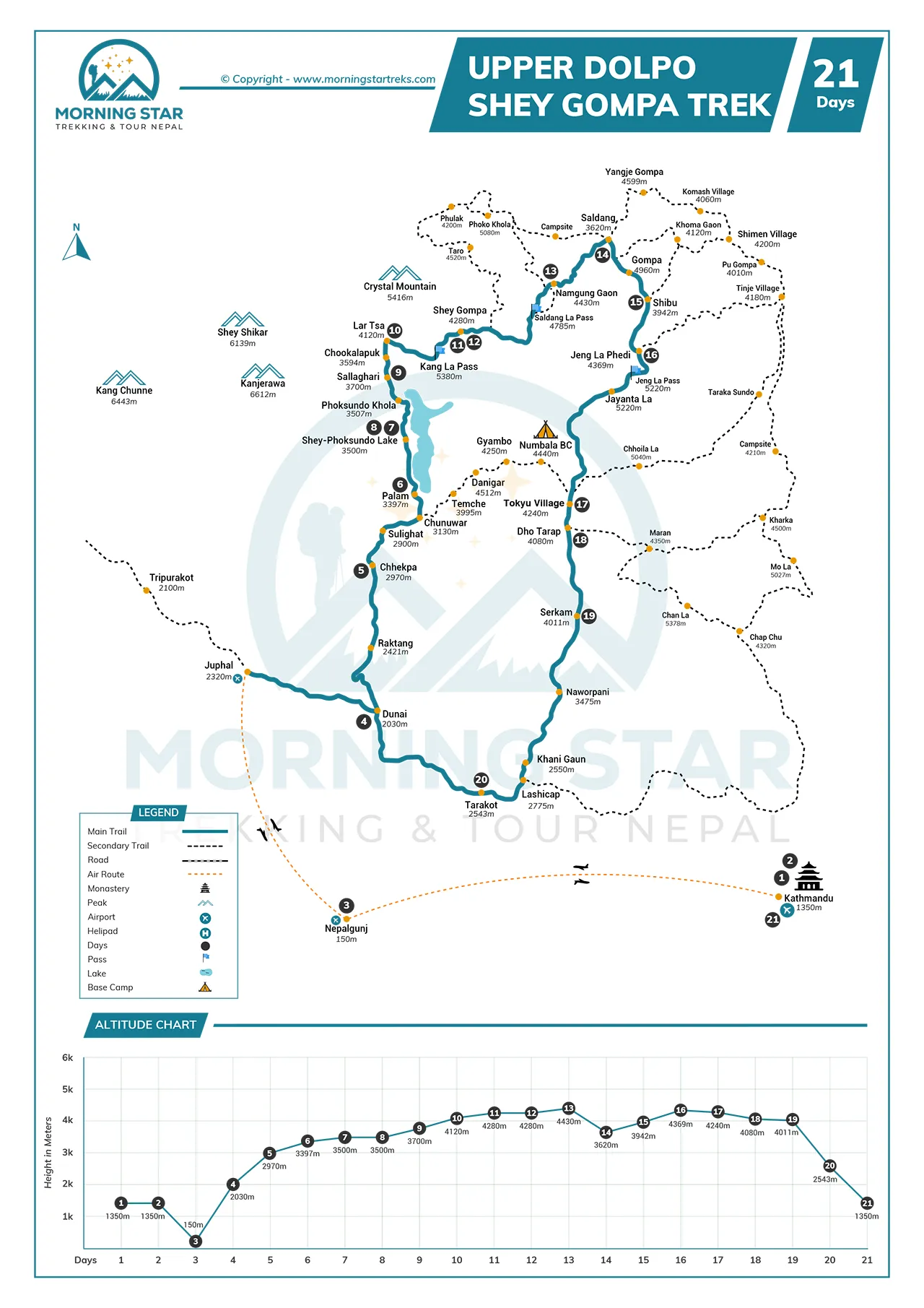
Route Map & Altitude Chart
Trip Information of Upper Dolpo Shey Gompa Trek
Best Time
The Upper Dolpo Shey Gompa Trek is in the rain-shadow area, which is why the climate is unique. The most suitable seasons for the trek are spring (March-May) and autumn (September-November).
The time is ideal in spring, in the Dolpo valley, where wildflowers bloom, days are mild, and the high valleys are mostly covered by snow, thus making the Dolpo valley ideal to execute the Upper Dolpo Shey Gompa Trek. Autumn weather is cool, has clear skies, and the Himalayas are well visible to improve the trekking experience.
Summer (June-August) can also be considered, since Dolpo does not get much rain; the routes are less green, and the number of trekkers is also less, but the slopes can be muddy.
The period during winter (December-February) is ruthless, with the cold weather being extremely cold and lots of snowfall. Trekking through the Dolpo Shey Gompa Upper Valley is highly difficult.
The Dolpo Shey Gompa Trek is also unpredictable in terms of mountain weather throughout the year. It is usually hot and sunny during the day, windy in the afternoon, and cold at night, with temperatures above 4,000 meters that can drop below -10 °C.
Multitasking outfits are necessary to deal with such conditions, and hikers are to check the local predictions daily. The action of being prepared will guarantee a pleasant trip via the desolate, alpine terrain of the Upper Dolpo Shey Gompa Trek, no matter the time of the year.
Trek Difficulty
The Dolpo Shey Gompa Trek is ranked among the most difficult high-altitude treks in Nepal. The trekkers are exposed to lengthy days of hiking, usually 5-7 hours through jagged mountain ranges, steep hiking trails, gorges, and narrow cliff trails.
Several passes are above 5,000 meters, including Kang La and Jeng La, across which there is thin air, which contributes to the physical strain.
Previous experience in trekking at high altitudes is highly demanded, and sufficient cardiovascular fitness, stamina, and leg strength of the legs are also required. Camping in remote regions, where the facilities are simple, further increases the adventure and challenge.
The Upper Dolpo Shey Gompa Trek adventure involves being mentally strong since the area is remote and there is a lack of routes to get out. The itinerary will be provided to enable safe adjustment of the trekkers through the aid of acclimatisation days, as well as gradual ascents.
Even seasoned trekkers are not spared by stream crossings, rocky footing, and a little snow or ice now and then. The trek is not impossible with sufficient preparation, such as uphill hikes, jogging, and strength exercises before the trek, and under the supervision of a team of experienced trek guides.
Although the trek has been completed by first-time trekkers who are very fit, the Upper Dolpo Shey Gompa Trek is typically designed to attract individuals who have tried high-altitude trekking before and want to make a memorable experience in some of the furthest parts of the Himalayas.
Acclimatization and Altitude Sickness
The Ultimate Dolpo Shey Gompa Trek followed a large portion of its trail past the altitude of 3,000 – 3,500 m, and thus, altitude sickness (AMS) became a matter of concern. The itinerary will be fully planned in order to ensure maximum acclimatization, and you will rest at Phoksundo Lake (~3,611m) and Shey Gompa (~4,320m) so that your body can adapt.
The daily ascents are moderate to avoid an abrupt increase in elevation. Some of the common mild symptoms are headache, fatigue, insomnia, and shortness of breath. It is necessary to inform your guide in case such instances happen.
To avoid AMS in the Dolpo Shey Gompa Upper Dolpo Trek, adopt gradual and consistent movement, take 3-4 litres of water per day, and avoid alcoholism or smoking. Other trekkers take Diamox (acetazolamide) with the physician’s advice.
It has guides who come with first aid kits and are trained to recognise and manage symptoms of AMS. In case of serious symptoms like intense headache, dizziness, or difficulty breathing, it is very important to go down as quickly as possible.
The trek is quite remote, and thus, the evacuation is possible but weather-dependent and expensive. Therefore, prevention is an important factor. The majority of trekkers acclimatise successfully using the plan.
By listening to your body and getting rest when you need it, you are guaranteed a safe and enjoyable trek on the Upper Dolpo Shey Gompa Trek, being able to fully experience the breathtaking Himalayan sceneries and the cultural diversity.
Food and drinks
When undertaking the Upper Dolpo Shey Gompa Trek, Trekkers receive three meals per day in order to sustain them through the days of long hours in the backcountry.
In Kathmandu and Nepalgunj, food is served in hotels or restaurants that serve different types of cuisine. Meals during the trek are less complicated but still hearty, providing you with the energy needed to carry on with the trek.
In the country lodges and teahouses, you can have Nepali favourites, such as dal bhat (rice and lentil soup with vegetables), noodles, buckwheat pancakes, potatoes, and, in some places, Tibetan bread or eggs as breakfast.
Boiled potatoes with curry, fried rice, or instant noodles with vegetables are also common as lunches. Drinks are served at night, such as soups, stews, and momos (dumplings), and, occasionally, cheese or canned meat.
Being vegetarian is not very difficult to organize, as most of the Dolpo food is vegetarian. Boiled or filtered water, tea, coffee, or hot lemon drinks are served as drinks at the camps. Trekkers need to have a filter bottle or purifier pills and must not drink untreated river water. Alcohol is not recommended because it increases symptoms of dehydration and altitude.
Our group takes care of all the nutritious and safe food they consume throughout the Upper Dolpo Shey Gompa Trek, but you can carry snacks or energy bars as additional sources of energy when trekking.
Visa and Permits
In the case of the Upper Dolpo Shey Gompa Trek, tourists should have a Nepal Tourist Visa and special trekking permission. The majority of visitors can get a visa on arrival at Kathmandu airport with passport photos and the corresponding fee of 15, 30, or 90 days.
More than this, the trek goes into an area that is restricted, and it is necessary to obtain the Upper Dolpo Restricted Area Permit. This permit will now cost approximately USD $ 500 on the initial 10 days and approximately USD 50 on the extra days per person, which will be compulsory for all trekkers in the 21-day Dolpo Shey Gompa Trek.
There is also a need to have a Shey Phoksundo National Park Entry Permit (approximately NPR 3,000 or USD $25). Similar to the other treks, one is not required to use a TIMS card, since a restricted permit and licensed trekking agency present the tracking. Individual walkers are required to either walk with a group or pay the phantom second-person fee to comply with the requirements.
Guiding services must be done using licensed guides, and Morning Star Treks takes care of all the documents, where the police or army need to be registered at the gates, like Dunai and Phoksundo. All you need to do is send copies of passports, photos, and visa information beforehand.
You are free to enjoy the excellent scenery and culture of the Upper Dolpo Shey Gompa Trek without worrying about being on time and validating permits.
Health and safety
Your health and safety are at the top priority list during the Upper Dolpo Shey Gompa Trek. Morning Star Treks offers a professional guide with wilderness first aid and altitude awareness training, who will be carrying a first aid kit in case of minor ailments such as headaches, cuts, or other light symptoms of altitude. Personal medicines, blister care, and pain relievers should be brought in by trekkers.
In Dolpo, the health care facilities are very minuscule, and the closest clinics are in Dunai or Dho Tarap, so prevention is necessary. The water is always boiled or filtered to supply good drinking water, and food is well-cooked to prevent food-borne diseases.
The guides lead trekkers on difficult routes, foot trails, and daily activities. The attraction is taken at a slow rate to avoid overstrain.
In the event of the necessity of emergency evacuation by helicopter, it is essential to be insured in terms of altitude trekking. In remote regions, it is aided by local and satellite telephones.
Climatic conditions are particularly observed over high places passed only be passed when the weather is favorable, and itineraries can be changed to suit the passing.
Dolpo is a very safe place as far as crime is concerned; the locals are honest and helpful. Dangers on the Upper Dolpo Shey Gompa Trek are mostly natural; they include altitude, harsh weather resistance, and rugged terrain. A secure and fun trekking experience is achieved by being prepared, guided, and insured.
Language & Communication
The Dolpo Shey Gompa Trek is an adventure into remote Nepal villages with their own unique languages and ways of life. The official language of Nepal is Nepali, and both your guide and crew are conversant in English and Nepali.
In Dolpo, people mostly use a Tibetan dialect, which is commonly referred to as the Dolpo-pa language, as they are very much related to Tibetan culture.
They speak a different language from normal Nepali, but your guide will translate wherever you want to communicate. It is pleasant and can be welcomed to learn a few Nepali greetings, which include “Namaste,” or simple Tibetan expressions.
The Upper Dolpo Shey Gompa Trek has very limited communication with the outside world. The mobile networks are patchy towards Juphal or Dunai, but when you get into the mountains, you cannot access the coverage.
Internet cafes or Wi-Fi hotspots are not available on the way or anywhere in Dho Tarap and Saldang. It is a great opportunity that trekkers can utilise to disconnect and get to know nature and the local culture quite well. The team has a satellite phone in case of emergencies.
The families are to be told that communication can be shut down for approximately two weeks. Connection again is made possible after getting back to Nepalgunj or Kathmandu.
Being an isolated place with language barriers, our crew provides the flow of information without disruptions, and the warmth and hospitality of the Dolpo-pa people make the Upper Dolpo Shey Gompa Trek a highly human and memorable experience.
Don’ts on this trek
When doing the Upper Dolpo Shey Gompa Trek, it is necessary to respect the local culture, religion, and the environment. Do not disrespect monasteries, gompas, and chortens: take off your shoes, keep quiet, and make a clockwise walk around stupas and prayer wheels.
Always take permission before capturing pictures in monasteries or sacred activities, and always ask people, especially the elders or monks, before taking pictures of villagers. Wear long clothes in villages, and cover shoulders and knees with clothes, but a trail outfit may be more relaxed.
No littering, collect all rubbish till it can be disposed of in a proper way. Alternatively, avoid a single use of plastics, which are difficult to manage in Dolpo, and go with refillable water bottles instead.
Do not disrupt wildlife (bluesheep, marmots, etc.) or fish or hunt in the national park: it is against the local tradition and sacred practices. You should never go out on the high passes or at night alone, and it is essential to always remain with the group and notify guides before leaving the camps.
Do not give children money or sweets. Contribute to the local schools or health posts with your guide (or not), should you feel the inclination to do so.
Adhering to these don’ts will see you become a responsible traveller who will leave Dolpo with its unique culture, sacred traditions, and pristine environment to be enjoyed by future generations. The Upper Dolpo Shey Gompa Trek is an ethical adventure, a safe, and memorable experience that has become this thanks to respect and mindfulness.
Photography & Drone Rules
The Trek of the Dolpo Shey Gompa Upper is spectacular and ideal for taking photos. You will be able to take the turquoise water of Phoksando lake, pass covered with prayer flags, and the Himalayan ranges.
Nevertheless, one should seek permission when taking pictures of natives or places of worship. A good number of Dolpo-pa are timid but receptive to kind demands. Religious rituals and monasteries might prohibit photography or flash- take orders of monks to adhere to the conventions.
In Nepal, the use of drones is strictly regulated. Special permissions to fly a drone in limited governments or national parks, such as Dolpo, need special permits from the Civil Aviation Authority and the park authorities.
The illegal drones may also cause disturbances to livestock, offence to residents, and penalties or seizure. Regions around the Tibetan border are particularly sensitive, and thus, we highly recommend against carrying drones unless all the licenses are obtained.
Normal cameras or smartphones suffice for most trekkers. Bring along spare batteries and carry spare memory cards, as no one sells them there in Dolpo. Take whatever pleases; however, observe and act well when near individuals and places of worship.
It is observable that by these guidelines, your experience with photography on the Upper Dolpo Shey Gompa Trek will remain safe, respectful, and rewarding so that you can leave some memories in mind without interfering with the local culture and the environment.
Tips for First-Time Visitors
The Upper Dolpo Shey Gompa Trek is a memorable introduction to the Himalayan wilderness, whether it is your first one to explore the Himalayas.
Physical preparation is key. Being in good shape, cardio training, hiking with a backpack, and walking in hilly areas are all necessary. Trekking fitness will make sure that you wake up to each and every day without causing unnecessary fatigue.
You should take in a pair of worn trekking shoes, a variety of different outfits depending on the season, a nice sleeping bag (at least -15 °C or even below), and a down jacket in the cold seasons.
It is better to keep your daypack light, with water, snacks, a camera, and a jacket. Porters can carry your heavier stuff, but there is a flight-to-flight limit on weight.
Dolpo is a remote location, and as such, flights are prone to delay and have a tendency to change. Make it a slow ride, have fun on the way, and laugh at it.
Wear enough clothes and keep yourself dry. Take lots of water, wear a hat, sunscreen, and glasses.
Engage with local culture. Get to know how to say greetings such as Tashi Delek, taste yak butter tea or chang, and know how to deal with villagers in a better way.
Respect the environment. Waste your garbage and adopt biodegradable goods.
Lastly, relax and explore the scenery, nature, and peaceful monasteries. These tips would make your Upper Dolpo Shey Gompa Trek safe, culture-rich, and filled with immense rewards that will stay with you forever.
Most Asked Questions
- Safety first, always
- Best prices guaranteed
- Expert travel team
- Easy booking, no extras
- Customize your journey
Based on 10 reviews
Have Questions?
+977 9767224414