
 English
 Dutch
Dutch Japanese
 Hindi
Hindi Italian
 Spanish
 French
 German
 Chinese
 Korean
 Arabic
 Hebrew
 Russian
 Portuguese
 Danish
 Czech
Czech Polish
 Swedish
Have Questions?
+977 9767224414
Unmissable holidays deals - Save up to 20%
Annapurna Base Camp Trek

Duration
11 Days

Trip Difficulty
Moderate

Max. Altitude
4,130m

Destination
Nepal

Group Size
2-16 People

Accommodation
Hotel, Teahouse

Transportation
Bus, Private Car

Meals
B L D
Explore more facts about the trip
Overview of Annapurna Base Camp Trek
The Annapurna Base Camp Trek is one of the most popular trekking regions in Nepal, encompassing many trekking destinations within its area. Last year, the Annapurna region was the most visited place in the country, beating even the world-famous Everest region. Its massive popularity can be linked to its beautiful highlands, rich cultural immersion, and stunning scenes of the Himalayas. From the deepest gorge in the world to one of the highest freshwater glacial lakes, the Annapurna region has it all.
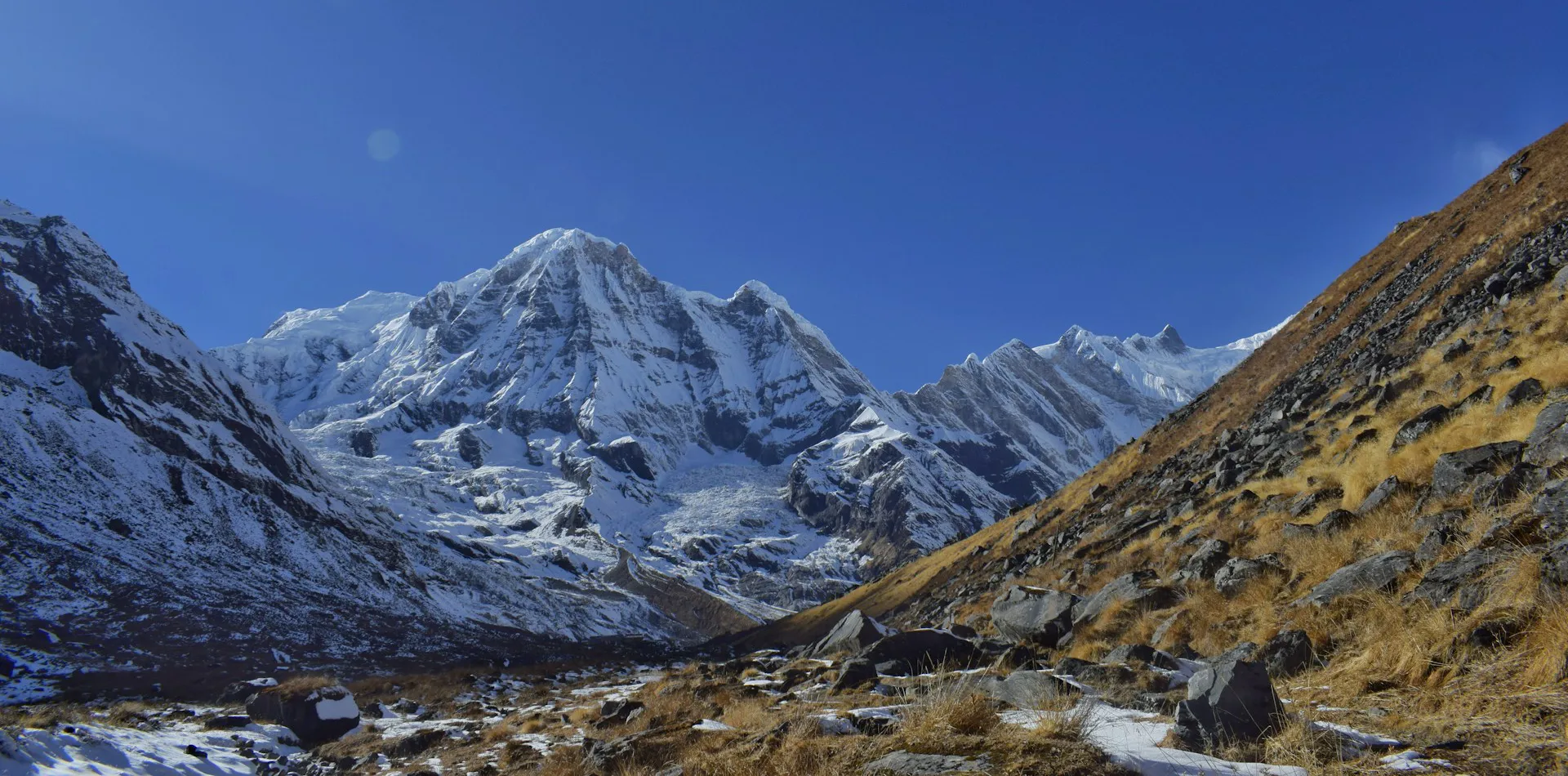
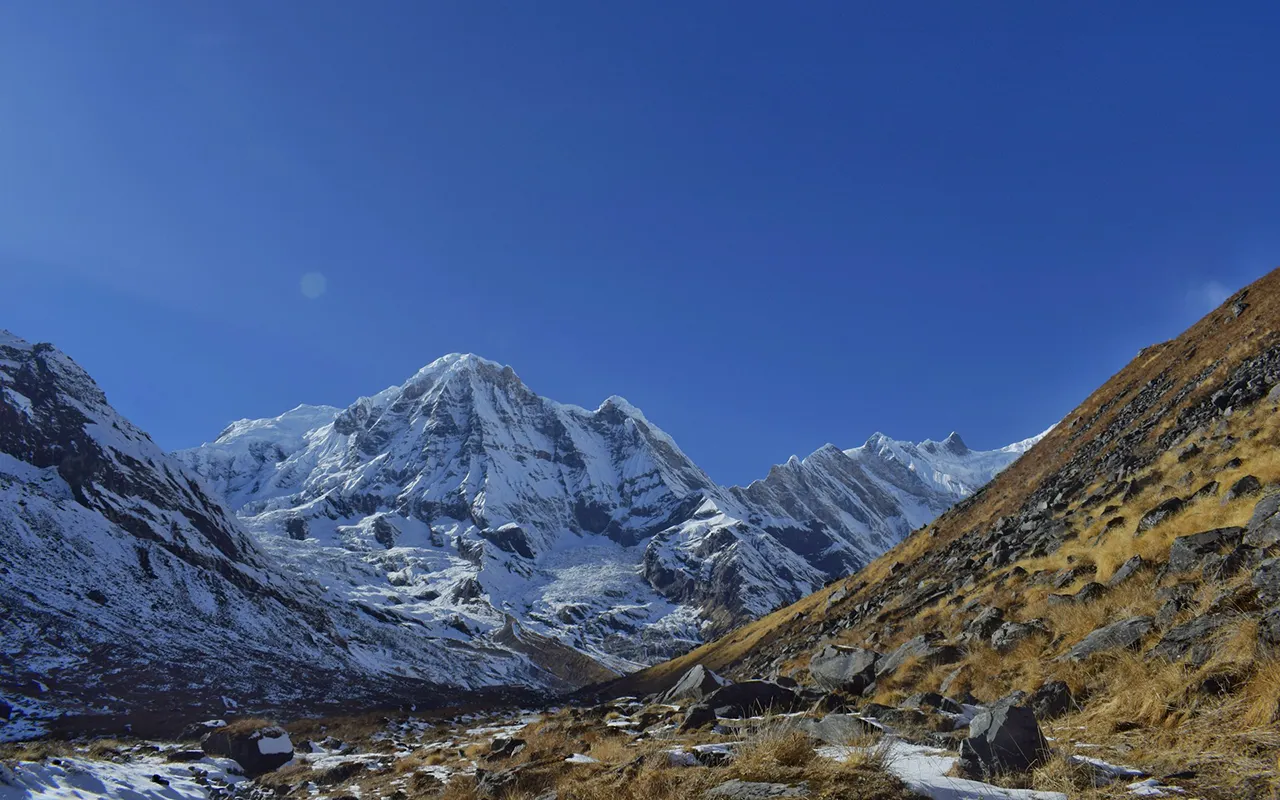
The climax of this trek is reaching the base camp of Machhapuchhre Peak and Annapurna Peak. Reaching 4130 meters of elevation, this base camp features a 360-degree panoramic scene of the Machhapuchhre, Annapurna South, Hiunchuli, Gangapurna, and other surrounding peaks. The scene will leave you deeply impressed and speechless. Along with that, you can also see most of the Annapurna region.
Established under the command of King Manhendra in the year 1986, the Annapurna Conservation Area is the main trekking ground we will explore. Stretching about 7629 sq. km, this active preservation effort has managed to save many species from becoming rare and continues to be a home for hundreds of animals and countless birds. Starting from diverse sub-tropical vegetation, we will slowly make our way into the sub-alpine region, followed by the barren, arid alpine vegetation at the base camps.
Along with many stunning scenes of nature, the Annapurna Base Camp Trek in Nepal takes you on a cultural tour, visiting many Gurung and Magar villages throughout the itinerary. Villages such as Ghandruk, Chomrong, Jhinu Danda, Ulleri, and others are great places to witness authentic Gurung and Magar culture that have survived for centuries. Many villages also perform a welcome program for travelers from outside the village, which includes traditional dance and music of the local community.
The Annapurna region is undoubtedly one of the most beautiful highland regions in the world. However, you must get to know the region and the trek before you decide to do it. There are many aspects that can make or break the trek for many people. So, here is a detailed breakdown of the Annapurna Base Camp Trek package so that you truly know what you are getting yourself into.
- Safety first, always
- Best prices guaranteed
- Expert travel team
- Easy booking, no extras
- Customize your journey
Based on 10 reviews

Trip Highlights
- Experience a one-of-a-kind sunrise scene from the Poon Hill viewpoint.
- Reach the amazing Annapurna Base Camp at 4130 meters above sea level.
- Take a rejuvenating bath at the natural hot springs of Jhinu Danda.
- Visit many cultural villages such as Chomrong, Ulleri, Ghandruk, Jhinu Danda, and more.
- Explore the gorgeous city of Pokhara, visiting many attractions in the city.
- Witness many panoramic scenes throughout the trek from several viewpoints.
Photo and Video Gallery




Annapurna Base Camp Trek Detail Itinerary

Day 01: Drive from Kathmandu to Pokhara, explore the city
On the first day of the Annapurna Base Camp Trek, we will head to Pokhara from Kathmandu. After a satisfying breakfast in Kathmandu, we will get on a comfortable tourist bus that takes us to Pokhara. The ride starts with leaving the Kathmandu valley via a winding road till Naubise. From there, we will get on the Prithvi Highway and continue the ride.
We will pass by Malekhu and stop at Mugling for lunch. Post-meal, we will pass Dumre, Khaireni, and eventually Lekhnath to reach Pokhara. This drive covers around 20 km with an estimated travel duration of 7 to 8 hours. After arriving at Pokhara, we will waste no time, check into our hotel for the night, and explore the city as much as possible before heading off to bed.

Activity: 7 - 8 hrs

Max. Altitude: 822m/2,697ft. (Pokhara)

Meal: Breakfast, Lunch

Accommodation: Hotel
Day 02: Drive from Pokhara to Tikhedhunga, trek to Ulleri
The following day, we will have a lovely breakfast by the Phewa Lake and drive to Tikhedhunga. The starting point of this Annapurna Base Camp Trek is about 42 km away from Pokhara, which takes about 2 hours to reach. Passing by Nayapul and Birethanti, we will reach Tikhedhunga, from there our 4-hour trek to Ulleri begins.
The total trek distance is 7 km with an elevation gain of 720 meters. Starting the trek, we will enter the Annapurna Conservation Area and follow the Bhurungdi River upstream. The trail takes us to Sudame first, followed by Hile, a popular rest spot on the trek. After a quick rest at Hile, we will begin the steep climb to Ulleri village, the infamous 3000 stone steps that are going to take a while to cover.
Activity: 4 hr trek
Max. Altitude: 2,070m/6,791ft. (Ulleri)
Meal: Breakfast, Lunch & Dinner
Accommodation: Lodge
Day 03: Trek from Ulleri to Ghorepani
Today’s Annapurna Base Camp Trek features an 11 km long trail that has an elevation gain of 1320 meters. This 4-hour trek starts with a windy trail passing by terraced farms and tiny villages. At this point, you will have a great view of the Annapurna South, Machhapuchhre (Fishtail), and Hiunchuli peaks in the distance. Soon after, the trail goes through a lush forest, leading us to Banthanti village, reaching 2250 meters above sea level.
After a short break there, we will continue ascending and reach Nangethanti, our lunch joint of the day. From there, we begin the final leg of the day, climbing a gradual ascent all the way to Ghorepani village. This Magar village sits on a ridgeline, overlooking the valley and rivers, offering a great view of the landscape. You will get to see the entire Dhaulagiri Himalayan range (I to V), Dhampus, Annapurna South, Nilgiri, Barah Sikhar, Machhapuchhre, Tukuche, and more.
Activity: 4 hr trek
Max. Altitude: 2,874m/9,429ft. (Ghorepani)
Meal: Breakfast, Lunch & Dinner
Accommodation: Teahouse
Day 04: Early morning hike to Poon Hill, trek to Tadapani
Today, you will experience one of the highlights of the Annapurna Base Camp Trek. Our day begins at around 4:30 in the morning, and by 5 AM, we must get on the climb to Poon Hill. This short hike lasts about 45 minutes with an elevation gain of 350 metres, reaching 3210 meters above sea level. From this viewpoint, you will experience a stunning sunrise scene that is sure to haunt your memories for years to come.
We will spend some time at the viewpoint, take stunning pictures, and some memorable ones too. Soon, we will get down to Ghorepani and have a filling breakfast before starting the trek of the day. From Ghorepani, we will have a net elevation loss of 230 meters, which takes about 3 hours. The trek distance is about 8 km, starting with a gentle climb to Deurali village. From there, the trail goes down to Banthanti, followed by a descent to Tadapani village.
Activity: 3 hrs trek
Max. Altitude: 2,630m/8,629ft. (Tadapani)
Meal: Breakfast, Lunch & Dinner
Accommodation: Teahouse
Day 05: Trek from Tadapani to Chomrong
Day 5 of the Annapurna Base Camp Trek requires us to cover 10 km of distance with an estimated trek duration of 5 hours. The elevation loss of the day is 465 meters, taking us to 2165 meters above sea level, starting from 2630 meters. We begin the trek with a descent to Chuile village, reaching 2309 meters. After a short break there, we will go up some stone steps and head towards Ghandruk village.
Ghandruk is a popular Gurung village that showcases traditional Gurung culture, houses, and practices. The village has a very charming personality, with a great view of Annapurna South, Hiunchuli, and Machhapuchhre peaks in the north. Leaving Ghandurk, we will sharply drop to the Kimron River and cross it over a suspension bridge. Then, the trail ascends sharply all the way to Chhomrong village, involving stone steps and switchbacks.
Activity: 5 hrs trek
Max. Altitude: 2,630m/8,629ft. (Chomrong)
Meal: Breakfast, Lunch & Dinner
Accommodation: Lodge
Day 06: Trek from Chomrong to Himalaya
On the next day of the Annapurna Base Camp Trek, we will trek over 12 km, which can be covered in about 6 to 7 hours, since the trail is rugged and ascending. At the end of the day, we will reach 2890 meters above sea level, starting from 2165 meters, gaining 725 meters of elevation. Leaving Chomrong, we will descend towards a river, going down a set of stone steps. Crossing the river, we will get on an ascending trail all the way to Sinuwa village, reaching 2340 meters.
From there, the trail continues ascending, passing by Khuldigar settlement. Following a quick rest, we will get on the path to Bamboo village. This village sits at 2130 meters above sea level, and serves as a major stop on the Annapurna trek in Nepal. We will stop there for an energizing lunch before we move any further. Post-lunch, the trail ascends steadily all the way to the Himalaya village, going through a mixed forest.
Activity: 6-7 hrs trek
Max. Altitude: 2,340m/7,677ft. (Himalaya)
Meal: Breakfast, Lunch & Dinner
Accommodation: Lodge
Day 07: Trek from the Himalaya to Annapurna Base Camp via Machhapuchhare Base Camp
Day 7 of the Annapurna Base Camp Trek has you on the trails for 5 hours, covering a total trek distance of approximately 12.5 km. Starting from 2890 meters, we will end the day at 4130 meters, gaining 1240 meters of elevation. The day starts with a filling breakfast, followed by a trek through a narrow gorge as we leave the Himalaya village. Traversing the Modi Khola Glacier Valley, we will ascend gently through a forested section and reach Hinku Cave.
From the cave, the trail ascends slightly steeper over stone steps, and the air gets much cooler as we continue gaining elevation. Soon enough, we will reach another village named Deurali, sitting at 3174 meters above sea level. From there, we will head towards the Machhapuchhare Base Camp, gaining about 526 meters of elevation. This base camp features a wide view of the Machhapuchhre (Fishtail), Hiunchuli, and Annapurna South.
After a short break at MBC, we will continue the ascent and head northwest towards the Annapurna Base Camp. Following the Modi River Valley, we will cross small glacial streams and traverse open pasturelands and rocky grounds to reach the base camp. A stunning scene of the Machhapuchhre, Annapurna South, Annapurna I, Gangapurna, Khangsar Kang, Annapurna III, and Hiunchuli awaits us.
Activity: 5 hrs trek
Max. Altitude: 4,130m/13,550ft. (Annapurna Base Camp)
Meal: Breakfast, Lunch & Dinner
Accommodation: Lodge
Day 08: Trek from Annapurna Base Camp to Bamboo
Day 8 of the Annapurna trek in Nepal features a 14 km trail that takes us to 2350 meters above sea level, starting from 4130 meters. This will lose us 1780 meters of elevation, which can be covered in about 6 hours. Today’s long descent begins with views of the nearby peaks, retracing yesterday’s path. Soon enough, we will reach the Machhapuchhre Base Camp, losing 430 meters, followed by a descent to Deurali village, losing an additional 526 meters.
After that, we will head down to the Hinku Cave, traversing stone steps and crossing small streams on the way. Following a short rest at Hinku Cave, we will head further down to the Himalaya village, reaching 2890 meters. This will be our lunch spot of the day. Post-lunch, the trail continues descending as we go over the final leg of the day.
Activity: 6 hrs
Max. Altitude: 2,890m/9,482ft. (Bamboo)
Meal: Breakfast, Lunch & Dinner
Accommodation: Lodge
Day 09: Trek from Bamboo to Jhinu Danda, relax at natural hot springs
Starting from Bamboo, the trek to Jhinu Danda takes about 3 to 4 hours, making it one of the shortest days of the Annapurna Base Camp Trek. The elevation loss of the day is 570 meters, reaching 1780 meters above sea level, with a total trek distance of 8.5 km. Starting off, the trail descends towards the Kimrong River, a gradual, steep drop after we cross the river over a suspension bridge. Soon after, we have to climb up to Jhinu Danda. This gentle ascent is very manageable as we wind through the forested sections.
Activity: 3-4 hrs
Max. Altitude: 1,780m/5,840ft. (Jhinu Danda)
Meal: Breakfast, Lunch & Dinner
Accommodation: Lodge
Day 10: Trek from Jhinu Danda to Ghandruk Phedi, drive to Pokhara
This is the last trekking day on the Annapurna Base Camp Trek. The trek distance is just 4 km, which we can easily cover in just 2 hours. Leaving Jhinu Danda, the trail is relaxing as we gently descend to Ghandruk Phedi and take a jeep ride all the way to Pokhara.
Activity: 2 hrs
Max. Altitude: 833m/2,733ft. (Pokhara)
Meal: Breakfast, Lunch & Dinner
Accommodation: Hotel
Day 11: Drive from Pokhara to Kathmandu
This is the final day of the Annapurna trek in Nepal. Waking up to the relaxing vibe of Pokhara, we will leave the city after breakfast, riding a comfortable tourist bus to Kathmandu. This 7 to 8-hour-long drive features lunch at a highway restaurant and countless scenes of the hills and the Trishuli River.
Activity: 7-8 hr drive
Max. Altitude: 1,400m/4,593ft. (Kathmandu)
If our standard itinerary doesn't fully meet your needs, we are happy to tailor it to your specific preferences and requirements.

Includes and Excludes
What’s Included?
- Tourist bus transport between Kathmandu and Pokhara, both ways
- Private vehicle transfer between Pokhara and Nayapul, both ways
- Hotel accommodation in Kathmandu before and after the trek
- Comfortable teahouse or lodge accommodation during the trek (twin-sharing)
- Breakfast in Kathmandu hotel, and three meals (breakfast, lunch, dinner) each day during the trek
- Professional, English-speaking trekking guide and required porters
- Trekking guide salary, insurance, meals, accommodation, equipment, transportation, etc.
- Seasonal fresh fruit during the trek
- All necessary trekking permits and national park entry fees
- Basic medical kit and safety equipment during the trek
- Sleeping bag, down Jacket, walking poles, duffel bags (you have to return after the trek)
- Certificate of achievement at the end of the journey
- Government taxes and agency service charges
What is not Included?
- International flights to and from Nepal
- Nepal entry visa fees upon arrival
- Lunch and dinner in Kathmandu
- Personal expenses such as drinks, snacks, hot showers, Wi-Fi, and device charging
- Travel insurance that covers medical emergencies and helicopter evacuation
- Tips for guides, porters, and drivers
- Extra hotel nights caused by flight delays, early arrival, or late departure
- Personal Travel insurance and emergency rescue evacuation
- Extra cost caused by natural or political disturbances beyond our control
Route Map & Altitude Chart
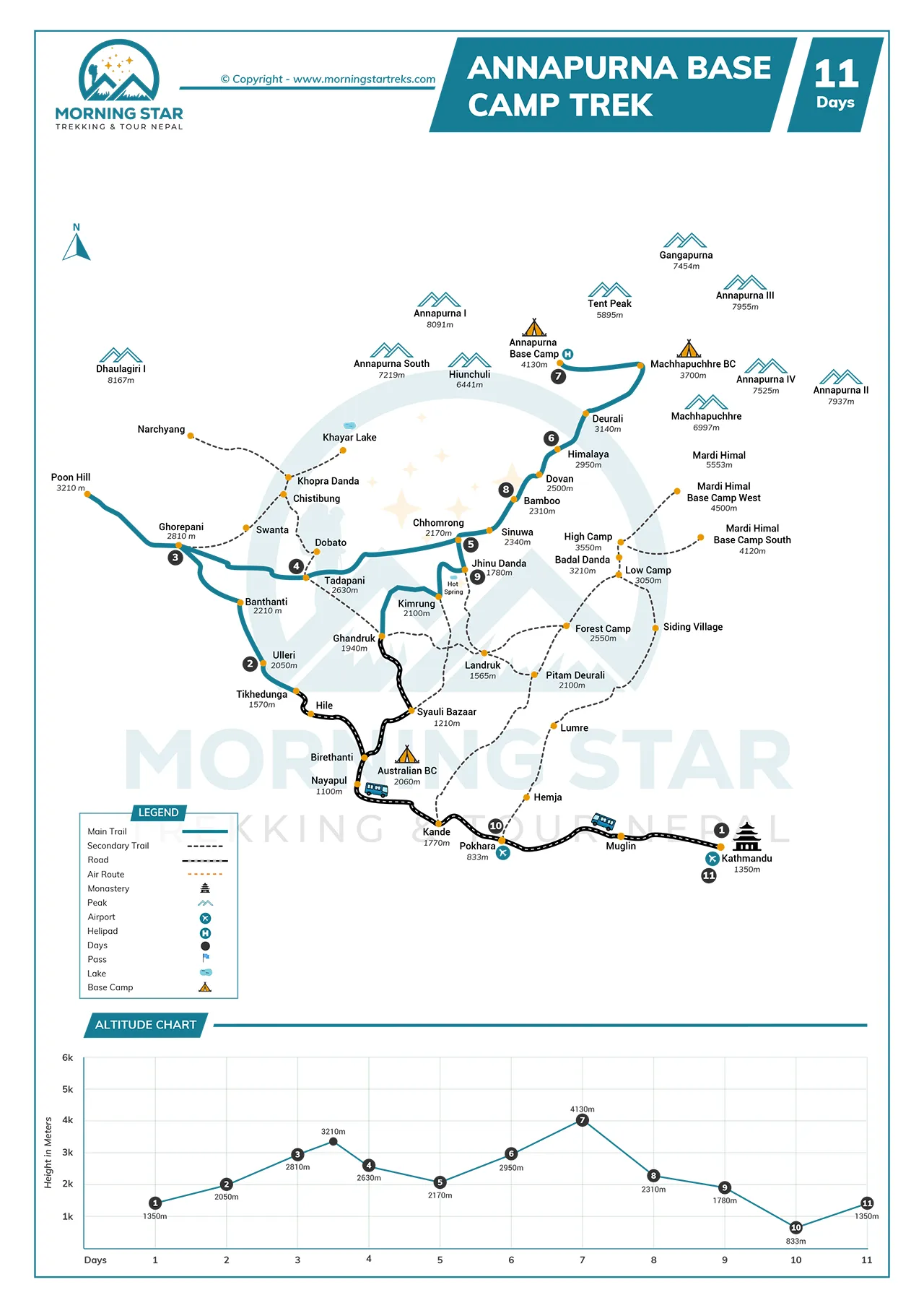
Trip Information of Annapurna Base Camp Trek
Best season and weather
The best season to do the Annapurna Base Camp Trek is obviously spring. This season offers you the most lush forests with vibrant flowers everywhere. In addition to that, the Rhododendron forests en route bloom lavishly in spring, adding aesthetic value to the green slopes of the hills. Moreover, the daytime temperature remains perfectly mild for activities like trekking and hiking.
Difficulty
The Annapurna Base Camp Trek is graded as a moderately challenging trek. This trek has many ascents and descents that will surely tire you out and test your endurance level. In addition to that, the high altitude of the trek also makes it harder for trekkers to cover the daily distance. However, they are all manageable with the help of porters and guides.
Altitude Sickness
The effects of altitude sickness generally start after we cross 3500 meters above sea level, and on this trek, we will only spend one night above that elevation. On the 7th day of the Annapurna Base Camp Trek, we will spend the night at the Annapurna Base Camp, reaching 4130 meters above sea level. All in all, the chances of altitude sickness on this trek are very low.
Preparation and Fitness
To prepare for this moderately challenging trek, you should draft a 14 to 16-week-long training period, wherein your main focus should be on building stamina and exercising your leg muscles. All of those exercises help you breeze through the trails of the Annapurna Base Camp Trek. If you are unsure of how to start, you can simply look for preparation guides on the internet.
Food and Accommodation
The Annapurna Base Camp Trek package will provide you with 3 meals per day, but not during your time in city areas. Your food options include dishes that are readily and easily available. The menu changes as per the season, and you can expect a variety of local dishes along the trek.
Similarly, your accommodation expenses are also a part of the Annapurna Base Camp Trek package. From the first day of the trek to the last, all your accommodation expenses will be covered. Rooms will she shared by two trekkers in the group, and you can also request private rooms at a price.
Transportation
Any kind of transportation required by the Annapurna Base Camp Trek in Nepal will be covered by the package. This includes drives to various places throughout Nepal, but not any kind of flight expenses. Flight expenses are your own expenses that have nothing to do with the trek.
Communication
The Annapurna region is one of the most well-facilitated trekking regions of Nepal, but you can still expect not to receive mobile networks at various points in the trek. WiFi connections are available at most tea houses en route, but they usually charge a buck or two as a service fee.
Permit
All the permits required for the Annapurna Base Camp Trek are covered by the package. This includes the Annapurna Conservation Area Permit and a TIMS card. The trek guide will ask you for all the required documentation for the permits. He will obtain the permits on your behalf.
Visa
Unlike permits, visa fees are considered to be personal expenses, which means the Annapurna Base Camp Trek in Nepal trek package will not cover them under any circumstances. You have to pay your visa fees to get a tourist visa to Nepal and freely roam around the country.
Travel Insurance
Similar to visa fees, your travel insurance fees are not a part of the Annapurna Base Camp Trek package. These are considered your personal and extra expenses.
Extra Expenses
The extra expenses on this trek are the international flight expenses, tips for the crew members, travel insurance, visa fees, extra accommodation, additional meals, any kind of beverages, upgraded accommodation, etc.
Private vs. group trek
A private trek to the Annapurna region is a great way to experience the beautiful nature of the highlands along with your loved ones. Meanwhile, a group trek consists of random trekkers who match your preferred date of trek.
Most Asked Questions
 General
What is the best time of year to undertake the Annapurna Base Camp trek?
The best time of the year to undertake the Annapurna trek in Nepal is probably March to May, the spring season.
Is the Annapurna Base Camp trek suitable for first-time trekkers?
No prior high-altitude trekking experience is required for this trek. The trails can be a bit too much for first timers with zero experience.
What is the maximum group size for this Annapurna trek in Nepal trek package?
The maximum group size depends on the accommodation available at the preferred time of trekking.
Can solo travelers join this trek, or is it only for groups?
Yes, solo travelers can join this amazing trek; they will be put in a group of random trekkers.
What permits are required, and are they included in the package?
You just need to have an Annapurna Conservation Area Permit to do this amazing trek, and yet it is included in the package.
 Preparation & Fitness
How fit should I be to handle the stone steps from Tikhedhunga to Ulleri?
You can have an average physique and easily cross the stone steps section with multiple rests.
How much prior trekking experience is recommended for this 11-day itinerary?
You need to have at least a couple of high-altitude trekking experiences.
What type of footwear is best for the varied terrain from Tadapani to Chomrong?
The best footwear for any trekking destination is a simple, sturdy trekking boot.
Should I train for high-altitude hiking to cope with the 4,130-meter elevation at ABC?
You do not have to take such measures; you can simply follow the preventive measures of altitude sickness.
Are there rest days built into the itinerary to help with acclimatization?
No, there are no acclimatization days in this itinerary since the risk of altitude sickness is very low.
 Insurance and Visa
Is travel insurance mandatory for the Annapurna Base Camp trek?
Yes, travel insurance is mandatory for the Annapurna trek in Nepal.
Does the trek package assist with visa arrangements for international travelers?
No, visa arrangements are done within the airport after your arrival; we can not interfere with government matters.
Are there specific insurance requirements for high-altitude trekking above 4,000 meters?
Yes, you need to make sure that your insurance covers medical expenses up to the highest point of the trek.
How can I ensure my insurance covers emergency evacuation from remote areas?
You can simply ask the insurance provider to point out specific clauses in the document.
Will I need to show proof of insurance to join the trek?
Yes, you need to provide us with a copy of your insurance document.
 Guides & Support Staff
Are English-speaking guides provided for the entire Annapurna Base Camp trek?
Yes, Morning Star’s guide will accompany you till the end of the Annapurna trek in Nepal.
What is the ratio of guides and porters to trekkers in this package?
Every 6 trekkers in the group will have a single trek guide, while every two trekkers will share a single porter.
Do porters carry personal gear, and is there a weight limit for bags they handle?
No, porters are usually hired to carry luggage while personal trekking gears are kept in the day pack you wear, for easy access.
Are guides trained in first aid and altitude sickness management for this trek?
Yes, our guides are well-experienced and well-trained for this trek
Can I opt out of hiring a porter if I prefer to carry my own gear?
Absolutely, however, if you can not seem to make it to the next destination because of the heavy load, there is nothing we can do.
How are guides and porters compensated, and should I tip them separately?
Our guides and porters are compensated daily, as per their experience and effort; however, tips are always appreciated.
 Accommodation and Facilities
Are the teahouses in places like Ghorepani and Chomrong equipped with Wi-Fi?
Yes, you will get the luxury of WiFi in Ghorepani, but Chhomrong is a different story.
How comfortable are the rooms at lodges?
The rooms are pretty comfortable, but they lack thick 8 to 10-inch mattresses.
Is drinking water provided, or do I need to bring a filtration system for the trek?
You can get drinking water at any of the eateries en route, but we recommend that trekkers use water purification tablets before drinking from anywhere.
Are there options for extra snacks or meals outside the standard breakfast, lunch, and dinner?
Yes, you are free to munch on extra meals and snacks, but they are your own extra expenses.
Can I request private rooms at all overnight stops, or are shared rooms common?
Shared rooms are the standard accommodation arrangement, but private rooms can also be managed at a price.
 Weather & Seasons
What weather conditions should I expect at Annapurna Base Camp?
At the base camp, you rarely see any clouds except when it’s winter or monsoon. The weather is generally clear.
Are there risks of snow or ice on the trail to Poon Hill?
No, there are no such risks on the trail to Poon Hill; however, you might experience snowfall in winter.
What are the temperature ranges at higher altitudes?
At the base camps, you can expect a temperature range of 9°C to -14°C.
How does fog or rain impact visibility at viewpoints like Poon Hill?
Fog and rain clouds will completely ruin the scenes of the beautiful landscape.
How often do weather conditions cause delays or changes to the itinerary?
Changes to the itinerary are rare; however, delays can be expected if you are opting for a flight to and from Pokhara.
 Health & Safety
What measures are in place for altitude sickness at Annapurna Base Camp (4,130 m)?
You can simply take a pill called Diamox or go down a couple of hundred meters.
How safe is it to use the suspension bridges over rivers like Kimron Khola?
The suspension bridges throughout the trek are very sturdy and reliable.
What precautions should I take for sun exposure at high altitudes?
Sunscreen is recommended along with dark sunglasses to combat the bright white landscape reflections in snow-filled terrains.
Are there risks of wildlife encounters in the rhododendron forests near Ghorepani?
No, the Ghorepani region is not inhabited by carnivores or other animals that can harm you.
Is first aid equipment provided by the trek organizers for emergencies?
Yes, first aid equipment is provided by Morning Star for every trek.
 Booking & Payment
Are there additional costs for single travelers booking this trek package?
No, there are no additional costs for single travelers booking the trek package.
Can I modify the itinerary, such as skipping Poon Hill, after booking?
Yes, you are free to modify our flexible itinerary, as long as the changes are doable. You can discuss the possibilities with one of our reps or the trek guide to make sure that the modifications are feasible.
Are there any hidden fees for last-minute changes to the trek itinerary?
Yes, last-minute changes will cost you a bunch, and most of the time, they can not be carried out. A trekking adventure takes months and weeks of preparation, so last-minute changes are generally not doable.
If I book as part of a group, can I get a partial refund if one member cancels?
Yes, as per the time of cancellation, we will refund the initial deposit after subtracting a certain percentage.
Are there specific deadlines for full payment to secure the trek package?
Yes, you need to clear your pending payment before the start of the trek. Usually, pending payments are paid before arrival in Nepal or after they settle into their hotel room on day 1.
 Transportation & Flight
What type of vehicle is used for the drive from Pokhara to Tikhedhunga on Day 2?
We will take a jeep ride to reach Tikhedhunga on the 2nd day of the Annapurna trek in Nepal.
Is the tourist bus from Kathmandu to Pokhara air-conditioned and comfortable?
Yes, those buses are the most comfortable option to go for.
How reliable is the off-road drive from Nayapul to Tikhedhunga in terms of road conditions?
The road features a few potholes, but overall, it should be a smooth ride.
Are there backup transportation options if the drive to Ghandruk Phedi is delayed?
No, there are no backups for it; however, it is rare to see the drives being delayed.
Can I arrange a private vehicle for the return trip from Pokhara to Kathmandu?
Yes, you can arrange a private vehicle for the return trip, but it will come at a price. Usually, private vehicles are not chosen; people prefer to upgrade to a flight instead.
- Safety first, always
- Best prices guaranteed
- Expert travel team
- Easy booking, no extras
- Customize your journey
Based on 10 reviews
Have Questions?
+977 9767224414