
 English
 Dutch
Dutch Japanese
 Hindi
Hindi Italian
 Spanish
 French
 German
 Chinese
 Korean
 Arabic
 Hebrew
 Russian
 Portuguese
 Danish
 Czech
Czech Polish
 Swedish
Have Questions?
+977 9767224414
Unmissable holidays deals - Save up to 20%
Makalu Base Camp Trek

Duration
20 Days

Trip Difficulty
Challenging

Max. Altitude
4,870m

Destination
Nepal

Group Size
2-16 people

Accommodation
Hotel, Lodge

Transportation
Flight, Tourist Bus

Meals
Breakfast, Lunch & Dinner
Explore more facts about the trip
Overview of Makalu Base Camp Trek
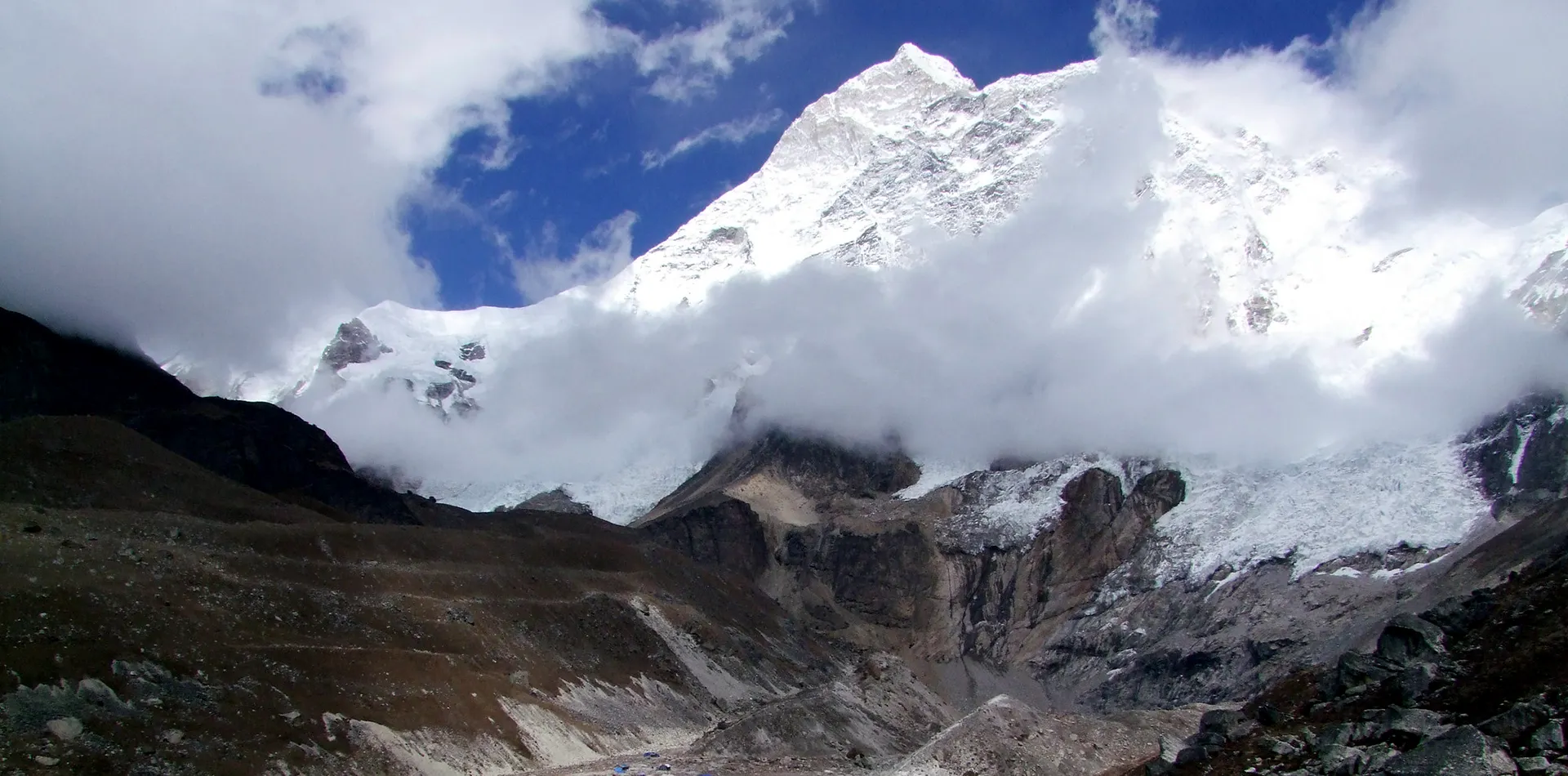
The Makalu Base Camp Trek is one of the most engaging and adventurous Himalayan trekking destinations in the world. Reaching the base of the 5th-highest peak in the world, this trek is located in the remote eastern part of Nepal, where tourists are seldom seen. This makes it a secluded trekking experience offering a great piece of wilderness and raw nature. It is really a great alternative to popular and often crowded trekking destinations such as the Everest and Annapurna region trekking destinations.
The itinerary we will follow goes through the Makalu Barun National Park, which spans over 2330 sq. km. This conservation area was established in the year 1992. Ever since, the region has been home to many birds and animals that have continued to multiply their population to a healthy amount. During your time there, you will definitely see hundreds of birds and might encounter animals as well.
The Makalu region is dominated by Sherpa, Gurung, Shingasawa, and Rai communities that are vastly influenced by Tibetan Buddhism. The main occupation of the majority of locals is agriculture, as there are no other businesses in the highlands except tea houses and lodges. The major production of the region is wheat and barley, grown mostly in terraced farms.
Until last year, the region was so remote that it was considered to be a camping-only trek. At present, there are many tea houses, and the accessibility of the region has improved quite a bit. However, the region still lags behind on network and communication, which can be a deal breaker for some, but it also adds to the feeling of remoteness, in a way.
Likewise, there are many things you should know before you hop on the Makalu trek-train. So, here is a detailed trek package for you to read through and understand what the journey feels like. We have discussed the itinerary and all the inclusions and exclusions, starting with some highlights of the trek.

Price starts
US$ 1800
US$ 1900
- Safety first, always
- Best prices guaranteed
- Expert travel team
- Easy booking, no extras
- Customize your journey
Based on 10 reviews

Trip Highlights
- Witness a close-up view of the great Mt. Makalu (8485 m) from its base camp.
- Cross the scenic Shipton La Pass, reaching 4200 meters above sea level, for a panoramic view of the entire surrounding.
- Visit the pristine Barun Valley region with glacial rivers all over.
- Visit the sacred Shiva Dhara Cave at the base camp and also climb up to a nearby viewpoint.
- Experience the culture of the local people as you stop by many authentic Rai, Sherpa, Gurung, and Shingasawa villages.
- Enjoy a scenic view of Everest and Lhotse from the viewpoint of Khongma Danda.
Photo and Video Gallery


Makalu Base Camp Trek Detail Itinerary

Day 01: Arrive in Kathmandu
Arrival in Kathmandu counts as the first day of your Makalu Base Camp itinerary. After you reach the Tribhuvan International Airport, you will find one of our reps waiting for you outside the terminal. He will have you dropped off at your accommodation for the night. But before you leave the airport, you must obtain a tourist visa, for which you need to present your passport, proof of accommodation, return tickets, a visa application form, and a visa fee payment receipt.

Activity: 30 mins drive

Max. Altitude: 1,400m/4,593ft. (Kathmandu)

Meal: Breakfast

Accommodation: Hotel
Day 02: Fly from Kathmandu to Tumlingtar, drive to Chichila
Day 2 begins with a flight to Tumlingtar, which takes about 35 minutes to complete. After that, we have to get on a ride to Chichila, the starting point of the Makalu Base Camp itinerary. This drive will last about 3 to 4 hours, covering about 30 km. After arriving at Chichila, we will check into our accommodation for the night, and you can explore the town a little before heading to bed.
Activity: 35 mins flight / 3-4 hrs drive
Max. Altitude: 1,602m/5,256ft. (Chichila)
Meal: Breakfast, Lunch & Dinner
Accommodation: Lodge
Day 03: Trek from Chichila to Num
Today’s total trek distance is about 10 km, which takes about 5 to 6 hours to cover. The elevation loss of the day is 400 meters, taking us to 1500 meters above sea level. The trails of the day are usually descending gently through small settlements and terraced farmlands. First, we will descend to Mane Bhanjyang after crossing many streams and head towards the village of Num.
Activity: 5-6 hrs trek
Max. Altitude: 1,519m/4,984ft. (Num)
Meal: Breakfast, Lunch & Dinner
Accommodation: Lodge
Day 04: Trek from Num to Seduwa
Covering about 8 km of distance, the trek today is 5 to 6 hours long. We will first descend towards the Arun River, sharply losing elevation and crossing suspension bridges. After a while, we have to ascend through tiny settlements to reach Seduwa, sitting at 1530 meters of elevation.
Activity: 5-6 hrs trek
Max. Altitude: 1,530m/5,020ft. (Seduwa)
Meal: Breakfast, Lunch & Dinner
Accommodation: Lodge
Day 05: Trek from Seduwa to Tashi Gaon
Day 5 of the Makalu Base Camp itinerary features 540 meters of elevation gain with an estimated trek duration of 4 to 5 hours. The trek distance of the day is 7 km, starting with a steady ascent through farmlands and passing by Sherpa villages. After lunch at Khongma, the trail keeps ascending all the way to Tashi Gaon (2070 m).
Activity: 4-5 hrs trek
Max. Altitude: 2,070m/6,791ft. (Tashi Gaon)
Meal: Breakfast, Lunch & Dinner
Accommodation: Lodge
Day 06: Trek from Tashi Gaon to Khongma Danda
The next day on the Makalu Base Camp itinerary, we will have to trek over 8 km with an estimated duration of 6 to 7 hours. The elevation gain of the day is 1490 meters, starting with a steep ascent to Unshisha village. From there, the trail becomes rocky as we gradually climb a ridgeline to Khongma.
Activity: 6-7 hrs
Max. Altitude: 3,500m/11,483ft. (Khongma Danda)
Meal: Breakfast, Lunch & Dinner
Accommodation: Lodge
Day 07: Acclimatization Day at Khongma Danda
There won’t be much trekking today as we will focus on rest and acclimatization. We will go on a short hike to a nearby viewpoint and spend the rest of the day exploring the village. Acclimatization days are mandatory and really important for this trek since they help us avoid altitude sickness and also serve as a rest day for our tired bodies.
Meal: Breakfast, Lunch & Dinner
Accommodation: Lodge
Day 08: Trek from Khongma Danda to Dobato
The following day, on the Makalu Base Camp itinerary, we have a trek distance of 7 km with an estimated trek duration of 6 to 7 hours. The day starts with a steep ascent over the Shipton La Pass, reaching 4200 meters above sea level. After reaching the summit, we will descend sharply all the way to Dobato.
Activity: 6-7 hrs trek
Max. Altitude: 3,420m/11,220ft. (Dobato)
Meal: Breakfast, Lunch & Dinner
Accommodation: Lodge
Day 09: Trek from Dobato to Yangla Kharka
Day 9 of the Makalu Base Camp itinerary is 5 to 6 hours long, with a trek distance of 8 km. We will first descend, cross small streams, and reach the Kalo Pokhari Lake. From there, the trail descends gradually, leading us to our destination. At the end of the trek, we will have lost 300 meters of elevation, reaching 3557 meters above sea level, starting from 3860 meters.
Activity: 5-6 hrs trek
Max. Altitude: 3,610m/11,844ft. (Yangla Kharka)
Meal: Breakfast, Lunch & Dinner
Accommodation: Lodge
Day 10: Trek from Yangla Kharka to Langmale Kharka
On the 10th day of the Makalu Base Camp itinerary, we will cover about 7 km of distance, with an elevation gain of 853 meters. Leaving Yangle, the trail ascends all the way to Merek, and continues going up the Barun River Valley until we reach Langmale Kharka. Starting from 3557 meters, our final elevation of the day is 4410 meters above sea level.
Max. Altitude: 4,410m/14,469ft. (Langmale Kharka)
Meal: Breakfast, Lunch & Dinner
Accommodation: Lodge
Day 11: Trek from Langmale Kharka to Makalu Base Camp
Today’s 8 km-long trail gains us 460 meters of elevation, taking about 6 to 7 hours to complete. Starting with an ascent over rocky trails, we will first get to Shershong, followed by a glacial trail to the base camp. This part of the trek is perhaps he most scenic trail of the journey as you get to see many peaks and the entire valley.
Activity: 6-7 hrs
Max. Altitude: 4,870m/15,978ft. (Makalu Base Camp)
Meal: Breakfast, Lunch & Dinner
Accommodation: Lodge
Day 12: Explore Makalu Base Camp
Day 12 is yet another acclimatization day on the Makalu Base Camp itinerary. We will spend the day exploring the highest point of the trek, 4870 meters above sea level. We can go on short hikes to nearby lakes to make the most of our time.
Meal: Breakfast, Lunch & Dinner
Accommodation: Lodge
Day 13: Trek from Makalu Base Camp to Yangla Kharka
Day 13 marks the start of the descending day. We will trek about 12 km, losing 1313 meters, which takes about 6 to 7 hours to complete. The trail leads us down to Shershong first, followed by Yangal Kharka’s pasture lands.
Activity: 6-7 hrs trek
Max. Altitude: 3,610m/11,844ft. (Yangla Kharka)
Meal: Breakfast, Lunch & Dinner
Accommodation: Lodge
Day 14: Trek from Yangla Kharka to Dobato
Today’s trek distance is about 8 km, with a net elevation gain of 303 meters. This 5 to 6-hour trek starts with an ascent to the Kalo Pokhari Lake. From there, the trail continues going up through pasture lands all the way to Dobato.
Activity: 5-6 hrs trek
Max. Altitude: 3,420m/11,220ft. (Dobato)
Meal: Breakfast, Lunch & Dinner
Accommodation: Lodge
Day 15: Trek from Dobato to Khongma Danda
Day 15 of the Makalu Base Camp itinerary has us cover 7 km of distance with an elevation loss of 300 meters. This trek takes about 6 to 7 hours to cover, starting with an ascent to Shipton La Pass. Following that, we will descend to Khongma Danda.
Activity: 6-7 hrs trek
Max. Altitude: 3,500m/11,483ft. (Khongma Danda)
Meal: Breakfast, Lunch & Dinner
Accommodation: Lodge
Day 16: Trek from Khongma Danda to Tashi Gaon
The trek distance today is 8 km with an estimated trek duration of 5 to 6 hours. The net elevation loss of the day is 1490 meters, descending through rocky ridges and forested sections. We will stop at Unshisa for a break before reaching Tashi Gaon.
Activity: 5-6 hrs trek
Max. Altitude: 2,070m/6,791ft. (Tashi Gaon)
Meal: Breakfast, Lunch & Dinner
Accommodation: Lodge
Day 17: Trek from Tashi Gaon to Seduwa
On the 17th day of the Makalu Base Camp itinerary, we will cover about 7 km with a trek duration of 4 to 5 hours. With a net elevation loss of 540 meters, the trek starts with a descent passing by Sherpa villages all the way to Khongma Danda. From there, we will continue descending till we reach Seduwa village.
Activity: 4-5 hrs
Max. Altitude: 1,530m/5,020ft. (Seduwa)
Meal: Breakfast, Lunch & Dinner
Accommodation: Lodge
Day 18: Trek from Seduwa to Num
From Seduwa, we have to trek about 8 km to reach Num, which takes about 5 to 6 hours. The trek begins with a descent through villages and crosses a couple of suspension bridges. Following the Arun River, we will ascend a little and reach Num village.
Activity: 5-6 hrs
Max. Altitude: 1,519m/4,984ft. (Num)
Meal: Breakfast, Lunch & Dinner
Accommodation: Lodge
Day 19: Trek from Num to Chichila, drive to Tumlingtar
Today is the last trekking day on the Makalu Base Camp itinerary. We will trek for 4 to 5 hours, cover about 9 km, and gain 400 meters of elevation to reach Chichila village. After lunch at Chichila, we will get on a ride to Tumlingtar. This drive is just 3 to 4 hours long, covering 30 km of distance.
Activity: 4-5 hrs trek / 3-4 hrs drive
Meal: Breakfast, Lunch & Dinner
Accommodation: Lodge
Day 20: Fly from Tumlingtar to Kathmandu
Day 20 is officially the final day of the Makalu Base Camp Trek. After a lovely breakfast, we will fly back to Kathmandu and go over the final processes. After all is set and done, we will hold a short farewell ceremony and escort you to the airport.
If our standard itinerary doesn't fully meet your needs, we are happy to tailor it to your specific preferences and requirements.

Includes and Excludes
What’s Included?
- Airport transfers in Kathmandu, including pickup on arrival and drop-off on departure
- Domestic flights from Kathmandu to Tumlingtar, both way
- Overland transfers by private jeep between Tumlingtar and Num
- Hotel accommodation in Kathmandu before and after the trek
- Comfortable teahouse or lodge accommodation during the trek (twin-sharing)
- Breakfast in Kathmandu hotel, and three meals (breakfast, lunch, dinner) each day during the trek
- Professional, English-speaking trekking guide and required porters
- Trekking guide salary, insurance, meals, accommodation, equipment, transportation, etc.
- Seasonal fresh fruit during the trek
- All necessary trekking permits and national park entry fees
- Basic medical kit and safety equipment during the trek
- Sleeping bag, down Jacket, walking poles, duffel bags (you have to return after the trek)
- Certificate of achievement at the end of the journey
- Government taxes and agency service charges
What is not Included?
- International flights to and from Nepal
- Nepal entry visa fees upon arrival
- Lunch and dinner in Kathmandu
- Personal expenses such as drinks, snacks, hot showers, Wi-Fi, and device charging
- Travel insurance that covers medical emergencies and helicopter evacuation
- Tips for guides, porters, and drivers
- Extra hotel nights caused by flight delays, early arrival, or late departure
- Personal Travel insurance and emergency rescue evacuation
- Extra cost caused by natural or political disturbances beyond our control
- Breakfast in Kathmandu hotels
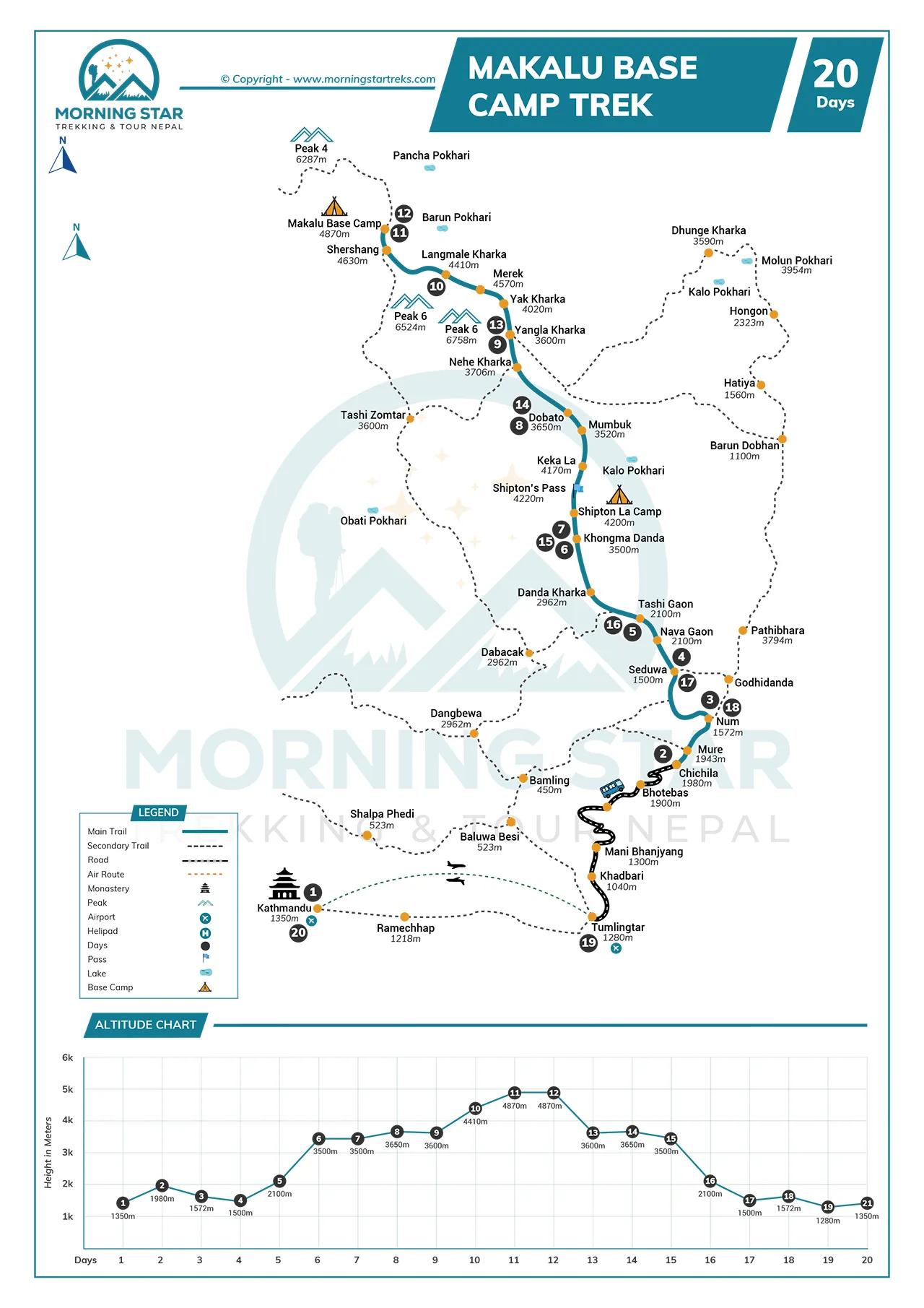
Route Map & Altitude Chart
Trip Information of Makalu Base Camp Trek
Best season and weather
Seasons like spring and autumn are the best options for this Makalu Base Camp itinerary since they generally offer the best trekking conditions. For instance, you will find that autumn offers mild daytime temperatures with very minimal chances of precipitation. Moreover, autumn offers a dry period, when trails are the least slippery, and it is also the festive period in Nepal. Meanwhile, spring offers the same traits, but it is a bit humid and more lush in comparison.
Difficulty
The difficulty level of this trek is around an 8.5 out of 10. The Makalu Base Camp Trek has been officially graded as a strenuous trek, which means that it is not suitable for beginners and first-timers. The trek has a lot of ascents, some of which are sharp and very exhausting, demanding high physicality.
Altitude Sickness
This trek requires us to spend many nights above 3500 meters, which can induce altitude sickness in trekkers, but we will be practicing all the preventive measures to prevent that from happening. You should keep yourself well hydrated, follow the pace of the trek guide (no rushing), and practice climbing high and sleeping low.
Preparation and Fitness
To prepare for this trek, we recommend just getting into cardio workout sessions and stamina-building. You do not have to do anything else, but if you want to, you can go on short hikes to nearby hills or hit the ladder machine at the gym. The physical preparation period is around 12 to 14 weeks for the Makalu Base Camp Trek.
Food and Accommodation
You can try the national dish of Dal Bhat Tarkari, Dhido Gundruk, momo, thukpa, Tibetan Bread, Puri Tarkari, Roti, Yak cheese, and more. Western options are also available at most eateries, along with many vegetarian dishes. We actually encourage trekkers to stick with veg meals since meats might not be frozen properly. Meanwhile, accommodation options are tea houses, lodges, and homestays. We will provide 3 meals per day during the trekking days and cover all your accommodation expenses.
Transportation
All the ground transport required by the Makalu Base Camp Trek will be covered by the trek package. This includes all the drive to and from the starting point of the trek, along with free airport pick-up and drop-off.
Communication
Communication can be a bit of a hassle on this trek since phone networks have yet to reach the remote parts of the region, and you are also less likely to get reliable WiFi connections. All in all, you might have to spend a couple of days without any contact with the outside world. The trek guide keeps a satellite phone to contact for help in case of injuries or emergencies.
Permit
Trekkers are required to have a Makalu Barun National Park Entry Permit and a Makalu Rural Municipality Permit. The fees for these permits will be covered by the trek package.
Visa
After you arrive at the Tribhuvan International Airport, you will have to apply for a tourist visa and pay the visa fees as per your preferred length of stay. This does not count as part of the trek; the package will not cover it.
Travel Insurance
Insurance is one of the mandatory documents for this trek; without it, we can not take you on this Makalu Base Camp Trek. Also, your insurance fee is not covered by the trek package.
Extra Expenses
There are some things that are not practical to include as a covered cost; these include flight expense, extra meals, visa fees, insurance fees, additional night stays, lunch and dinner in Kathmandu, tips for the guides, laundry, hot showers in tea houses, etc.
Private vs. group trek
The Makalu Base Camp Trek is a secluded trekking experience, and it is always a great experience to do it with your close ones. A private trek offers just that experience; meanwhile, a group trek will have you paired up with random trekkers, and you have to share a room with a fellow trekker in the group.
Most Asked Questions
 General
When’s the best month for clear Makalu Base Camp Trek views?
The best months for clear Makalu Base Camp views are definitely September and October.
How isolated is the Makalu trek compared to Everest Base Camp?
The Makalu Base Camp Trek is very secluded compared to the standard EBC trek.
Are there local festivals in Num or Seduwa during the trek?
Yes, there are a couple, but you need to be there during the autumn season to experience them. You also have to be there at the right time and date.
What’s the max group size for the Makalu trek package?
Typically, we form a single group of 6 trekkers. However, we can also work out a larger group with additional guides.
Is a high-altitude trekking experience needed for this route?
Yes, prior high-altitude trekking experience is mandatory for this route since it is a physically demanding trek.
Any age limits for joining the Makalu Base Camp Trek?
No, there are no age limits for joining this trek, but we do not take kids under 12 years of age.
 Preparation & Fitness
What exercises prep for the Shipton La climb?
There are no particular exercises; you just have to focus on endurance training and cardio exercises.
How many daily trekking hours should I train for?
On average, you will have to walk for about 5 to 6 hours, so you should train accordingly.
Is a multi-day trekking experience required for the Makalu Base Camp Trek?
Yes, a multi-day or multi-week trekking experience is required for Makalu since it is a physically demanding and difficult trekking destination.
How do I train for 4,870 m at Makalu Base Camp?
You can go on short hikes to nearby hills or just use the treadmill in an incline setting. While the environmental conditions will be drastically different, the incline will feel the same.
How much personal gear should I carry?
You just need to have a pair of trekking boots and microspikes for this trek. You can also carry other gear if you want to.
What shoes work best for Yangla Kharka trails?
Just normal trekking shoes will be enough for any part of this Makalu Base Camp Trek.
 Insurance and Visa
Is a standard Nepal visa enough for the Makalu Base Camp Trek?
No, a standard Nepal visa is not enough for the Makalu trek; you must also have the necessary trekking permits and travel insurance.
Must insurance cover 5,000 m for Makalu Base Camp?
Absolutely, your trek or travel insurance must cover the medical expenses and rescue operation expenses up to 5000 meters of elevation.
Where can I get the Makalu Barun permit without an agency?
Without the assistance of an agency, you need to visit the Tourism Board Office in Kathmandu or Pokhara to obtain the necessary permits.
Does the trek package cover the Makalu Rural permit?
Yes, all the mandatory permits are covered by the trek package.
Which insurers cover high-altitude trekking in Nepal?
There are many companies that offer trek insurance packages. You can consult the trek experts at Morning Star to recommend the best options.
Does my insurance need helicopter evacuation coverage?
Yes, your insurance needs to have helicopter evacuation coverage; that is the main point of getting trek insurance.
Are permit fees refundable if the trek is canceled?
No, permits are not refundable tickets.
 Guides & Support Staff
Is a guide required for the entire Makalu Base Camp Trek?
Technically, a guide is required to enter the Makalu Barun National Park; you can visit the other regions with a guide as well. However, at this point, it will not be much of a trekking experience.
How much weight do porters carry per trekker?
Per trekker, your luggage needs to be under 12 kg. Extra weight will be met with extra charges.
Are guides trained for altitude sickness emergencies?
Yes, Morning Star’s trek guides are trained for altitude sickness emergencies. They know the drill and will contact the rescue services asap.
Can I request a female guide for the Makalu Base Camp Trek?
Yes, you can, but the chances of getting one are highly unlikely.
What’s the tipping norm for Makalu guides and porters?
You should just tip whatever you are content with; there is no norm for tipping guides and porters.
Do porters carry gear all the way to Makalu Base Camp?
Yes, our porters will carry all your gear all the way to the base camp and back.
 Accommodation and Facilities
What bedding do teahouses provide at Makalu Base Camp?
The bedding materials are pretty standard; however, it might be a bit stiff for international visitors since soft, spring-loaded mattresses are not a thing in the remote villages.
Are hot showers available in Khongma Danda teahouses?
Yes, hot showers are available at Khongma Danda teahouses and most of the tea houses along the route. It will cost you a buck or two.
Do Chichila teahouses have charging or Wi-Fi?
While Chichila teahouses have electricity, there is no reliable internet connection.
 Food and Drinks
Are vegan meals available above Tashi Gaon?
Yes, you will have plenty of vegan meal options above Tashi Gaon and throughout the entire Makalu Base Camp Trek.
Can I order dhido or yak cheese at Langmale Kharka?
Yes, Langmale Kharka is one of the authentic Sherpa villages in the region, offering a variety of local and traditional food options.
What snacks should I pack for high-altitude days?
You can just pack energy bars since we will be having lunch en route; you do not want to stuff yourself too much during trekking days.
 Weather & Seasons
How cold is Makalu Base Camp in late October?
The daytime temperature in late October ranges from 0 to 5 degrees Celsius, while at night, the temperature drops to way below 0 degrees Celsius.
Can snow block Shipton La in early March?
No, the possibility of that happening is very low; however, you might experience some snowfall around that period.
Do monsoon rains delay Kathmandu-Tumlingtar flights?
Yes, monsoon rains can often be heavy, offering really poor visibility.
How often does it rain in Seduwa in April?
April is not really the monsoon period in Nepal, but you can expect a little rain here and there.
What’s the visibility at Makalu Base Camp in autumn?
The autumn season offers the best visibility. You will get a crystal clear view from the base camp.
Are microspikes needed for Shipton La in March?
It is not really needed, but you can use them if you feel confident with them.
How do temperatures differ between Chichila and Dobato in May?
You will definitely feel the difference in temperature as Dobato is 1960 meters higher than Chichilla. The difference will be around 10 to 12°C.
 Health & Safety
What altitude sickness signs to watch for at Langmale Kharka?
At Langmale, you need to watch for shortness of breath, a slight headache, lightheadedness, and nausea.
Are there emergency clinics near Makalu Base Camp?
No, there are no emergency clinics near Makalu Base Camp. Emergency services are the only form of medical help.
Are leeches common between Num and Seduwa in July?
Yes, you can expect leeches between Num and Seduwa during the month of July.
Should I take Diamox for this Makalu Base Camp Trek?
Absolutely, Diamox helps a lot if you get altitude sickness. It holds the power to save your trekking journey.
Is the teahouse water safe at Khongma Danda?
While local spring water sources are usually germ-free, transporting can contaminate it. So, we recommend always using water purification tablets.
What wildlife risks exist in Makalu Barun National Park?
There are no risks while visiting the Makalu Barun National Park. The carnivores live far away from the trekking trails, while the herbivores are usually chill.
Is there a mobile signal for emergencies at Dobato?
No, there is no mobile signal at Dobato, but we can use a satellite phone to reach out for help.
 Booking & Payment
What’s the cancellation policy for the Makalu Base Camp Trek?
You are free to cancel the trek for whatever reason, but you will not receive a full refund, as we have already spent most of the initial deposit to arrange a seamless trek for you.
Are Makalu Barun permit fees included in the package?
Yes, the permits are a part of the trek package; you won’t have to pay for them separately.
How early should I book for a March trek?
For a trek in March, you should book the trek about 18 to 20 weeks early, so that you have enough time for physical training and other preparations.
Can I change the trek date without fees?
Unless you change the trek date on the same day of booking, you will be charged for it. Depending on how late you change the date, you will have to pay additional fees.
Is my deposit refunded if the weather cancels the trek?
No, cancellations due to unforeseen circumstances that we have no control over do not return you the full deposit. We will offer you a partial refund or a trek to a similar destination.
Are group discounts available for the Makalu Base Camp Trek?
No, there are no group discounts in any of our trek packages.
Do I get a refund if altitude sickness stops me?
No, altitude sickness is an element that we can not control, so the refund policy does not offer a refund.
 Transportation & Flight
How often are Kathmandu-Tumlingtar flights delayed?
Flights from Kathmandu to Tumlingtar are generally always on time.
What vehicles are used for the Tumlingtar-Chichila drive?
We will preferably use a jeep to reach Chichila from Tumlingtar since jeeps are the best option for rugged roads. Normal cars and buses will have issues traversing the route.
Are there alternate routes if the Chichila road is blocked?
Yes, there are alternative routes, but they require a long walk. Usually, you will not experience a blockage at that point of the trek.
Can I book a private jeep to Chichila?
Yes, you can do so, but it will come at a price.
How early should I reach Kathmandu airport for the flight to Tumlingtar?
The entry time is around 1.5 hours before the scheduled time of the flight. One of our reps will escort you to the airport as per the schedule.
Price starts
US$ 1800
US$ 1900
- Safety first, always
- Best prices guaranteed
- Expert travel team
- Easy booking, no extras
- Customize your journey
Based on 10 reviews
Have Questions?
+977 9767224414