
 English
 Dutch
Dutch Japanese
 Hindi
Hindi Italian
 Spanish
 French
 German
 Chinese
 Korean
 Arabic
 Hebrew
 Russian
 Portuguese
 Danish
 Czech
Czech Polish
 Swedish
Have Questions?
+977 9767224414
Unmissable holidays deals - Save up to 20%
Tsum Valley Trek

Duration
13 Days

Trip Difficulty
Moderate

Max. Altitude
4,200m

Destination
Nepal

Group Size
2-16 People

Accommodation
Hotel, Lodge

Transportation
Tourist Bus

Meals
B L D
Explore more facts about the trip
Overview of Tsum Valley Trek
Located in the Annapurna region of Central Nepal, the Tsum Valley Trek is a secluded trek experience taking you to remote highland villages of the region. Tsum village is rich in Tibetan Buddhist culture, and around 1800 people of Tibetan origin live there, as per the 2011 census data. The Annapurna region villages are dominated by Gurung, Magar, and Thakali communities, all of whom have their own set of traditional values and practices.
As the trek leads us into the highlands, deeper into the valley, you will stay among the locals. The people there are generally known for their warm hospitality, which you will feel in an instant. Their culture and tradition have been passed down for many generations and its still a huge part of their identity. During your time in the villages, you might get to enjoy a cultural performance that is specially arranged to welcome and entertain travellers from afar.
The entire Tsum valley region is lightly populated, with only 33 villages in total, with a population of 4000, as per the census of 2011. Most people there speak a Tibetan dialect since they are deeply rooted in Tibetan Buddhism. However, there are also some communities that follow the Bon religion. Regardless of the gods they worship, everyone there is very respectful and helpful in nature.
Passing by forests, rivers, waterfalls, and villages, you will get to enjoy many scenes of peaks in the distance. Peaks including Ganesh Himal, Sringi Himal, Buddha Himal, Himalchuli, and more will be occasionally in view. During the springtime, these scenes will be at their best since it is the time when nature blooms grandly.
A lot goes into arranging a trek to the remote highlands, and you, as a trekker, must know the details of the trek without any hidden charges. That is why we have crafted a detailed trek package so that you know what you are paying for and what you can expect from this journey.
- Safety first, always
- Best prices guaranteed
- Expert travel team
- Easy booking, no extras
- Customize your journey
Based on 10 reviews

Trip Highlights
- Visit the ancient Milarepa Piren Phu Cave in Burji village, a site where Milarepa used to meditate.
- Experience scenic trails passing by lush forests, crossing swaying suspension bridges, and passing by waterfalls.
- Enjoy an expansive scene of Sringi Himal, Ganesh Himal, Buddha Himal, Himalchuli, and others.
- Stay in remote villages, witnessing their culture and Tibetan Buddhism-influenced daily lives.
- Many chances of encountering wildlife as we pass through remote forests that are almost untouched by human civilization.
- Experience many cultural traits as we pass by Gurung, Magar, and Thakali villages en route.
Photo and Video Gallery


Tsum Valley Trek Detail Itinerary

Day 01: Arrive in Kathmandu
As your flight gets closer to Kathmandu, you will get to see a wide view of the Himalayas in the north. It will be an overhead view, which will not be anything like the ones you see in pictures. Nonetheless, the scene is amazing. After you land at the international airport, you will have to obtain a tourist visa before you can leave the airport and start your journey in Nepal. As you exit the terminal, one of our reps will be waiting for you. He will then take you to your accommodation for the night.

Activity: 30 mins drive

Max. Altitude: 1,400m/4,593ft. (Kathmandu)

Meal: Breakfast

Accommodation: Hotel
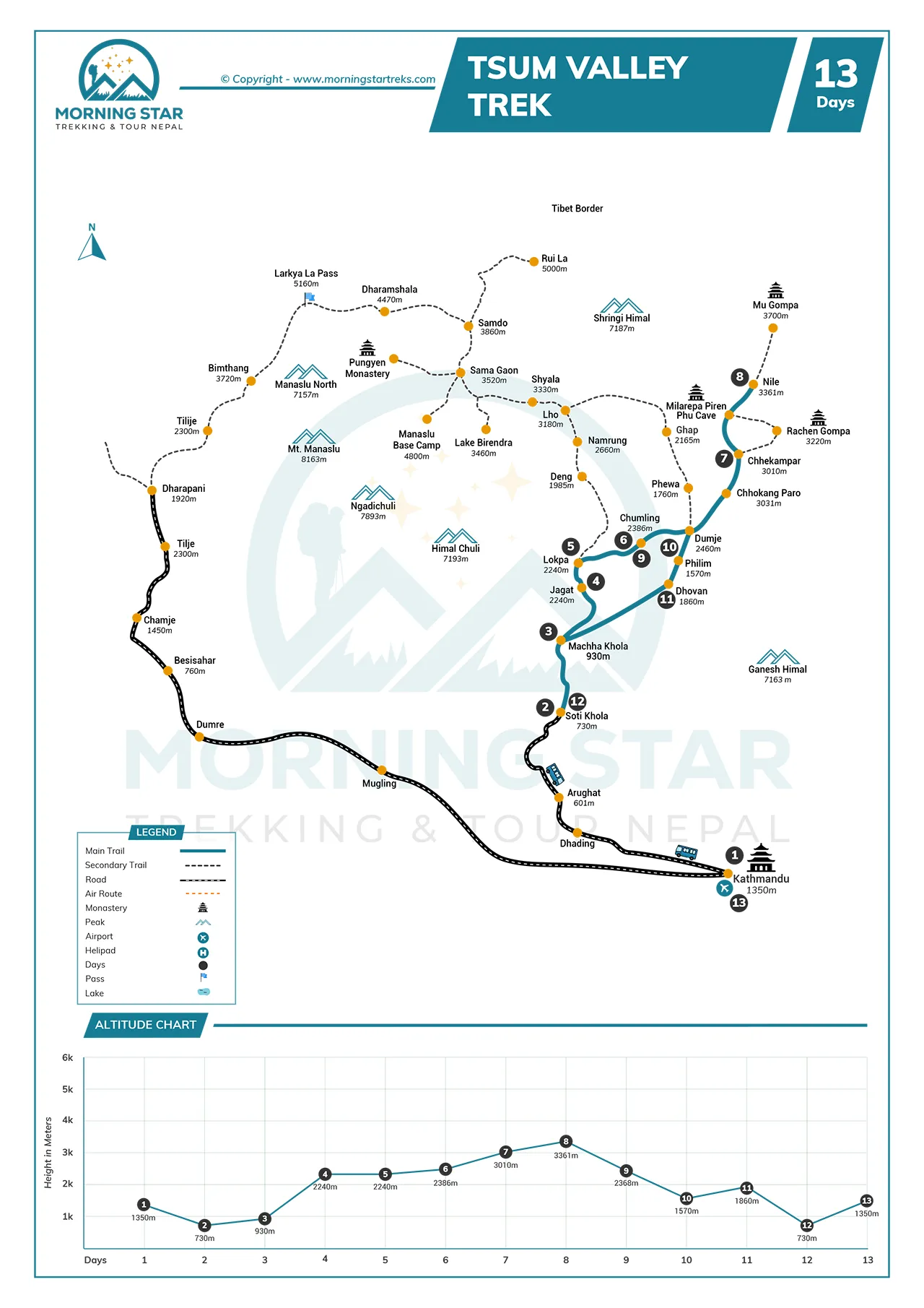
Day 02: Drive from Kathmandu to Soti Khola
Day 2 of the Manaslu Tsum Valley itinerary features a 141 km drive from Kathmandu to Soti Khola. This drive is going to be a long one, as the road conditions are not great at all. First off, we will head west from Kathmandu and drive over the Prithvi Highway connecting Kathmandu and Pokhara. After we reach Malekhu, we will take a right turn and head north towards Soti Khola. From this point on, the roads are rugged and bumpy.
Max. Altitude: 730m/2,395ft. (Soti Khola)
Meal: Breakfast, Lunch & Dinner
Accommodation: Guesthouse
Day 03: Trek from Soti Khola to Machha Khola
Today is the first trekking day of the Manaslu Tsum Valley itinerary. We will start the day at 700 meters of elevation and reach 930 meters at Machha Khola, gaining 230 meters of elevation. The trek features a 14 km long trail that takes around 6 to 7 hours to complete. Initially, the trail is plain, following the Budi Gandaki River upstream. After a while, the path turns into a ridgeline that takes us through Khursani Bari, followed by Lapu Besi village. Keeping up with the ascent, we will reach Machha Khola.
Activity: 6-7 hrs trek
Max. Altitude: 870m/2,854ft. (Machha Khola)
Meal: Breakfast, Lunch & Dinner
Accommodation: Lodge
Day 04: Trek from Machha Khola to Jagat
From Machha Khola, we will have to trek about 15 km to reach Jagat, which takes about 6 to 7 hours. This trek gains us an elevation of 410 meters, taking us to 1340 meters above sea level. The trail begins with crossing the Budi Gandaki River over a suspension bridge. Then, we will trek through a rocky terrain and pass by a couple of Gurung villages, including Tatopani and Khorlabesi. After crossing a couple more bridges and ascending rocky trails, we will reach Jagat.
Activity: 6-7 hrs trek
Max. Altitude: 1,340m/4,396ft. (Jagat)
Meal: Breakfast, Lunch & Dinner
Accommodation: Lodge
Day 05: Trek from Jagat to Lokpa
Today’s trek is around 16 km long, with an estimated trek duration of 6 to 7 hours. The elevation gain of the day is 700 meters, taking us to 2040 meters above sea level. The trail initially follows the Budi Gandaki River through a lush forest. Soon after, we will reach the village of Salleri, followed by Sirdibas. From there, the trail leads us into the Tsum Valley, passing by Philim. After about an hour or two, we will reach our destination.
Activity: 6-7 hrs trek
Max. Altitude: 2,040m/6,693ft. (Lokpa)
Meal: Breakfast, Lunch & Dinner
Accommodation: Lodge
Day 06: Trek from Lokpa to Chumling
Day 6 of the Manaslu Tsum Valley itinerary spans a little over 13 km with an estimated trek duration of 6 to 7 hours. Gaining 346 meters of altitude, this trek starts off with crossing the Syar Khola over a suspension bridge. This trail leads us to a lush forest over a narrow rocky trail. As we continue the ascent, scenes of Baudha Himal and Himalchuli come into view. After a while, we will pass by many settlements and reach Chumling, sitting at 2386 meters above sea level.
Activity: 6-7 hrs trek
Max. Altitude: 2,386m/7,828ft. (Chumling)
Meal: Breakfast, Lunch & Dinner
Accommodation: Lodge
Day 07: Trek from Chumling to Chhekampar
On the 7th day of the Manaslu Tsum Valley itinerary, we will cover over 14 km of distance, with an elevation gain of 624 meters. This trek should take about 6 to 7 hours to complete. Leaving Chumling, we will cross a suspension bridge and get on a gradually ascending trail with a gorgeous Himalayan view. Passing by a couple of Tsumba settlements, the traditional stone houses make up a charming village scene. After lunch at Gho village, we will reach Chhekampar in about 1.5 hours.
Activity: 6-7 hrs trek
Max. Altitude: 3,031m/9,944ft. (Chhekampar)
Meal: Breakfast, Lunch & Dinner
Accommodation: Lodge
Day 08: Trek from Chhekampar to Nile via Milarepa Piren Phu Cave
Today, we will cover about 12 km of distance, within 5 to 6 hours, gaining 351 meters of net elevation. Leaving Chhekampar, the trail climbs gradually to Milarepa Piren Phu Cave with clear views of Ganesh Himal and Shringi Himal. After visiting the sacred cave, we will head towards Lamagaon and take a lunch break. Post-lunch, the trek continues until we reach Nile village, at 3361 meters.
Activity: 5-6 hrs trek
Max. Altitude: 3,361m/11,027ft. (Nile)
Meal: Breakfast, Lunch & Dinner
Accommodation: Lodge
Day 09: Trek from Nile to Chumling
This is the longest trekking day on the Manaslu Tsum Valley itinerary, featuring a 22 km trail which takes about 7 to 8 hours to complete. Needless to say, the day is going to be a tiring one. The elevation loss of the day is 975 meters, which takes us to 2386 meters of elevation, starting from 3361 meters above sea level. Leaving Nile, we will descend along the Syar River, pass by Lamagaon, and eventually reach Chumling.
Activity: 7-8 hrs trek
Max. Altitude: 2,386m/7,828ft. (Chumling)
Meal: Breakfast, Lunch & Dinner
Accommodation: Lodge
Day 10: Trek from Chumling to Philim
Today is yet another long trekking day as we have to trek almost 20 km, which takes about 6 to 7 hours. By the end of the day, we will lose 816 meters of elevation, which takes us down to 1570 meters, starting from 2386 meters above sea level. This trek starts alongside the Syar River over a rocky terrain and crosses a couple of suspension bridges before we arrive at Ripchet. From there, we will re-enter the standard Manaslu trail and head to Philim.
Activity: 6-7 hrs
Max. Altitude: 1,590m/5,217ft. (Philim)
Meal: Breakfast, Lunch & Dinner
Accommodation: Lodge
Day 11: Trek from Philim to Dovan
Day 11 of the Tsum Valley Trek features a 16 km trail with an estimated trek duration of 5 to 6 hours. This descent will lose us 500 meters of elevation, taking us down to 1070 meters above sea level. The trail starts alongside the Budi Gandaki River and crosses many suspension bridges. Passing by a couple of waterfalls, the trail has a rest point at Nyak village. From there, the forested sections begin, leading us all the way to Dovan.
Activity: 5-6 hrs
Max. Altitude: 2,600m/8,530ft. (Dovan)
Meal: Breakfast, Lunch & Dinner
Accommodation: Lodge
Day 12: Trek from Dovan to Soti Khola
Today is the last trekking day of the Tsum Valley Trek; the day features 5 to 6 hours of trek, covering around 14 km of distance with a net elevation loss of 370 meters. Leaving Dovan, we will follow the Budi Gandaki River through forested sections and cross a couple of suspension bridges to reach Yaru village. From there, we will head towards Jagat village and eventually down to Soti Khola to spend the night.
Activity: 5-6 hrs trek
Max. Altitude: 730m/2,395ft. (Soti Khola)
Meal: Breakfast, Lunch & Dinner
Accommodation: Lodge
Day 13: Drive from Soti Khola to Kathmandu
The next morning on the Tsum Valley Trek, we will have breakfast at Soti Khola and get on a jeep to Kathmandu. This 140 km long ride will take about 6 to 7 hours to complete. We will have a delicious lunch at one of the restaurants en route. After reaching Kathmandu, we will drop you off at the accommodation for the night.
Activity: 6-7 hrs drive
Max. Altitude: 1,400m/4,593ft. (Kathmandu)
If our standard itinerary doesn't fully meet your needs, we are happy to tailor it to your specific preferences and requirements.

Includes and Excludes
What’s Included?
- Airport transfers in Kathmandu, including pickup on arrival and drop-off on departure
- Private vehicle transportation between Kathmandu and Soti Khola, both ways
- Hotel accommodation in Kathmandu before and after the trek
- Comfortable teahouse or lodge accommodation during the trek (twin-sharing)
- Breakfast in Kathmandu hotel, and three meals (breakfast, lunch, dinner) each day during the trek
- Professional, English-speaking trekking guide and required porters
- Trekking guide salary, insurance, meals, accommodation, equipment, transportation, etc.
- Seasonal fresh fruit during the trek
- All necessary trekking permits and national park entry fees
- Basic medical kit and safety equipment during the trek
- Sleeping bag, down Jacket, walking poles, duffel bags (you have to return after the trek)
- Certificate of achievement at the end of the journey
- Government taxes and agency service charges
What is not Included?
- International flights to and from Nepal
- Nepal entry visa fees upon arrival
- Lunch and dinner in Kathmandu
- Personal expenses such as drinks, snacks, hot showers, Wi-Fi, and device charging
- Travel insurance that covers medical emergencies and helicopter evacuation
- Tips for guides, porters, and drivers
- Extra hotel nights caused by flight delays, early arrival, or late departure
- Personal Travel insurance and emergency rescue evacuation
- Extra cost caused by natural or political disturbances beyond our control
Route Map & Altitude Chart
Trip Information of Tsum Valley Trek
Best season and weather
The best seasons for most of the trekking destinations in Nepal are autumn and spring; the Tsum Valley Trek is no exception. Our Manaslu Tsum Valley itinerary goes through dense forest and wide open trails that are best experienced in spring since the forests are lush and flowers are fully blooming. Meanwhile, in the autumn season, the trails are dry, eliminating any slippery sections. In addition to that, autumn is also the festive season in Nepal, giving you plenty of chances to observe a traditional celebration.
Difficulty
The Tsum Valley Trek is officially graded as a moderately difficult trek. This means it is not quite suitable for beginners, but if you are someone with a great physique and preparation, you might just do it regardless of your beginner stage. While the Manaslu Tsum Valley itinerary does not have any technical sections or aggressively steep climbs, the remoteness and the high elevation profile make it difficult. On a scale of 10, this trek is a solid 7.
Altitude Sickness
Although the trek spans 14 days, there are no nights that are spent over 3500 meters above sea level. 3500 meters is the point where altitude sickness generally starts. Our highest nightstay elevation is 3360 meters at Nile village. In a nutshell, you are very safe from altitude sickness; you do not need to worry about it at all.
Preparation and Fitness
Being a moderately difficult trek, the Tsum Valley Trek requires 8 to 10 weeks of physical preparation. If you are ill-prepared, you will struggle to make it to the next destination on the Manaslu Tsum Valley itinerary. Some trekking days are long, which calls for endurance and strong leg muscles, which is why you should do cardio exercises. You can also train your leg muscles as they will be working overtime on this trek.
Food and Accommodation
As per the standard practice, we will provide you with 3 meals per day for the entire trekking days. Any extra meals will be your personal expense, and only breakfast will be provided during your time in Kathmandu. You can choose freely from the menu of the tea houses, and the trek package will cover the expenses. As for accommodation, we cover the entire night stays of the Manaslu Tsum Valley itinerary. However, if extra nights are spent, they will be accounted separately.
Transportation
Starting with a drive from Kathmandu to Soti Khola, the itinerary requires us to travel back to Kathmandu from Soti Khola. These are the only rides you will need for the trek and the only ones the trek package will cover. However, we do provide free airport pickup and drop off.
Communication
After leaving Machha Khola on the 3rd day of the Manaslu Tsum Valley itinerary, we are highly unlikely to receive any mobile network until day 12 of the trek. You might get some reception here and there, but it will not be very usable. However, you can find WiFi connectivity in most of the villages en route. The tea houses might charge you a dollar or two as a service charge.
Permit
The permits required for this trek are a restricted area permit (RAP) and a Manaslu Conservation Area Permit (MCAP). The fees for these permits will be covered by the Tsum Valley Trek package.
Visa
Your visa fees are not a part of the trek package, as it is an expense of a personal nature. You will need to pay your visa fees while applying for a tourist visa at the Tribhuvan International Airport. Your international flight expenses are not excluded from the coverage of the trek package.
Travel Insurance
Without insurance, we will not be able to take you on the Manaslu Tsum Valley itinerary. While it is true that altitude sickness is realistically non-existent during this trek, it is also true that accidents can happen while doing outdoor activities. If you do not have insurance, you will have to pay a huge amount of money after you are rescued from the remote villages via a helicopter.
Extra Expenses
Your extra expenses include an international flight to and from Nepal, personal trekking gear, insurance fees, tips for the guides and porters, extra meals, bar bills, laundry, WiFi, hot shower, visa fees, and more.
Private vs. group trek
The Manaslu Tsum Valley itinerary is a great route to experience with your close friends and family. A private trek can be a memory of a lifetime as you will be exploring the highlands with your loved ones, making lasting memories as you go. Meanwhile, a group trek is the cheaper option, where you will be in a group with random trekkers from all over the world. This is great for trekkers who are visiting Nepal alone or in pairs.
Most Asked Questions
 General
What is the best time of year to undertake the Tsum Valley Trek?
The best time of the year for this trek is definitely March to May and September to November. These months offer the best trekking conditions.
How remote is the Tsum Valley Trek compared to other trekking routes in Annapurna?
Compared to most other trails within the Annapurna region, this trek is quite remote and secluded. You are highly unlikely to see any huge crowds in the region.
Are there any cultural or religious customs that I should be aware of?
Yes, there are many customs in the region, but the locals do not really expect foreign trekkers to know everything. However, if you see them engaged in some ritual, it is best not to get involved without being asked to.
What permits are required for the Tsum Valley Trek, and how are they obtained?
For this trek, you need a Tsum Valley Restricted Area Permit (RAP), and a Manaslu Conservation Area Project Permit (MCAP). These can be obtained at the Tourism Board Office in Kathmandu or Pokhara.
Is the Tsum Valley Trek suitable for solo trekkers, or is a group recommended?
Although it is suitable, trekking solo is not allowed in the region since it is a restricted region. The laws of Nepal restrict international trekkers from roaming around protected zones on their own.
 Preparation & Fitness
How physically demanding is the Tsum Valley trek?
On a scale of 10, this trek has a physical demand of 6. The trek does not require ascending to considerably high elevations.
Do I need prior high-altitude trekking experience?
No, you do not need to have prior high-altitude trekking experience since this trek is graded as moderate.
How should I train or prepare physically before the trek?
You can just go on long walks, hit the treadmill or the ladder machine, or go on short hikes.
Are there acclimatization days built into the itinerary?
No, there are no acclimatization days in the itinerary since the risk of altitude sickness is basically zero in this trek.
Can older trekkers or those with minor health issues do this trek?
It depends on the type of health issues; the best thing to do is to consult a doctor and only then join the trek.
 Insurance and Visa
How do I obtain the Tsum Valley Restricted Area Permit, and is it included in the package?
The trek guide will handle the permits for you, which are included in the Tsum Valley Trek permit. You do not have to pay separately for the permit fees.
Does my travel insurance need to cover trekking above a certain altitude?
Yes, it should include covering medical expenses up to 3360 meters above sea level. The trek package will not cover this expense under any circumstances.
Will I need to show proof of insurance?
Yes, you need to have insurance if you want to go on this trek. Insurance keeps you safe from the hefty medical fees if you ever need emergency medical assistance in remote regions.
Is helicopter evacuation covered by standard travel insurance?
There are special insurances specifically made for trek adventures. If you do not have any idea how to proceed, you can ask the trek guide.
Can the trekking company help arrange permits in advance?
Yes, we can help you with that. Our reps and trek guides will visit the related offices on your behalf.
 Guides & Support Staff
Is a guide mandatory for the Tsum Valley trek due to its restricted status?
Yes, foreign trekkers are not allowed to visit any restricted zones without the company of a licensed guide.
What language(s) does the guide speak?
Morning Star’s experienced guides are fluent in English, Nepali, and a little bit of Hindi.
How experienced are the guides with high-altitude and remote trekking?
Each one of our guides has 5 to 10 years of experience, with a couple having more than 10.
Can I hire a porter only without a guide?
No, you can not hire only a porter since guides are mandatory for the trek. However, you can opt for no porters if you are capable of carrying your own heavy luggage.
What is the maximum weight a porter can carry per person?
The maximum weight a porter can carry per person is 12 kg. Every two trekkers in the group will share a single porter.
 Accommodation and Facilities
Will we be staying in teahouses or camping along the way?
We will stay in teahouses all throughout the trek, which will be arranged and booked before the trek.
Are hot showers and Wi-Fi available in any of the lodges?
Yes, every teahouses and lodges are facilitated with a hot shower and Wi-Fi, but they are usually priced a couple of dollars.
Can I charge electronic devices during the trek?
Yes, you can; however, remote villages often face power outages. The tea houses also have backup solar energy, but they rarely let you use it for charging.
Are the lodges equipped with clean bedding, or should I bring a sleeping bag?
Yes, they are equipped with clean bedding; however, you can bring a sleeping bag too, since it can be a bit too cold.
 Food and Drinks
What kind of meals can I expect on the Tsum Valley trek?
As it is in the Himalaya, the meals are traditional and local, which are grown in the same villages.
Are vegetarian or vegan options available throughout the trek?
Yes, vegetarian or vegan options are available throughout the itinerary.
Is it necessary to bring snacks or energy bars from Kathmandu?
Yes, you do not get a lot of options in the remote villages, so if you have particular preferences, you can pack it up from Kathmandu.
 Weather & Seasons
How cold does it get at night during peak trekking seasons?
It does not get too cold at night since we will not be going to extreme elevations; however, it will be colder than the city areas.
Is it possible to trek in Tsum Valley during the monsoon?
Yes, it is possible, but the trails will be wet and slippery, not to mention the views will be blocked by rain clouds for the most part.
Will there be snow on the trail in April or October?
No, snow is unlikely to fall in April and October. However, you might get to see some snow in higher elevations, especially in base camps.
What kind of clothing should I pack for changing mountain weather?
Along with your trekking trousers and t-shirts, you need to have a weather-proof jacket to combat sudden weather changes.
Can I get weather updates during the trek?
Yes, you can get weather updates during the trek, but the Himalayan weather is notorious for being unpredictable. The afternoon winds often bring in clouds from the west.
 Health & Safety
What altitude does the Tsum Valley trek reach, and is altitude sickness a concern?
The highest altitude of this trek is just 3360 meters, which is below the altitude sickness line. There is no concern of altitude sickness.
How do I recognize and respond to signs of AMS (Acute Mountain Sickness)?
Signs of AMS include light headache, nausea, shortness of breath, and others. You can just go down in elevation if you experience these symptoms.
Are there any clinics on the trail?
While clinics are only available in lower region villages, health posts are in every village en route.
What emergency procedures are in place if someone falls ill?
If someone falls ill, the trek guide will assess the situation and take the necessary actions.
Should I bring water purification tablets or filters?
Water purification tablets are the best option to purify your water and get rid of the contaminants in it.
 Booking & Payment
What is the cancellation policy if I need to back out?
Depending on how early you cancel the trek, a certain amount of the initial deposit will be withheld.
Is there a deposit required, and is it refundable?
Yes, a deposit is required to confirm the booking, and it is refundable with some cutbacks.
Can I change the trek dates after booking?
Yes, you can, but it will cost you a certain sum of money depending on how later you requested the change.
Are there any hidden costs not included in the package price?
No, there are no hidden costs; we have mentioned everything the trek package includes; other than the included services, you have to pay for the extra services you get.
Do you offer any group or last-minute booking discounts?
No, there are no such things as arranging a highland trek takes time, you can not book the trek last-minute, it takes weeks and even months to prepare it all.
 Transportation & Flight
How do I get from Kathmandu to the Tsum Valley trailhead?
From Kathmandu, we will get on a ride to reach Soti Khola. You can either take a jeep or a bus.
Are there regular bus or jeep services to the starting point?
Yes, there are regular transport options from the starting point, but most of them go down to the lower region villages, rather than going up the valley.
Is private transport included in the trekking package?
No, private transport is not a part of the Tsum Valley Trek package.
How long is the drive to/from the trailhead?
Generally, it will take us 6 to 7 hours to get to the trailhead. The road condition is not great, but it is expected in the remote highlands of Nepal.
Can flights be arranged to shorten the travel time to the region?
No, there are no airstrips in the highlands of Annapurna, so flying to the trailhead is not an option.
What happens if the road is blocked due to landslides or strikes?
If the roads are blocked and there are no alternative routes, we will have to wait until the next day.
Do I need to book transport in advance during peak seasons?
Morning Star’s reps will handle all the booking processes; you just have to focus on preparing for the trek.
- Safety first, always
- Best prices guaranteed
- Expert travel team
- Easy booking, no extras
- Customize your journey
Based on 10 reviews
Have Questions?
+977 9767224414