
 English
 Dutch
Dutch Japanese
 Hindi
Hindi Italian
 Spanish
 French
 German
 Chinese
 Korean
 Arabic
 Hebrew
 Russian
 Portuguese
 Danish
 Czech
Czech Polish
 Swedish
Have Questions?
+977 9767224414
Unmissable holidays deals - Save up to 20%
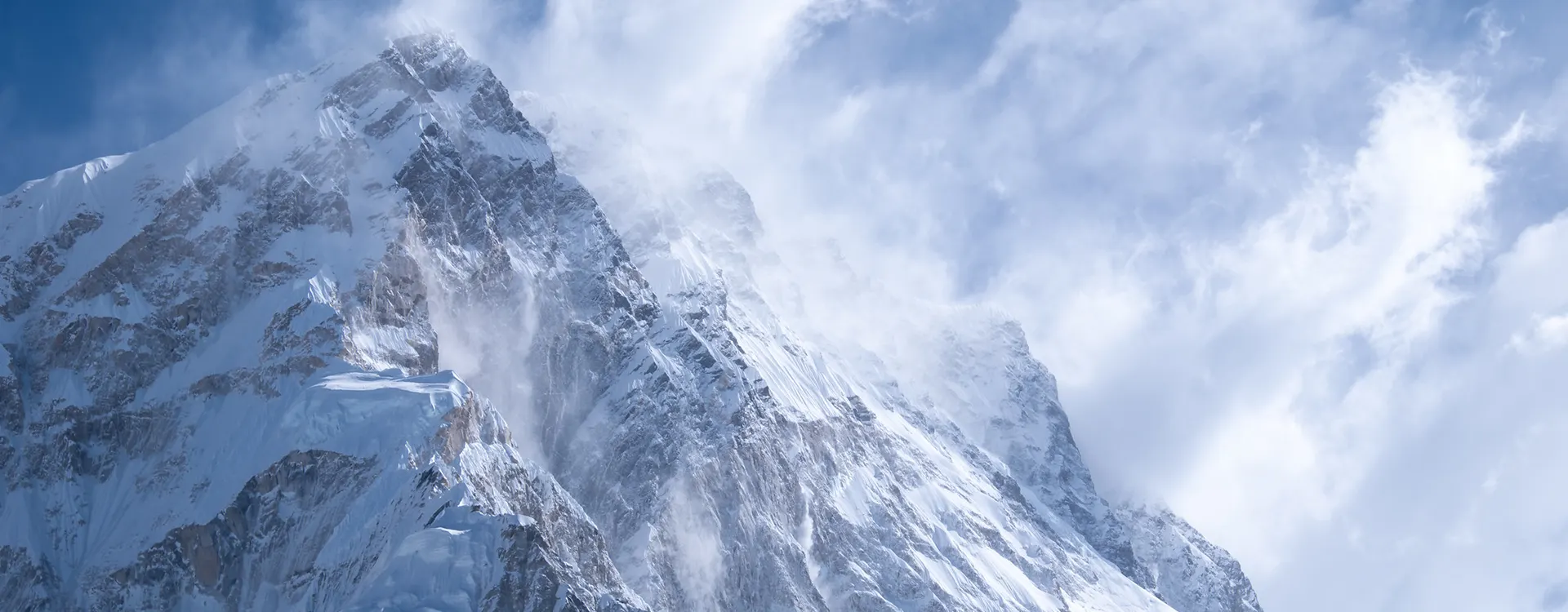
Lobuche Peak Climbing

Duration
17 Days

Trip Difficulty
Moderate

Max. Altitude
6,119m

Destination
Nepal

Group Size
2-16 pax

Accommodation
Hotel, Tea House

Transportation
Bus , Flight

Meals
B L D
Explore more facts about the trip
Overview of Lobuche Peak Climbing
Lobuche Peak Climbing is an ultimate high-altitude adventure in Nepal, combining the technical difficulty, the beauty of the Himalaya, and the cultural experience of Nepal. Located in the Khumbu region, Lobuche East is a 6,119-meter trekking peak, making it an excellent choice for the first summit in the Himalayas. Being close to Everest Base Camp and offering wide views of Everest, Lhotse, Nuptse, and Ama Dablam, Lobuche Peak Climbing has become an adventure that all trekkers and mountaineers aspire to go for.
The mountain is one of the twin peaks itself, which are Lobuche East and Lobuche West. Lobuche West is a more technical journey and requires advanced climbing permits and expertise, whereas Lobuche East is good for fit and determined trekkers with basic mountaineering skills. This differentiates Lobuche Peak Climbing as an introduction to those who start trekking to high altitude climbing. This route passes through glaciers, snow slopes, and a final steep ridge ascent that is challenging enough to be memorable, but also achievable with proper guidance and preparation.
The unique feature of Lobuche Peak Climbing is that it is combined with the classic Everest trekking route. Climbers start their adventure in Kathmandu by flying to Lukla and trek through famous villages such as Namche Bazaar, Tengboche, and Dingboche. On the way, trekkers acclimatize by hiking to Everest View Hotel and Nagarjun Peak, and most of them visit Everest Base Camp and Kalapatthar by the time they go to Lobuche High Camp. This route not only improves the acclimatization process, but it also enhances the experience by letting trekkers enjoy the iconic beauty of Everest.
More than a physical climb, Lobuche Peak Climbing is a cultural adventure. The path passes through Sagarmatha National Park, a UNESCO World Heritage Site, and gives a glimpse into Sherpa life; prayer flags blowing in the fresh air, ancient monasteries on mountain ridges, and groups of yaks. The spirituality of the area can be felt highly, and the climbers usually stop and take blessings at Tengboche Monastery before going ahead with their climb.
This 17-day trip is not only a journey, it’s a transformation. Through the chaotic streets of Kathmandu to the snow-covered mountains of Lobuche East, each footstep of Lobuche Peak Climbing is a journey of survival, exploration, and amazement. This expedition is an amazing opportunity, whether you are going on your first Himalayan summit or a new addition to your expedition list. Lobuche never disappoints you.
- Safety first, always
- Best prices guaranteed
- Expert travel team
- Easy booking, no extras
- Customize your journey
Based on 10 reviews

Trip Highlights
- Reaching the summit of Lobuche East (6,119m)
- Wide views of Everest, Lhotse, Nuptse, Ama Dablam, Makalu, and Pumori
- Trekking through Sagarmatha National Park (UNESCO World Heritage Site)
- Crossing suspension bridges and alpine forests
- Visiting Tengboche Monastery and Pangboche village
- Acclimatization hikes to Everest View Hotel and Nagarjun Peak
- Experiencing Sherpa hospitality and teahouse culture
- Optional Everest Base Camp and Kalapatthar expedition
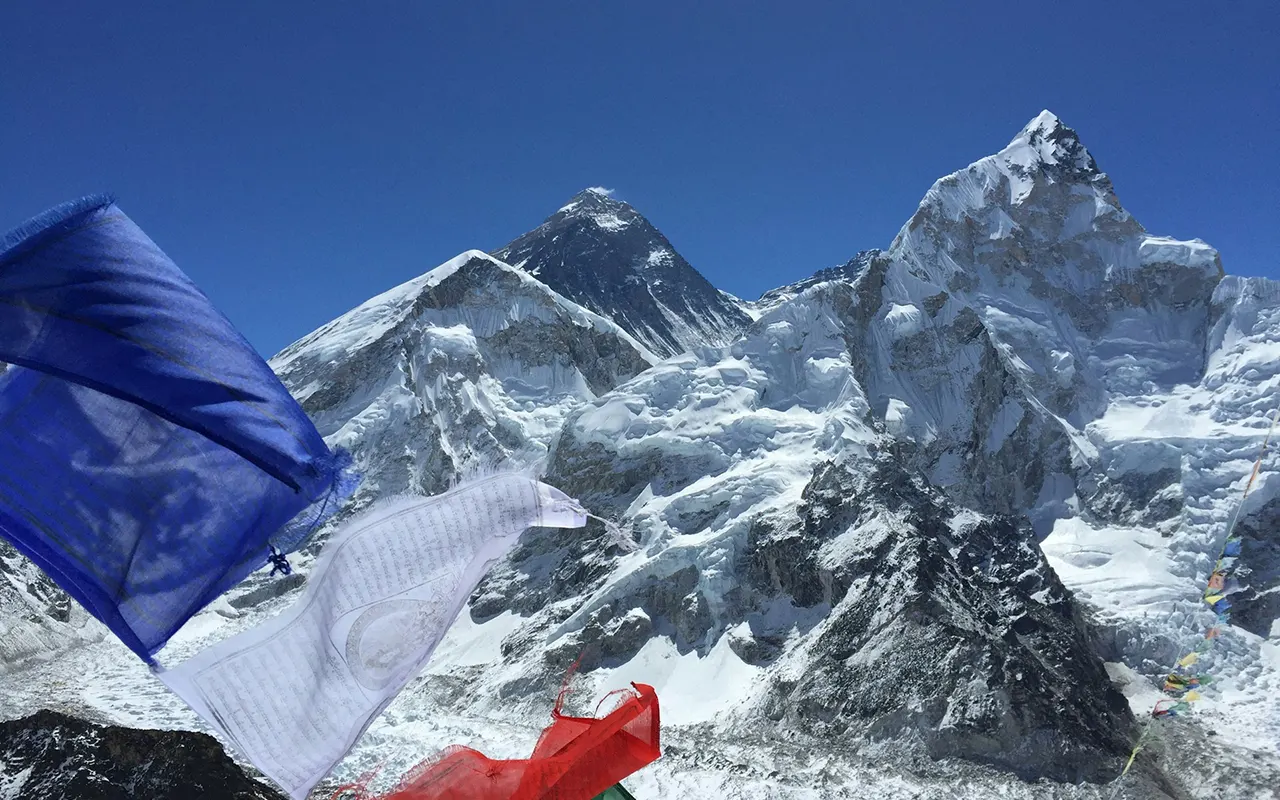
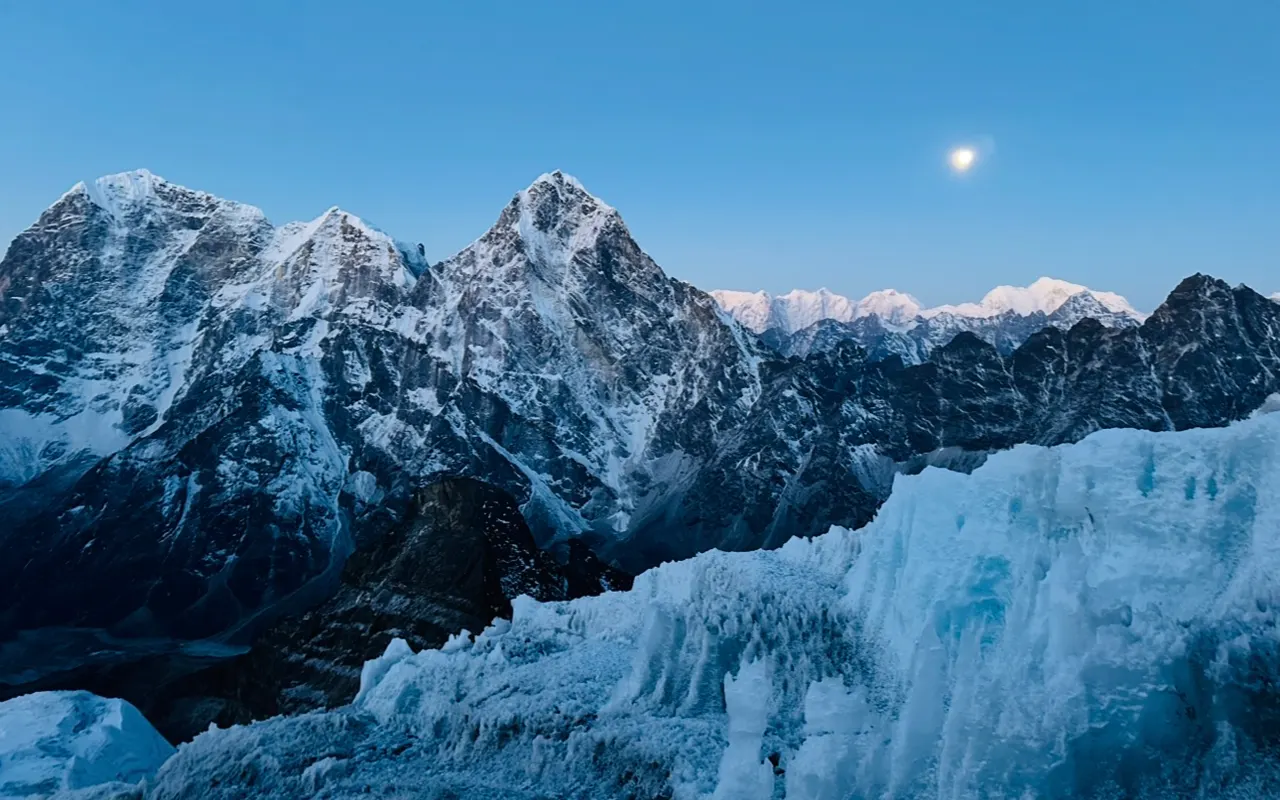
Photo and Video Gallery



Lobuche Peak Climbing Detail Itinerary

Day 01: Arrival in Kathmandu, hotel transfer, welcome dinner
Your Lobuche Peak Climbing adventure starts as you arrive at Kathmandu, the capital of Nepal. Kathmandu is located at 1400 meters above sea level, which makes the city a warm-up to altitude. One of our representatives will welcome you at the Airport, then you will be taken to your hotel. After that, you can rest and get refreshed.
This evening, you will have a traditional Nepali welcome dinner with your climbing team and guide. It is a wonderful time to feel the vibes of the lively streets of Thamel and to get your mind ready for the adventure to come. The rich culture and beauty of Kathmandu set the mood for the unforgettable Lobuche Peak Climbing expedition that is ahead.

Max. Altitude: 1,400m/4,593ft. (Kathmandu )

Accommodation: Hotel
Day 02: Preparation day: gear check, briefing, shopping
Today is the day of preparing for your Lobuche Peak Climbing adventure. After having breakfast, you will meet with your climbing guide to receive a detailed briefing of the route logistics, altitude strategy, and safety procedures. A complete gear check is needed to make sure you have the tools that are extremely important, such as crampons, harnesses, and layered clothing.
If you need anything, you can go to the local gear shops in Thamel to rent or buy missing items that you forgot. Today is also the day for finalizing permits and going moving wth the itinerary. After getting everything prepared, like climbing gear in hand and your mind prepared, you can feel ready and eager about what lies ahead. Lobuche Peak Climbing requires preparation, and today is one of such days where you prepare for the things that are yet to come..
Max. Altitude: 1,400m/4,593ft. (Kathmandu )
Accommodation: Hotel
Day 03: Fly to Lukla (2860m), trek to Phakding
This Lobuche peak Climbing adventure formally starts with a 30-minute flight to Lukla (2860m), which is one of the wildest mountain airports in the world. Once you have landed, you will be introduced to your porter team and begin a slow, uphill 3-4 hour trek to Phakding (2610m).
The trail goes down steadily through the village of Chaurikharka and through some small villages like Cheplung and Ghat. You will be crossing suspension bridges hung with prayer flags and alongside the Dudh Koshi River. The land is green and peaceful with a view of the Himalayan mountains in the sky. Your first night in the Lobuche Peak Climbing route is in the teahouse of Phakding tonight.

Activity: 30-minute flight & 3-4 hour trek
Max. Altitude: 2,610m/8,563ft. (Phakding )
Accommodation: Teahouse
Day 04: Trek to Namche Bazaar, enter Sagarmatha National Park
We start our 6-7-hour trek after having breakfast in Phakding and set our eyes on Namche Bazaar, the gateway to the Khumbu region and a crucial stop on your Lobuche peak climbing adventure. The route is along the Dudh Koshi River, where you will cross several suspension bridges, including the famous Hillary Bridge.
The trail goes through villages such as Toktok, Benkar, and Monjo, where you formally enter the Sagarmatha National Park, a world heritage site. The last part is a very steep climb through pine wood, where you can somehow get glimpses of Everest. Namche welcomes you with the most beautifully painted lodges, bakeries, and warm locals. Sleep well, as the elevation gain has just started here.
Activity: 6-7-hour trek
Max. Altitude: 3,447m/11,309ft. (Namche Bazaar)
Accommodation: Teahouse
Day 05: Acclimatization hike to Everest View Hotel
Today is a very important acclimatization day of Lobuche Peak Climbing. Following breakfast, you hike to the Everest View Hotel (3880m), one of the highest luxury hotels in this region, and a 3-4 hours of trekking will take you there. The trail then ascends steadily, above Namche, past Syangboche airport (which is not operated), and gives you excellent views of Everest, Lhotse, Ama Dablam, and Thamserku.
This hike helps your body to acclimatize to the thinning air and welcomes you with gorgeous views. You make your way back to Namche in time to have lunch, and then you will visit the Sherpa Museum or sit in the warm cafes. Acclimatization is important as it makes you ready to endure the higher altitude tomorrow.
Max. Altitude: 3,447m/11,309ft. (Namche Bazaar)
Accommodation: Teahouse
Day 06: Trek to Tengboche, visit monastery
The day starts with breakfast in Namche and then you will hike 5-6 hours to Tengboche (3800m), one of the most beautiful spots of the Lobuche Peak Climbing Trail. The path follows up and down through forests to the village of Kyanjin gompa and Sansa, where the trail is followed down to the bridge across the river Dudh Koshi at Phunki Thenga (3250m).
Then you will ascend at a steep forest climb to Tengboche which has a magnificent monastery. In the afternoon, you might be able to see a Buddhist ritual conducted by the monks. Surrounded by Everest, Nuptse, and Ama Dablam, Tengboche will bring both calmness and amazement to you. It an experience that you will never forget on your climbing journey.
Max. Altitude: 3,800m/12,467ft. (Tengboche )
Accommodation: Teahouse
Day 07: Trek to Dingboche (4347m), views of Ama Dablam
Today, a long 5-6 hour trek takes you to the heart of the Khumbu region with Ama Dablam standing above you like a carved sculpture. You will start by descending through the rhododendron forest to Debuche and cross the Imja Khola on a suspension bridge draped in the colorful prayer flags.
You will pass one of the highest permanent settlements of Sherpas, Pangboche, and move through the grassland with yak grazing nearby. The view becomes startlingly open as we reach near Dingboche, a small village just below the huge mountains. This is a major acclimatization point in the Lobuche Peak Climbing trail, and it is both restful and full of scenic Himalayan views.
Activity: 5-6 hour trek
Max. Altitude: 4,347m/14,262ft. (Dingboche )
Accommodation: Teahouse
Day 08: Acclimatization hike to Nagarjun Peak (5000m)
To acclimatize for the higher elevations, you will go for a 4-5 hour hike to Nagarjun Peak (5000m), a rocky ridge above Dingboche. The route ascends sharply and gives breathtaking views of Makalu, Lhotse, Ama Dablam, and Imja Valley. It is slightly difficult, but the climb is also worth the scenes.
It helps you with altitude preparedness and the beautiful Himalayan views. You will be going down gradually to Dingboche to have lunch and spend the rest of the afternoon hydrating yourself, writing, or socializing. This hike will not only be physical; this is a psychological preparation for the days ahead. Each step upwards increases your resilience and confidence.
Max. Altitude: 4,347m/14,262ft. (Dingboche )
Accommodation: Teahouse
Day 09: Trek to Lobuche, memorials along the route
Today is a 5-6 hour trek to Lobuche (4940m) that is both beautiful and thoughtful. You will gain altitude gradually to Dughla (Thukla), where you stop and have some tea, then proceed to a steep climb to the Everest Memorials, which are stone cairns in tribute to those climbers who died trying to reach the top. It is a vulnerable site and reminds us of the power of the mountain and its heritage.
The trail becomes less steep, and it goes through hills and rough land. Mountains such as Pumori and Nuptse are visible above your heads as you arrive at Lobuche, a village with infertile land. The Lobuche Peak Climbing finally seems to be worth it.
Max. Altitude: 4,940m/16,207ft. (Lobuche )
Accommodation: Teahouse
Day 10: Trek to Gorakshep, visit Everest Base Camp (5364m)
Today you will make a 6 to 7-hour trek to Gorakshep (5164m), the final village before Everest Base Camp. The path goes across the Khumbu Glacier and the glacial deposit. You will rest for a bit at Gorakshep, and then move to the Everest Base Camp (5364m), the dream base camp of several trekkers.
The trail is challenging and thrilling as you can see the Khumbu Icefall and massive mountains around. The sight of the Lobuche Peak base camp is a milestone moment for you that is unforgettable. Now, you head back to Gorakshep in the night with your hearts filled and your legs sore after this whole day of walking.
Activity: 6 to 7-hour trek
Max. Altitude: 5,364m/17,598ft. (Everest Base Camp )
Accommodation: Teahouse
Day 11: Hike to Kalapatthar (5644m), return to Lobuche
In the very early morning, you start a steep 2 to 3 hours of ascent to Kalapatthar (5644m), which has the best views of Mt. Everest, Pumori, and the rest of the huge mountains without any obstruction. This is an early morning walk, which lets you feel the chilled mountain air.
This is the highest trekking point before you start the Lobuche peak climbing. You will then enjoy the views and then head back down to Gorakshep to have your breakfast and head back to Lobuche (4940m). This trek takes 4-5 hours, and this allows you to rest, and mentally prepare yourself for the journey to come.
Max. Altitude: 4,940m/16,207ft. (Lobuche)
Accommodation: Teahouse
Day 12: Trek to Lobuche High Camp, climbing prep
This is the day when it becomes mountaineering rather than trekking. You will then climb up for 2 – 3 hours to Lobuche High Camp (5300m) across rocks and glacial deposits. The elevation change here can be felt strongly, and each step requires concentration. After reaching the high camp, you will camp and prepare for the final ascent before summiting the Lobuche peak.
Your guide will discuss rope skills, crampons, and safety measures. You will spend the afternoon hydrating yourself, resting, and preparing yourself for the ascent. When the sun goes down behind the mountains, the camp is all hush with restless excitement. You will wake up the next morning very early and start climbing up to the top of Lobuche East.
Activity: 2 - 3 hours trek
Max. Altitude: 5,300m/17,388ft. (Lobuche High Camp)
Accommodation: Camp
Day 13: Summit Lobuche East (6119m), descend to Pheriche
The day of the Summit starts before the sunlight, with headlights guiding the way through the icy path. The climb to Lobuche East (6119m) takes 8-10 hours up and down. High levels of concentration and stamina are required in the sections where crampons are used while crossing the glacier.
As you get to the top, the view presents you with Everest, Lhotse, Makalu, and the Khumbu valley, and it seems endless. It is the highest point of Lobuche Peak Climbing and is memorable. You can take photos and have a moment of silence to celebrate your success, and then proceed back down to High Camp, pack up again, and trek down to Pheriche (4371m), a 3-4 hour walk. Tonight you sleep at a lower altitude.
Activity: 3-4 hour trek
Max. Altitude: 4,371m/14,341ft. (Pheriche)
Accommodation: Teahouse
Day 14: Trek to Namche Bazaar
Today you have to descend for 6-7 hours, in familiar tracks, but the feeling is new, lighter, more fulfilling. Leaving Pheriche, you cross the Imja Khola and move through Pangboche, Debuche, and ascend to Tengboche.
You will then take a short rest and continue descending through forests and riverside to come to Namche Bazaar (3446m). The path is less difficult now, and the air is filled with more aroma. In Namche, you will get to eat and sleep, and probably have a celebratory pastry.
Activity: 6-7 hours trel
Max. Altitude: 3,446m/11,306ft. (Namche Bazaar)
Accommodation: Teahouse
Day 15: Trek to Lukla
On the last trekking day, it will take you 6 – 7 hours to reach Lukla (2860m) because you are going to descend to Namche. The trail goes through Monjo, Benkar, and Phakding on suspension bridges and pine forest one more time.
Every village is a chapter in your story, every step bids a farewell to the Khumbu Region. You will rejoin your porter team in Lukla and dine together. This is where the Lobuche Peak Climbing trail ends but the memories are deep down. Tomorrow you will fly back to Kathmandu, and keep this memory in your heart for a lifetime.
Activity: 6 - 7 hours trek
Max. Altitude: 2,860m/9,383ft. (Lukla)
Accommodation: Teahouse
Day 16: Fly back to Kathmandu
You will take a morning flight to Kathmandu (1400m), a 30-minute aerial farewell to the Himalayas. This flight will take you back to urban life is which seems rapid and unreal now.
Back in Kathmandu, you will check in to your hotel and, after a much-needed shower and a fresh set of clothes, you may go for a celebratory dinner. You can roam around Thamel and its shops, or just relax. The climbing expedition to Lobuche Peak is complete now, with the journey back to the city.
Max. Altitude: 1,400m/4,593ft. (Kathmandu)
Accommodation: Hotel
Day 17: Final departure
Your journey has come to an end today, but its memories will be felt for far more than that. Depending on your flight time, you may have a last walk in Kathmandu or a meal with the team.
After that, you move to the airport and as you board the flight, you have more than souvenirs to carry with you, you have resilience, perspective, and the memory of Lobuche East. A Lobuche Peak Climbing experience will change you in many ways, and wherever you go in the future, the mountains will accompany you.
If our standard itinerary doesn't fully meet your needs, we are happy to tailor it to your specific preferences and requirements.

Includes and Excludes
What’s Included?
- Airport transfers in Kathmandu, including pickup on arrival and drop-off on departure
- Domestic flights from Kathmandu to Lukla, both ways
- Hotel accommodation in Kathmandu before and after the trek
- Comfortable teahouse or lodge accommodation during the trek (twin-sharing)
- Breakfast in Kathmandu hotel, and three meals (breakfast, lunch, dinner) each day during the trek
- Professional, English-speaking trekking guide and porters
- Guide and staff salary, insurance, meals, accommodation, equipment, transportation, etc.
- Seasonal fresh fruit during the trek
- All necessary trekking permits and Sagarmatha National Park entry fees
- Basic medical kit and safety equipment during the trek and climb
- Sleeping bag, down jacket, walking poles, duffel bags (return after trek)
- Certificate of achievement at the end of the journey
- Government taxes and agency service charges
What is not Included?
- International flights to and from Nepal
- Nepal entry visa fees upon arrival
- Lunch and dinner in Kathmandu
- Personal expenses such as drinks, snacks, hot showers, Wi-Fi, and device charging
- Travel insurance covering medical emergencies, helicopter evacuation,
- Tips for guides, porters, and drivers
- Extra hotel nights caused by flight delays, early arrival, or late departure
- Extra cost caused by natural or political disturbances beyond our control
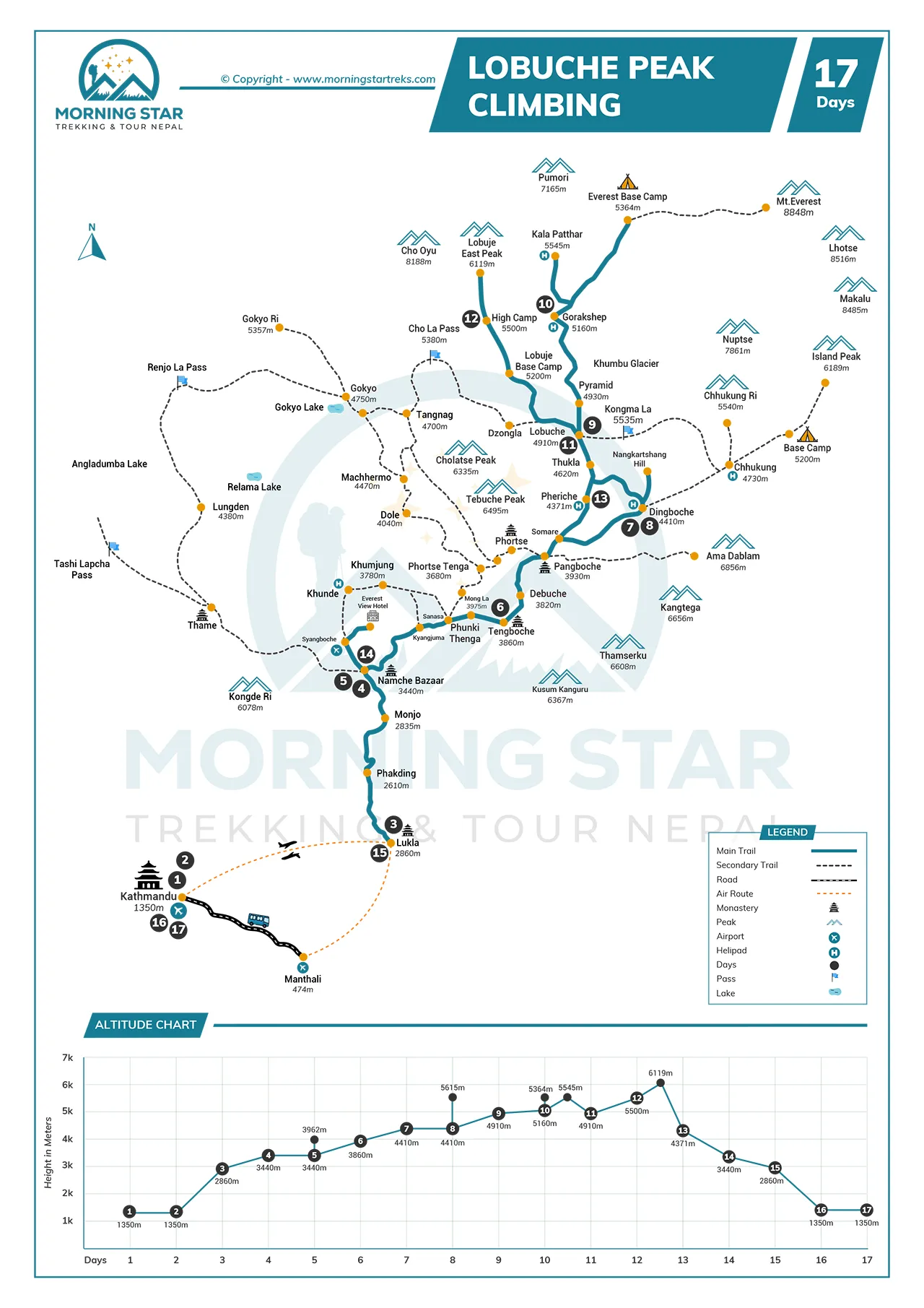
Route Map & Altitude Chart
Trip Information of Lobuche Peak Climbing
Best Season to go for Lobuche Peak Climbing
To have a successful Lobuche Peak Climbing experience, it is important to make the right choice of season. The trekking calendar of Nepal has two best seasons, spring (March to May) and Autumn (September to November). The weather is mostly stable, skies are clear, and the trails are safe; these months are ideal both to trek and climb in high altitudes.
During spring, the trails are brightened by rhododendrons and the daytime temperatures rise to 10°C to 20°C in the lower areas and -10°C to -15°C at the summit. There is great visibility, and the snow conditions on Lobuche East are usually firm, so summit attempts are more predictable. Spring is also the time of Everest expeditions, so the Khumbu region is full of energy and team spirit.
Fall, after the monsoons, is cool, dry, and dust-free with outstanding light after the rains. Temperatures are cooler than in spring, particularly at night, but skies are usually crystal clear. Autumn is a popular time to climb because it is a low-risk time to climb due to the stable weather and the lower chance of snow during summit days. Lobuche Peak Climbing in this season has one of the best views and a vibrant environment due to festivals like Dashain and Tihar.
Out-of-season climbing can be done, but not without difficulties, in winter (December to February) or monsoon (June to August) months. Winter is extremely cold, with summit temperatures falling below -20°C and an increased threat of frostbite. Monsoon season causes muddy tracks and low visibility, particularly at lower levels. Flights to Lukla are often delayed, and leeches can also be found in forested trails.
During the off-season, Lobuche Peak Climbing can be attractive to people who want to get away from the crowd, but the dangers usually overshadow the benefits. Spring and autumn have the best combination of safety, scenery, and summit success for most climbers. By planning your climb during these seasons, you will have the best opportunity of reaching the peak and the entire climb.
Difficulty Level of the Lobuche Peak Climbing and Its Preparation
The Lobuche Peak climbing is a challenging, though rewarding trek that mixes high altitude trekking and simple mountaineering. The expedition starts in the greenery of the Khumbu region and then climbs gradually to more than 6,100 meters, finishing with a summit push that takes both physical and psychological energy. The trail is steep and rugged, and days are long, which tests your endurance, as the oxygen decreases with altitude.
The last climb up Lobuche High Camp is a glacier climb with fixed ropes and a steep snowy slope that involves the use of crampons, harnesses, and ice axes. Although the climb is not as technical as that of major expedition peaks, it requires that one be familiar with alpine equipment and the capability of following guided rope systems. The weather is unpredictable, and cold winds at high altitude increase the challenge, especially during summit day, which starts early before sunrise and can take up to ten hours.
Mental conditioning is equally important as physical conditioning. Trekkers should be prepared to fight off the exhaustion, remain alert in poor weather, and adjust to the demands of altitude. Climbers are advised to start training two or three months before the expedition. The most important are cardiovascular fitness, leg strength, and endurance, as well as practice hikes that will simulate long days on uneven terrain. Altitude experience would be advantageous, but not necessary when you train regularly and when climbing with a certified guide who provides technical briefings and safety backup.
Lobuche East is not as intensive as Island or Mera Peak, but technically challenging compared to Pokalde or Yala Peak. It is an ideal option for trekkers who want to enter the field of mountaineering without making a full expedition. Lobuche Peak is a great way to feel a sense of accomplishment and to be rewarded with panoramic Himalayan views that make the effort worth it, with the right mentality, training, and assistance.
How to deal with Acute Mountain Sickness during Lobuche Peak Climbing
AMS is a common danger in such high-altitude climbs as Lobuche Peak. When you climb to a height of more than 3,000 meters, the lower oxygen levels may have an unpredictable impact on the body. The symptoms may start with headaches, nausea, dizziness, and fatigue. When not taken seriously, AMS can develop into severe cases like High Altitude Pulmonary Edema (HAPE) or High Altitude Cerebral Edema (HACE), which are both potentially life-threatening and require urgent descent and medical intervention.
Most climbing itineraries include preventative measures, which are gradual acclimatization. Rest days, hiking at high altitudes, and gradual ascent to the peak have the effect of tuning the body. Drinking lots of water, eating healthy food, and avoiding alcohol are important. Others take Diamox to assist with acclimatisation, but it should not be taken without medical advice.
Guides can detect symptoms and help during safety decision-making. In case AMS symptoms become worse, a descent of several hundred meters can help considerably. Helicopter evacuation and emergency oxygen are possible in extreme cases, especially when one is at Pheriche or Lobuche.
With care and watchfulness, Mountain Sickness is controllable. Being conscious of the altitude, attentive to the signs of your body, and putting health before the desire to reach the summit will make the climb safer and more successful.
Permits Needed for the Lobuche Peak Climbing
Lobuche Peak Climbing involves obtaining a number of official permits, each having a different use in controlling access and guaranteeing safety in the Himalayas. The most significant is the Lobuche Peak Climbing Permit, which is given by the Nepal Mountaineering Association. This permit is compulsory for anyone who tries the summit and costs differently depending on the season. It tends to be more expensive during spring and autumn, whereas in winter and monsoons it is cheaper.
Besides the climbing permit, trekkers need to have the Sagarmatha National Park Entry Permit. This gives access to the restricted area around Everest and assists in conservation. The park permit is obtainable in Kathmandu or at the entry checkpoint in Monjo. It requires a photocopy of the passport and a passport-sized photograph.
Previously TIMS card or a Trekkers Information Management System card was also required. It used to assist authorities in monitoring trekkers in terms of safety and rescue. But it is not required anymore.
Any permits should be carried along the entire trip to be shown at different checkpoints in the trail. Most trekking agencies do the paperwork on behalf of climbers, making the process easy and compliant. Without these permits, it is not possible to access important places such as Lobuche High Camp and the summit. Proper documentation not only legalizes your Lobuche peak climbing trip but also helps in the sustainable management of Nepal’s mountainous areas.
Why are Porter and Guide required in the Lobuche Peak Climbing
Lobuche Peak Climbing is not an individual one but a teamwork based on trust, experience, and mutual strength. It is important to hire a certified guide, both to be safe and the successful completion of the trek. Trekking guides take care of the trekking route between Lukla and Lobuche, managing the pace, acclimatization, and cultural insights. They understand the terrain well and may modify the route according to weather, health, and trail conditions.
When you arrive in Lobuche High Camp, the services of the climbing Sherpa are very important. These well-trained mountaineers help with rope arrangement, glacier orientation, and safety on the summit. They have experience in technical terrain and high altitude conditions that are beneficial during the last ascent. Sherpas who climb usually carry emergency equipment and watch the climbers to check whether they have altitude sickness or are tired.
The porters are the unheard heroes during the Lobuche Peak Climbing. They bring necessary items like sleeping bags, food, and equipment, so that trekkers can save energy to be used in the climb. In addition to logistics, cultural insight is provided by the guides and porters. Most are of Sherpa origin and tell of mountain life, spiritual customs, and stories from former expeditions. Their presence makes the journey more than a physical experience; it becomes a human experience.
Things to Pack for the Lobuche Peak Climbing
Lobuche Peak Climbing Packing should be carefully planned and layered. The trek covers all the way through the warm valleys and the frozen high peaks, so climbers should be prepared to face a whole variety of conditions. Your clothing should be based on moisture-wicking base layers, insulating mid-layers such as fleece or down, and a waterproof outer shell to block the wind and snow. A down jacket is vital during the cold nights and summit day, and insulated gloves and thermal leggings are important to keep the cold at bay.
Footwear is essential. Sturdy, well-worn trekking shoes are required on the lower trails, and compatible mountaineering boots are necessary on the final climb. The necessities would include wool socks, gaiters, and a pair of camp shoes to wear in the evenings. The headwear must have a sun hat, a warm beanie, and a buff or balaclava in case of wind.
Technical equipment consists of a climbing harness, helmet, crampons, ice axe, and carabiners. A lot of this gear can be hired in Kathmandu or offered by your trekking company. A head lamp with additional batteries is essential when starting early to summits, and trekking poles come in handy to reduce the impact on knees when descending.
Personal items may consist of a sleeping bag rated -15°C or colder, a quick-dry towel, toiletries, sunscreen, lip balm, and a small first aid kit. It is recommended to bring water purification tablets or a filtration bottle and snacks with high energy: nuts, chocolate, and granola bars. Electronic items include a power bank, a camera, a GPS watch, etc., but there are few charging points above Dingboche, so bring your chargers.
A large duffel bag should be in the backpack with a daypack to be used personally. The daypack must bring water, layers, snacks, and necessities for every trekking day. Waterproof covers are utilized to guard equipment against random rain or snow. Smart packing for Lobuche Peak Climbing entails a balance between weight, warmth, and utility. Each should have a purpose and each gram should have its justification.
Importance of Insurance during the Lobuche Peak Climbing
Insurance is an important aspect of any high-altitude trek, and in the case of Lobuche Peak Climbing, it is not just a good idea, but a must. The expedition includes trekking and mountain climbing in inaccessible locations with high altitude, where medical care is limited and evacuation is both expensive and time-consuming. A good travel insurance cover will cover you against unforeseen circumstances like altitude sickness, injury, flight cancellations, or an emergency helicopter evacuation, like in Lobuche or Pheriche.
In Lobuche Peak Climbing, altitude-related illnesses such as AMS can develop rapidly, and air evacuation might be the only possible way to save the life of the victim. In the absence of insurance, such procedures may cost thousands of dollars and have to be paid out of pocket. Insurance also has provisions for hospital treatment, trip interruption, and loss or damage of gear, which ensures peace of mind during the expedition.
In order to get coverage, climbers must buy a policy prior to arriving in Nepal, with coverage that includes high-altitude trekking and mountaineering up to at least 6,500 meters. The procedure usually involves providing your itinerary, travel dates, and personal information. Most of the policies are purchased online and do not involve any physical document.
Food & Accommodation on Lobuche Peak Climbing
The food and accommodation along the Lobuche Peak trail are meant to facilitate the trekkers and climbers as they rise and fall in altitude and energy levels. In smaller villages such as Lukla, Phakding, and Namche Bazaar, teahouses serve a range of meals that include: dal bhat (lentils, rice, and vegetables), fried noodles, pasta, eggs, and pancakes.
These are basic meals that are carbohydrate and calorie-heavy, which is necessary during trekking. The higher you go, the more limited the menus you get because of the remoteness, though you still get your staples such as soups, potatoes, and rice. Fluids are essential and thus warm drinks such as ginger tea, garlic soup, and hot lemon are prevalent.
Accommodation is largely in teahouses, which are simple lodges with twin beds, shared toilets, and communal dinner rooms. Blankets are available, but recommended sleeping bags are advisable. At Lobuche Base Camp, climbers change to tent camps. These have expedition-standard sleeping, with foam pads and sleeping bags. Dinners in base camp are cooked by support staff and are high-altitude-friendly–soups, porridge, energy-dense snacks.
Most Asked Questions
 General
What is the height of Lobuche East Peak?
Lobuche East stands at 6,119 meters above sea level.
Is Lobuche Peak Climbing suitable for beginners?
Yes, it’s ideal for fit trekkers with basic mountaineering skills and proper guidance.
How long does the Lobuche Peak Climbing itinerary take?
The standard itinerary takes 17 days from arrival to departure.
Do I need prior climbing experience for Lobuche Peak?
No technical experience is required, but high-altitude trekking experience is recommended.
What permits are required for Lobuche Peak Climbing?
You’ll need a Lobuche Peak permit and, Sagarmatha National Park entry permit.
What is the best season to climb Lobuche Peak?
Spring (March–May) and autumn (September–November) offer the best conditions.
How difficult is Lobuche Peak Climbing?
It’s a moderately challenging trek.
Is altitude sickness common on this climb?
Yes, AMS is a risk above 3,000m, but proper acclimatization helps prevent it.
Can I visit Everest Base Camp during this itinerary?
Yes, the route includes a visit to Everest Base Camp and Kalapatthar.
Are meals included during the Lobuche Peak Climbing?
Yes, most packages include three meals a day throughout the trek.
Is Wi-Fi available during the trek?
Wi-Fi is available in lower villages for a fee, but is limited at higher altitudes.
Can I charge my devices on the trail?
Yes, charging is available in teahouses for a small fee.
Do I need travel insurance for this climb?
Yes, insurance covering high-altitude trekking and emergency evacuation is essential.
What gear do I need for Lobuche Peak Climbing?
You’ll need mountaineering boots, crampons, a harness, and a helmet.
Can I rent climbing gear in Nepal?
Yes, most technical gear can be rented in Kathmandu or arranged by your guide.
How cold does it get near the summit?
Temperatures can drop below -15°C to -20°C during summit day.
Are guides and porters included in the package?
Yes, certified guides and porters are typically part of the climbing team.
Is helicopter evacuation available if needed?
Yes, emergency evacuation is possible from key points like Pheriche or Lobuche.
What makes Lobuche Peak Climbing unique?
It combines technical climbing with Everest views and rich Sherpa culture in one journey.
- Safety first, always
- Best prices guaranteed
- Expert travel team
- Easy booking, no extras
- Customize your journey
Based on 10 reviews
Have Questions?
+977 9767224414