
 English
 Dutch
Dutch Japanese
 Hindi
Hindi Italian
 Spanish
 French
 German
 Chinese
 Korean
 Arabic
 Hebrew
 Russian
 Portuguese
 Danish
 Czech
Czech Polish
 Swedish
Have Questions?
+977 9767224414
Unmissable holidays deals - Save up to 20%
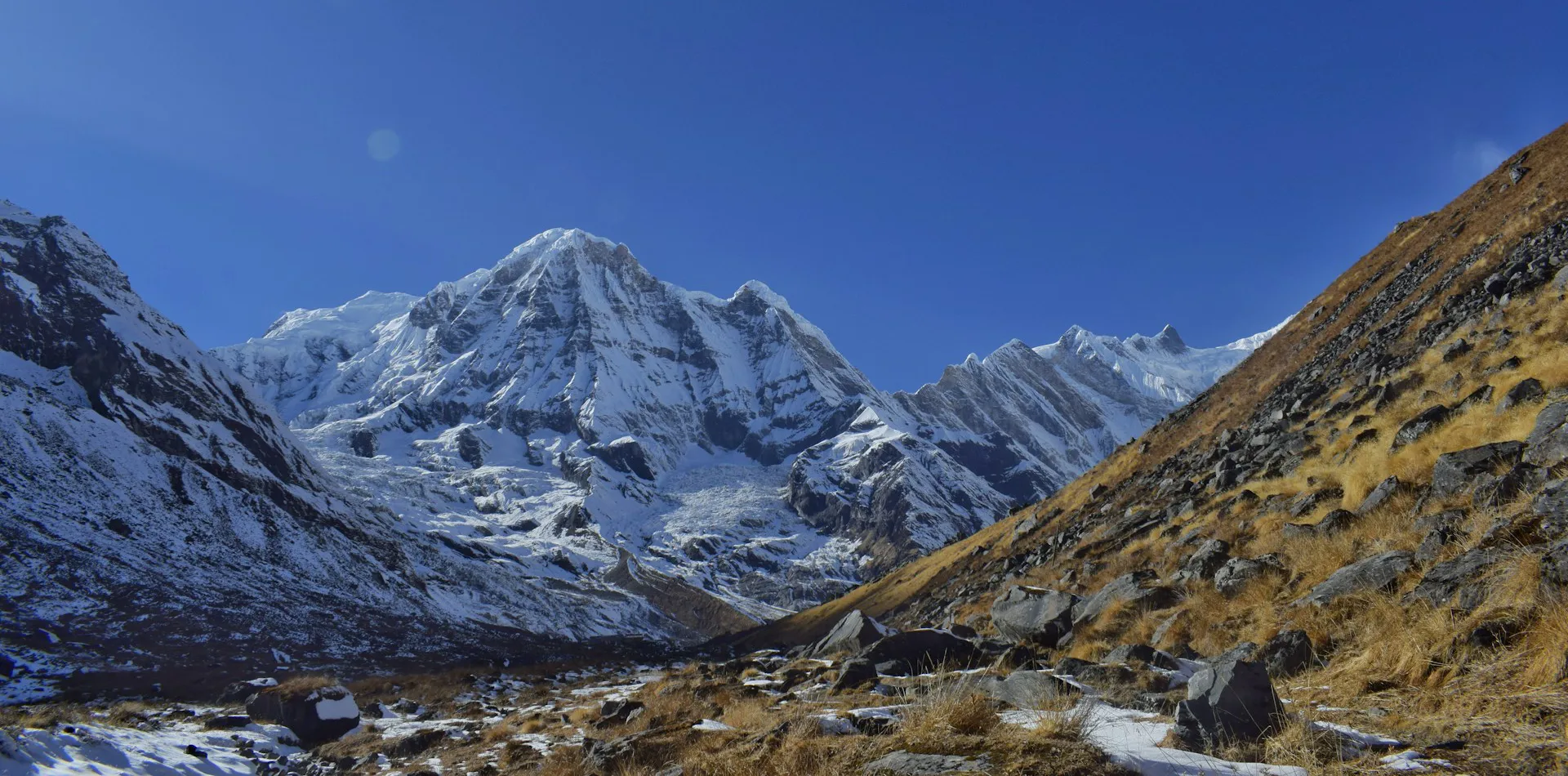
Short Annapurna Base Camp Trek

Duration
7 Days

Trip Difficulty
Moderate

Max. Altitude
4,130m

Destination
Nepal

Group Size
2-16 People

Accommodation
Hotel, Teahouse

Transportation
Tourist Bus

Meals
B L D
Explore more facts about the trip
Overview of Short Annapurna Base Camp Trek
The Annapurna area of Nepal is among the most popular trekking regions. It is full of rich culture, green valleys, terraced fields, and high snow peaks. The Annapurna Base Camp trek is renowned amongst all the treks here in terms of its combination of beauty, accessibility, and cultural experience.
The 7-day Short Annapurna Base Camp Trek is a variation of the original 10 to 12 days trek. This walk takes the shortest possible route to the base camp instead of the long circuits. You will be at the core of the Himalayas, 4,130 meters high, in under one week.
This is the trip to go on in case one has limited time and wishes to get a big Himalayan experience. It needs average fitness and should walk for 5 to 7 hours daily, not technical climbing ability. Through the beautiful Gurung villages, thick forests, and river valleys, the trail leads to the Annapurna sanctuary.
Mountain views are the greatest attraction of the Short Annapurna Base Camp Trek 7 Days. Annapurna I, Machhapuchre, Hiunchuli, and Gangapurna are all cloaked around the base camp. A sunrise view in this place is usually cited as one of the most beautiful in Nepal.
The peculiar feature of Short Annapurna Base Camp Trek is the diversity of the landscapes within a limited time. You pass through subtropical warm forests and bamboo groves to the alpine fields and glaciers in a span of one week. Few treks in the world offer this much contrast in such a short time.
Another attraction is the cultural encounter. Ghandruk and Chhomrong are some of the villages that present you with the Gurung traditions, domestic hospitality, and traditional buildings. Such exchanges provide warmth to the adventure and give the trek a better memory.
Morning Star Trek experienced operators help to make the journey a lot easier and comfortable. Even first-time trekkers are able to go through the adventure safely by having professional guides, proper planning, and local knowledge.
In a recap, the Short Annapurna Base Camp Trek 7 Days is an ideal time-wise, difficulty-wise, and reward balance. It is crafted to fit time-constrained travelers, moderate trekkers, and is laden with natural and cultural attraction spots.
- Safety first, always
- Best prices guaranteed
- Expert travel team
- Easy booking, no extras
- Customize your journey
Based on 10 reviews

Trip Highlights
- View spectacular mountains: Annapurna I, Machhapuchre (Fishtail), Annapurna South, Hiunchuli, Gangapurna, Annapurna III, and Khangsar Kang.
- Visit Gurung villages like Ghandruk and Chhomrong, rich in culture, architecture, and local hospitality.
- Walk through terraced fields, rivers, bamboo forests, rhododendron trails, and alpine meadows.
- Enjoy close-up mountain views at Machhapuchre Base Camp.
- Reach Annapurna Base Camp (4,130m) for incredible Himalayan scenery.
- Relax in the natural hot springs at Jhinu Danda by the Modi River.
- Stay in teahouses with meals, twin rooms, and meet other trekkers.
- Try local food like Dal Bhat, noodles, and soups.
- Take photos of mountains, forests, rivers, and village life.
- Learn about the rural Nepalese lifestyle, farming, and traditions.
Photo and Video Gallery


Short Annapurna Base Camp Trek Detail Itinerary

Day 01: Drive from Pokhara to Nayapul and Trek to Ghandruk
The expedition begins with a 1.5-hour car journey between Pokhara and Nayapul, the gateway to the trek. Here, the path enters the Birethanti checkpoint and progressively ascends above Sauli Bazaar and Kimche. The route takes the terraced land and the villages through which one gets an idea of the rural community in the Annapurna region.
A long walk of 5-6 hours brings you to a large Gurung village known as Ghandruk, with its culture and traditions. This is where the views of Annapurna South (7,219 m), Hiunchuli (6,441 m), and Machhapuchre (6,993 m) help the first day to pay off. Also, in dry season, jeep can reach upto Siwai/Jhinu/Matque which can shorten this day.

Activity: 5-6 hrs trek

Max. Altitude: 1,940m/6,365ft. (Ghandruk)

Meal: Breakfast, Lunch & Dinner

Accommodation: Hotel
Day 02: Trek to Chhomrong
The day begins with a downward journey from Ghandruk to Kyuri Khola, and a gradual climb up to Kimrong Danda. It crosses terraced lands, villages, and the hills, where one has a lovely view of the mountains that are beyond. In 5-6 hours, trekking, you arrive at Chhomrong, a Gurung village which acts as the entry point to Annapurna Base Camp.
Chhomrong gives you a cultural insight into the Gurung people, their olden-day houses, and their locality. The village is at an elevation of 2,170 meters, thus a perfect location to acclimatize. As you walk through this region, you will be able to see how the low forests change into more of the alpine-like vegetation as you ascend in altitude.
Activity: 5-6 hrs trek
Max. Altitude: 2,170m/7,119ft. (Chhomrong)
Meal: Breakfast, Lunch & Dinner
Accommodation: Lodge
Day 03: Trek to Himalayan
Out of Chhomrong, the path goes down a little to Chhomrong Khola, then up to Khuldighar at 2,380 meters. The trail then runs through thick bamboo groves and rhododendron thickets, providing shade and scenic beauty on its way. In 5-6 hours, you arrive at the Himalayan Hotel at 2,920 meters and can relax and see the views around.
This part of the trail is relatively difficult because of the numerous ups and downs. The combination of nature tracks and cleared roads offers an adventure and comfort mix. The trekkers are refreshed and rewarded by the changing vegetation and fresh mountain air.
Activity: 5-6 hrs trek
Max. Altitude: 2,920m/9,580ft. (Himalayan)
Meal: Breakfast, Lunch & Dinner
Accommodation: Lodge
Day 04: Trek to Annapurna Base Camp via Machhapuchre Base Camp
This hike begins at the Himalayan Hotel, then proceeds to the Hinku Cave and Deurali. Then, the path leads to the Machhapuchre Base Camp (3,720 meters), where the visitors can see the close-ups of the famous peak. After a 6-7 hour walk further you arrive at Annapurna Base Camp at 4,130 meters.
Gangapurna, Machhapuchre, Annapurna III, and Annapurna I are towering giants that surround you at ABC. It is a combination of snow, glaciers, and alpine landscape, which gives the pictorial panoramic views. There are a number of teahouses where the trekkers rest, eat, and admire the view at ABC.
Activity: 6-7 hr trek
Max. Altitude: 4,130m/13,550ft. (Annapurna Base Camp)
Meal: Breakfast, Lunch & Dinner
Accommodation: Lodge
Day 05: Trek to Bamboo
Leaving ABC, the path goes down slowly via Machhapuchre Base Camp and Deurali. The path traverses tropical bamboo and mountainous plants, a smooth stroll following the greater altitudes trek. After 5-6 hours, you reach Bamboo Village, located at 2,350 meters, where you will spend the night in teahouses.
This part is not as difficult as the climb to ABC, so the trekkers can view the mountain at a slow pace. The journey via woody trails makes it a fruitful day, even as it displays the beauty of the Annapurna region.
Activity: 5-6 hrs trek
Max. Altitude: 2,350m/7,710ft. (Bamboo)
Meal: Breakfast, Lunch & Dinner
Accommodation: Lodge
Day 06: Trek to Jhinu Danda
It starts with a short hike through the Bamboo to Sinuwa at 2,320 meters, then a downward trail to Chhomrong. At Chhomrong, a trail goes off to Jhinu Danda in 5-6 hours of journey. In the process, the trekkers will cross through forested roads, terraced lands, and tiny villages.
There is also the Jhinu Danda that has natural hot springs along the Modi River. This gives an ideal chance to rest strained body muscles after several days of trekking. The village has plain teahouses where one can stay overnight and have meals, thus a good break before the last descent.
Activity: 5-6 hrs trek
Max. Altitude: 1,780m/5,840ft. (Jhinu Danda)
Meal: Breakfast, Lunch & Dinner
Accommodation: Teahouse
Day 07: Trek to Nayapul and Drive to Pokhara
On the last day, the route goes along the Modi Khola River for 5-6 hours, through the village of Birethanti, to the location of Nayapul. You can also take jeep which can shorten the time by 4-5 hours. Trekkers can also drive back to Pokhara in Nayapul, and this completes the Short Annapurna Base Camp Trek 7 Days.
This final part is primarily downhill, and it is possible to take a leisurely pace and see the last views of the other mountains around. The expedition results in a feeling of achievement and unforgettable experiences in the Himalayas.
Activity: 5-6 hrs trek
Max. Altitude: 820m/2,690ft. (Pokhara)
If our standard itinerary doesn't fully meet your needs, we are happy to tailor it to your specific preferences and requirements.

Includes and Excludes
What’s Included?
- Private vehicle transport between Pokhara and Nayapul, both ways
- Hotel accommodation in Pokhara before and after the trek
- Comfortable teahouse or lodge accommodation during the trek (twin-sharing)
- Breakfast in Kathmandu hotel, and three meals (breakfast, lunch, dinner) each day during the trek
- Professional, English-speaking trekking guide and required porters
- Trekking guide salary, insurance, meals, accommodation, equipment, transportation, etc.
- Seasonal fresh fruit during the trek
- All necessary trekking permits and national park entry fees
- Basic medical kit and safety equipment during the trek
- Sleeping bag, down Jacket, walking poles, duffel bags (you have to return after the trek)
- Certificate of achievement at the end of the journey
- Government taxes and agency service charges
What is not Included?
- International flights to and from Nepal
- Nepal entry visa fees upon arrival
- Lunch and dinner in Pokhara
- Personal expenses such as drinks, snacks, hot showers, Wi-Fi, and device charging
- Travel insurance that covers medical emergencies and helicopter evacuation
- Tips for guides, porters, and drivers
- Extra hotel nights caused by flight delays, early arrival, or late departure
- Personal Travel insurance and emergency rescue evacuation
- Extra cost caused by natural or political disturbances beyond our control
Route Map & Altitude Chart
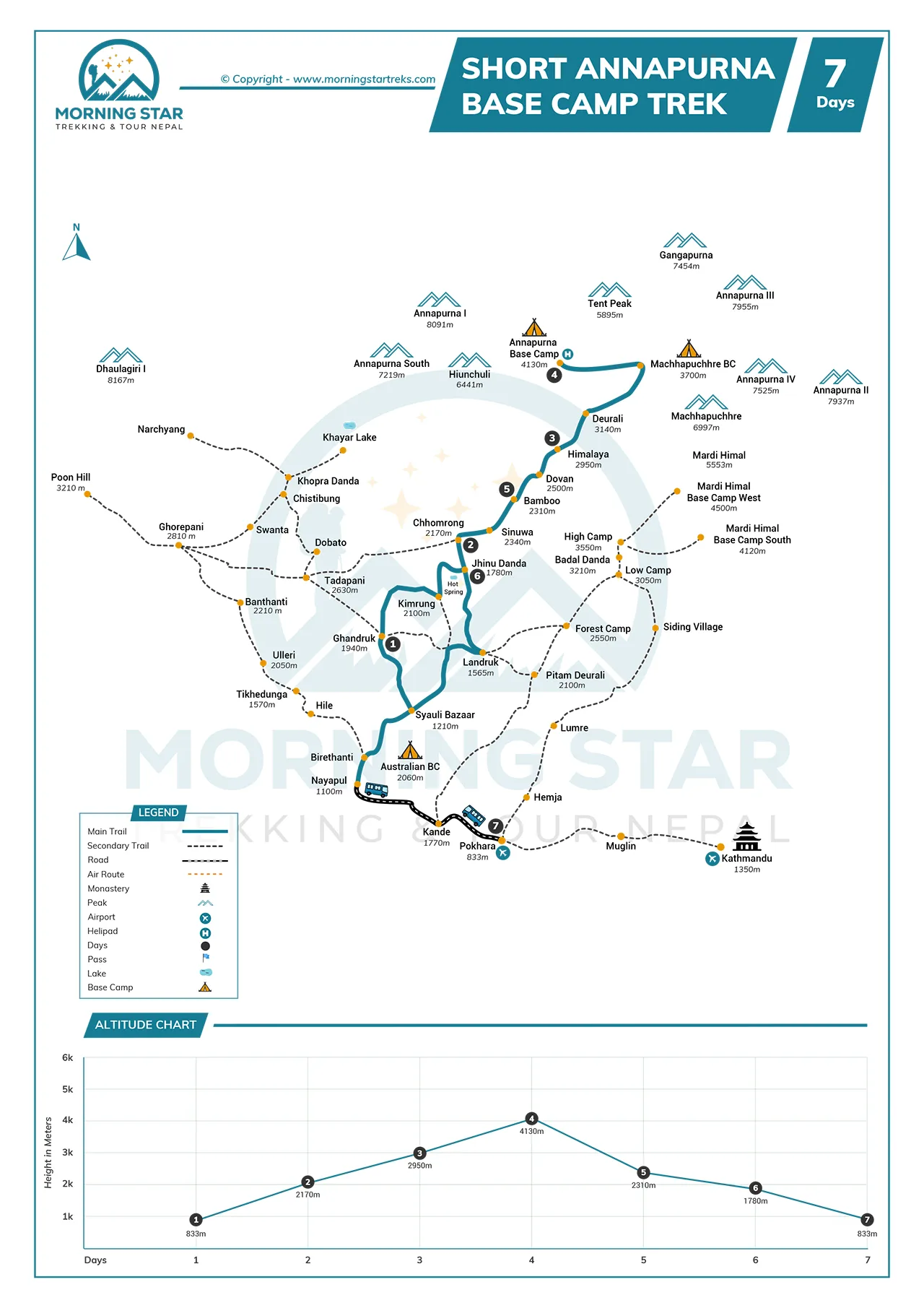
Trip Information of Short Annapurna Base Camp Trek
Best Time
The Short Annapurna Base Camp Trek 7 Days is preferably done in the spring (March to May) and autumn (September to November). These seasons are clear, moderate, with great mountain views. The paths are mostly dry and secure, and therefore trekking is more comfortable and pleasant.
Spring is the best season for lovers of nature. Between March and May, the area is blanketed with blooming rhododendron and greenery. The climate is cool, and the mountains are distinctly seen. Nevertheless, it might rain occasionally, and lower hiking trails might be muddy; hence, trekking shoes are advised.
The most trekking season is said to be autumn, which falls between September and November. The monsoon is gone, and fresh air and clean mountain views are left. The skies tend to be clear and give spectacular panoramas of the Annapurna, Machhapuchre, and other nearby mountains. The bad thing is that it is also the busiest season on the trails, and therefore, teahouses and places to stay might be full.
Winter (December to February) is not the best season because it is colder with snow at elevations at times. Summer (June to August) is the monsoon, and the trails are slippery, leeches are present, and visibility due to clouds is low.
The spring and autumn months are the most ideal season to be in as they have the ideal weather, visibility, and trail conditions to achieve the optimum results in the case of the Short Annapurna Base Camp Trek 7 Days.
Elevation and Distance
Short Annapurna Base Camp Trek 7 Days begins at Pokhara, 820 meters above sea level, and goes up to Annapurna Base Camp, 4,130 meters. This step-by-step ascent enables trekkers to acclimatize as they get to see a variety of landscapes in the process.
The total distance is about 60-80 kilometers, the distance to the ABC plus the trip back. The daily hikes differ in length and level of altitude gain, and certain days may include some steep ascents while other days may be more gradual. That is why the trek is reachable by average travelers.
The daily ups and downs are aimed at a balanced difficulty and ease. In the example, the first day is the ascent of 1,050 meters starting at Nayapul to 1,940 meters at Ghandruk, and further days have more elevated climbs to Machhapuchre Base Camp (3,720m), all the way up to ABC. Downward days, like returning to ABC to Bamboo or Jhinu Danda, are a pleasant relief and less walking after trekking on higher altitudes.
Being familiar with the change in elevation and distance assists trekkers in preparing against the impact of physical activities and altitude. To enjoy the ride, proper pacing should be done, and one should take a rest. The route is a combination of hills, forests, and rivers that will make the entire adventure last 7 days.
Difficulty and Altitude Sickness
The 7-Day Short Annapurna Base Camp Trek is said to be moderate trip. Trekkers are not technical in terms of climbing, but one needs to be reasonably fit. The average range of walking hours is 5 to 7 days with different landscapes such as hills and river banks, and rocky paths.
The Short Annapurna Base Camp Trek is progressively rising in altitude, where acclimatization can be done in the process. Beginning at 1,050 meters at Nayapul, and climbers ascending to 4,130 meters at Annapurna Base Camp, the body adjusts to the varying altitude provided one paces well. This slow, gradual uphill means that most of the trekkers are not exposed to altitude-related problems.
Altitude Sickness or Acute Mountain Sickness (AMS) may take place at altitudes over 2,500 meters. The typical ones are headache, nausea, dizziness, and fatigue. Severe cases are uncommon, yet they may occur in cases of rapid ascending or disregard of warning signals. You should pay attention to your body and go down in case the symptoms get worse.
The precautions can be taken by drinking lots of water, avoiding alcohol, walking slowly, and having rest intervals. Other trekkers bring AMS medication, which requires a prior consultation with a physician.
It is possible to mitigate such risks by opting to use a guided walk with seasoned guide companies like Morning Star Trek. Guides control health, pace, and acclimatization, and therefore render the trek safer to first-time trekkers.
Maximum and Minimum Walk per Day
In the Short Annapurna Base Camp Trek 7 Days, walking hours will differ based on the path and the altitude variation. There is a trekking day of an average of 5 hours, and the maximum trekking day is 7 hours. This diversity gives trekkers the chance to enjoy the easy walk and harder climbs in the course of the journey.
Nayapul to Ghandruk is usually a 5–6-hour introduction to the trek. Longer days, like the hiking to the Annapurna Base Camp, include 6-7 hours of walking over steep trails and rocky routes. These are longer days and rewarding views of the mountains as the reward for the effort.
One of the characteristics of the trek is terrain variation. The walks follow terraced fields, forest walks, bamboo groves, river banks, and so on. There are flat and easy sections and steep ascents or descents. This combination makes the trek captivating, and survivalists get to see the variety of the Annapurna region.
Knowing the difference between the walking times and the terrain assists in the planning and pacing. The right preparation, suitable footwear, and a gradual pace make sure that shorter and longer hiking days are pleasant and within the reach of a moderately fit person.
Accommodation
On the route of the Short Annapurna Base Camp Trek 7 Days, the place of rest is primarily in teahouses and lodges. These offer simple services, such as food, hot showers (where applicable), and a place to sleep after big trekking days. By staying in teahouses, the trekkers will have the opportunity to learn about the hospitality of locals and other travellers.
Rooms are generally plain twin-sharing, wooden or brick-built, with a bare minimum of furnishings. There are bed/rolls, though a sleeping bag is advisable, particularly at elevated altitudes where the nighttime temperatures become much lower. Certain lodges have individual rooms at a premium, although this may not be very much.
Generally, there is accommodation all over the trail, although the experience differs depending on the season. Teahouses may be full during peak seasons in trekking, like spring (March-May) and autumn (September-November). It is therefore recommended to book early or arrive early. During the off-season, the number of trekkers is low and rooms are not difficult to obtain, but not all facilities are active.
The possible choice to remain in teahouses lets one experience local culture, have traditional dishes, and sleep comfortably before the following day’s trek. It is a special combination of comfort and the local culture that the Annapurna Base Camp trekking experience offers.
Food and Drink
The teahouses and lodges along the Short Annapurna Base Camp Trek 7 Days have a diverse variety of meals that are available to the trekkers. The main meal is Dal Bhat, a Nepali meal, which is rice, lentil soup, and vegetables that give strength to work on long trekking days. Alternative foods are noodles, soups, and plain continental foods.
There is a proliferation of vegetarian meals along the trail. Lodges and teahouses can usually make a tailored vegetarian menu on demand so that even non-meat eaters can still get a balanced diet. There are also hot beverages such as tea, coffee, and cocoa as a way of cooling the cold mornings and evenings.
Water consumption must be done cautiously at high altitudes. Lodges normally supply bottled, boiled, or filtered water. Trekkers should always carry a refillable bottle and water purification tablets or filters so that they can ensure that they remain hydrated during the trek.
In general, the food on Short Annapurna Base Camp Trek is basic yet healthy and helps to maintain the energy level, as well as providing trekkers with an idea of local cuisine and Himalayan hospitality.
Alternative Routes
The Short Annapurna Base Camp Trek 7 Days takes the straight route via Ghandruk and Chhomrong, but there are also other routes available to the trekkers who are willing to have longer experiences in the forest. The more frequently used one is the extended one through Ghorepani-Poon Hill, which has added spectacular views of the sunrise and panoramas to the itinerary. The path also opens up other villages and forests, and the journey becomes more picturesque and culturally diverse.
The other option is the Mardi Himal trek that they can do in addition to the ABC for those who have additional days. It is a trail which cuts across thick forests, meadows in the Alps, and small villages before joining the main trail of ABC. It has fewer-traveled trailways and inimitable mountain vistas, such as those of Mardi Himal and Annapurna South.
These other paths are more flexible options that Trekkers are able to take to have a longer and more varied adventure. They may be selected by the criteria of fitness, time, and the kind of experience that one wants, and yet arrive at the iconic Base Camp of Annapurna.
Can a Beginner Join This Trek?
Yes, the Short Annapurna Base Camp Trek 7 Days is fitting for novice hikers with fair fitness. No technical skills are required during the trek, and therefore it is open to first-time trekkers. The majority of the trails are clearly marked, and teahouses along the trail give you a rest stop and meals so beginners can take their time.
The hike is planned with slow uphills and comfortable daily walks, which makes the novice oriented to the highland and enjoy the view. Although the altitude is at 4,130 meters at the Annapurna Base Camp, with proper pacing and acclimatization, the trek becomes easy without any serious challenges.
The beginners need to look at simple fitness preparation, including daily walking, light jogging, or climbing stairs, to enhance leg and cardiovascular endurance. Correct trekking shoes and proper equipment also assist in the management of rocky and uneven surfaces.
The beginners who book the trek can be greatly helped by the experienced trek operators like Morning Star Trek. Guides are also helpful, offering pacing tips and carrying out health checks that make it a safer and more enjoyable experience.
With proper planning and slow development, even novice trekkers will be able to finish the Short Annapurna Base Camp Trek in 7 Days and enjoy the breathtaking scenery in the Himalayas, cultural experience, and feeling of achievement.
Preparation and Fitness
The Short Annapurna Base Camp Trek 7 Days requires preparation to make the experience safe and enjoyable. Although the trek is moderate in difficulty, stamina and strength developed before the expedition make the expedition less difficult and more comfortable.
The cardiovascular exercise is strongly advised. Exercises, jogging, brisk walking, cycling, or swimming, increase stamina during long trekking days. Target at least 30-45 minutes of cardio, 3-4 times a week, to develop the required stamina to ensure every day of ascents and descents.
Strength is also critical as far as legs are concerned. Squats, lunges, step-ups, and stair climbing exercises can be used to strengthen the muscles that are important during hiking uphill and downhill. Balance and stability on uneven trails can be enhanced by including core exercises such as planks and crunches.
The endurance is also strengthened through a weighted backpack, which is practiced in walking for several hours, to mimic the conditions of trekking. Slowly add weight to train the body to carry water, snacks, and warm-ups, which are necessities.
Gear preparation is crucial. The necessary items are comfortable trekking boots, trekking poles, clothing of different temperatures, a warm jacket, protection against rain, gloves, and a hat. A comfortable backpack, water bottle, and simple first-aid kit are also suggested.
It is important to be physically and mentally fit as well as to possess the appropriate equipment so that trekkers can concentrate on the magnificent views, cultural experience, and the accomplishment of reaching the Annapurna Base Camp. The right preparation will make the Short Annapurna Base Camp Trek 7 Days a safe and memorable experience.
Gadget Charging, Internet, and Communication
Charging of gadgets in most teahouses and lodges along the Short Annapurna Base Camp Trek 7 Days is normally offered at an additional fee. Power is also restricted, particularly at higher altitudes; hence, a portable power bank is highly recommended.
Some lodges have access to the Internet via Wi-Fi, which has a slow and variable connection. Essential communication or a quick update is better on the internet than heavy downloads or streaming.
Mobile networks such as NTC and Ncell have coverage in most of the villages along the trail with basic calls and text messages. But network strength may be poor or unreachable in remote locations or in deep valleys, so prepare.
Trekkers are advised to expect low connectivity and plan disconnected maps, offline entertainment, and a fully charged device. This will enable a better experience in the Annapurna region, although there is little communication, as well as a safe and connected experience when it is required.
Permit
All trekkers are required to acquire the Annapurna Conservation Area Permit (ACAP) which cost NPR 3,000 to trek the Short Annapurna Base Camp Trek 7 Days. The permit assists in conserving the environment, wildlife, and surrounding communities in the Annapurna region. ACAP fees help with conservation and trail, and facility upkeep.
Trekker must have a Trekker’s Information Management System (TIMS) card which cost NPR 2,000 in addition to ACAP. It is a safety measure card, which monitors all registered trekkers in the area. It guarantees adequate control in case of an emergency and permits the authorities to give help when necessary.
In Pokhara, one can acquire the permits at the ACAP office or with authorized trekking agents such as Morning Star Trek. The paperwork is usually taken care of by Trekking agencies and thus is a lot easier and faster. The citizens of the world and Nepal are charged at varying rates, and as such, the existing rates should be verified before embarking on the trek.
Carry your permits with you at all times when doing the trek because, at times, there are checkpoints on the way, and they may request to see your permits. Sound permits will guarantee a hassle-free, legal, and risk-free trekking experience, besides promoting the conservation of the Annapurna environment.
Transportation
Short Annapurna Base Camp Trek 7 Days starts with a trip to Nayapul by road in Pokhara, where the trail starts. It is about 70 km. It is about 1.5 to 2 hours back and forth, based on the road conditions. The path cuts across beautiful hills, rivers, and little villages where trekkers are provided with a view of rural living in the Annapurna region.
Trekkers have the option of either having their own vehicle or taking a local bus. Vehicles owned privately are comfortable, flexible, and fast. They are best suited to the traveler who travels with companies or additional baggage. The local buses are cheaper and more of a local experience, but they may be slower and less comfortable.
It is advisable to be at Nayapul early in the morning in order to arrive there on time and begin the trek without hurrying. Mostly, the roads are in good condition, although they may slow down or get bumpy during the monsoon.
The proper planning of transportation makes the start of the trek smooth. The Nayapul is accessible by both private and public means, giving the trekkers a chance to start the Short Annapurna Base Camp Trek 7 Days comfortably and on time.
Insurance
Those who are trying to do the Trek Short Annapurna Base Camp Trek 7 Days need trekking insurance. This walk is in isolated places and places of elevation, where anything can happen around, like sickness, injury, or accidents. Insurance covers the journey with the insurer protecting money and mind.
A proper trekking insurance policy must encompass medical emergencies, such as altitude sickness, which would occur over 2,500 meters. There should also be coverage of hospitalization, medication, and treatment in case of trail injury.
The coverage of evacuation is vital, because in remote locations it may be complicated and costly to access the medical facilities. Helicopter rescue or stretcher evacuation are part of many policies if a trekker falls seriously ill. This provides quick aid and minimizes the threats related to high-altitude climbing.
When beginning the trek, be sure that your policy is valid there and specifically covers trekking up to 4,130 meters at Annapurna Base Camp. Also, maintain a duplicate of the insurance forms with you and provide information to the guides or trekking agencies, like Morning Star Trek, to be even safer.
Trekking insurance is a preventative care that protects health, money, and general fun. It enables trekkers to concentrate on the adventure as they tour the beautiful Annapurna region without unnecessary worry.
What to Expect
The Short Annapurna Base Camp Trek 7 Days is currently a breathtaking sight of the Himalayas, including terraced fields, forest-covered areas, and snow-capped mountains. Trekking will be a mix of sceneries; rivers, bamboo groves, and alpine meadows will all have their share in making each day a visual delight. The opinions of the Annapurna I, Machhapuchre, and other surrounding peaks are panoramas that imprint unforgettable memories.
Local culture accompanies the trail. Other villages, such as Ghandruk and Chhomrong, have traditional Gurung ways of life, buildings, and hospitality. By staying in teahouses, it is possible to meet local people and fellow travelers to make the experience more enriching culturally as well as in terms of the natural landscape.
The weather in the Annapurna region is unpredictable. Blue skies can be transformed to clouds, rain, or snow in a short time, according to the season and altitude. Trekkers are advised to expect weather changes, particularly at high altitudes, and to have layered materials to cover them during the process.
The walk is not too difficult, yet can be done by persons with moderate fitness. Walking 5-7 hours a day, slow uphill paths, and steep paths here and there challenge the stamina and bring the most satisfying rewards of panorama and a feeling of achievement to the trekker. By hiring skilled operators, e.g., Morning Star Trek, the trek will be led, safe, and assisted.
A blend of adventure, natural beauty, and cultural experience will be experienced, and this short trek is a memorable Himalayan experience.
Most Asked Questions
 General
When is the right time to go on with the trek?
Clear skies, moderately cool weather (spring, March-May), and mountain views at their best are available in spring (March-May) and in autumn (September-November).
Do I need a guide?
The trail is marked with signs, but still, a guide provided by an accredited operator, such as Morning Star Trek, assists with the speed, protection, and local knowledge.
Is Wi-Fi available?
Some teahouses have Wi-Fi, but the speed is slow and erratic. Plan for limited connectivity along the trek.
What gear should I pack?
Among the necessary things are trekking boots, layered clothes, trekking poles, a warm jacket, gloves, a hat, a water bottle, and a simple first-aid kit.
Can I do the trek solo?
Solo trekking without licensed guide is not allowed.
What about permits?
Trekkers require an ACAP permit and a TIMS card, which is available in Pokhara or with trekking agencies.
How challenging is the trek?
The expedition is moderate in nature, and daily walks of 5-7 hours, including gradual acclimatization to greater altitudes.
Should I have trekking insurance?
Yes, medical emergency, altitude sickness, and evacuation insurance are very necessary.
- Safety first, always
- Best prices guaranteed
- Expert travel team
- Easy booking, no extras
- Customize your journey
Based on 10 reviews
Have Questions?
+977 9767224414