
 English
 Dutch
Dutch Japanese
 Hindi
Hindi Italian
 Spanish
 French
 German
 Chinese
 Korean
 Arabic
 Hebrew
 Russian
 Portuguese
 Danish
 Czech
Czech Polish
 Swedish
Have Questions?
+977 9767224414
Unmissable holidays deals - Save up to 20%
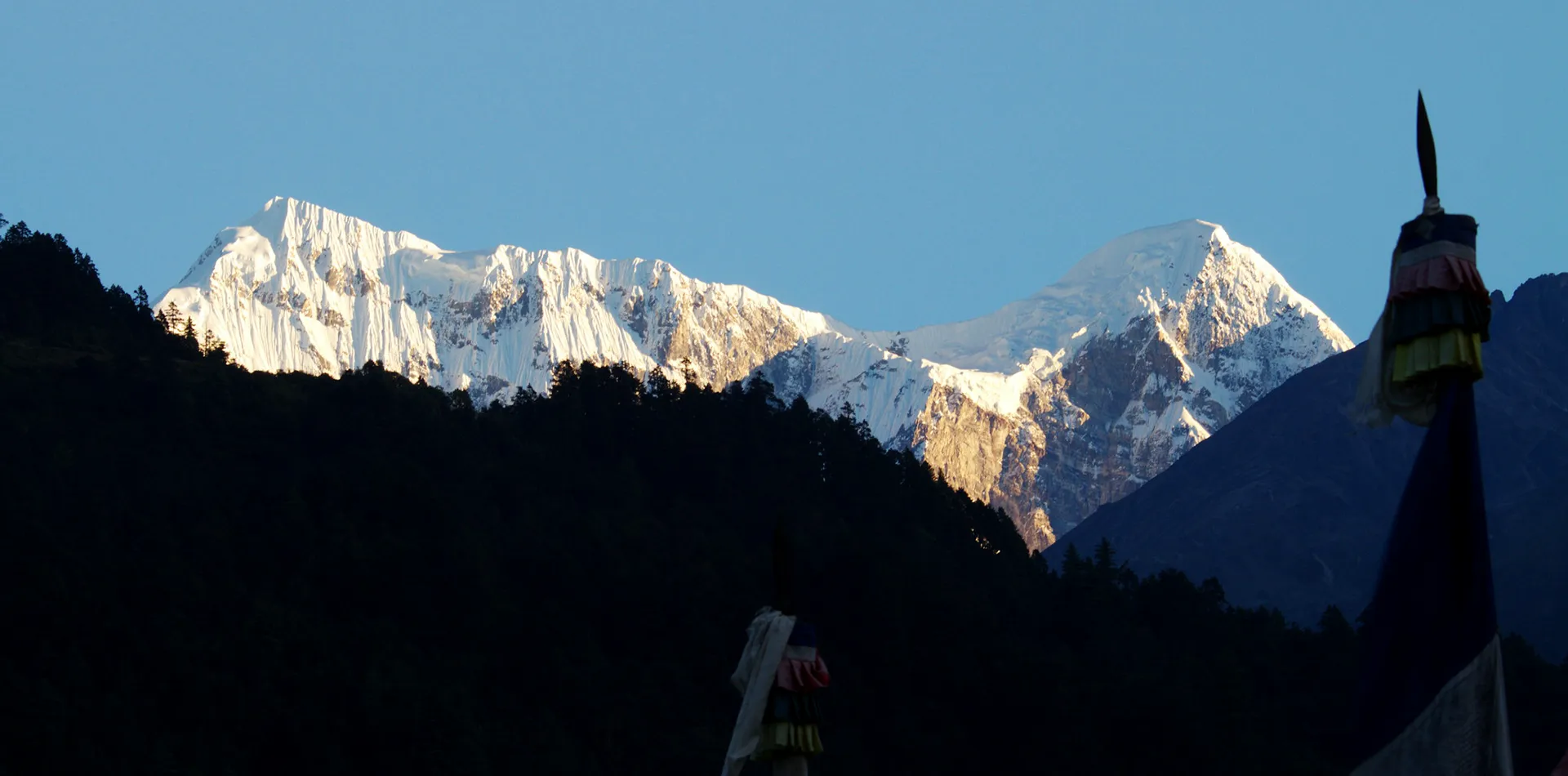
Dudh Kunda Trek

Duration
9 Days

Trip Difficulty
Moderate

Max. Altitude
4,561m

Destination
Nepal

Group Size
2-16 People

Accommodation
Hotel, Lodge

Transportation
Flight, Bus

Meals
B L D
Explore more facts about the trip
Overview of Dudh Kunda Trek
The Dudh Kunda Trek is a 9-day-long journey that takes you to a remote part of the Everest region. The ultimate destination of this trek is the Dudh Kunda Lake, a 4560-meter-high glacial lake that sits on the base of Mt. Numbur. This less crowded alternative to other popular Everest region treks is one of the best trekking destinations you can visit, and also offers a great view of Karyalung, Makalu, and Everest peak.
You will have plenty of instances to dive into the culture of Sherpa communities since most of the villages on our Dudh Kunda Trek itinerary are Sherpa-dominated. Passing by villages such as Junbesi, Ringmo, Salleri, and more, you will get to see the traditional stone houses of the Sherpas and also get to participate in various religious rituals. The itinerary takes you to visit many gompas that showcase traditional Tibetan Buddhism architecture and practices.
Ultimately, we will reach the Dudh Kunda Lake and experience a serene scene of a beautiful glacial lake. You can also indulge in worshiping rituals on the lakeshore since this body of water is considered sacred by Buddhists and Hindus. Devotees claim that this lake has the power to grant wishes of those with a pure heart and righteous intentions.
The 108 natural springs near the Dudh Kunda Lake are one of the main attractions of the region. With diverse wildlife and flowering plants, the Solukhumbu region offers a lot for trekkers who want to experience authentic Himalayan trekking. In addition to being naturally diverse, the trek also offers a spiritual experience as we will visit many monasteries and join their morning prayer sessions.
There’s a lot to discuss on this amazing journey to the Everest region of Nepal. That is why we have crafted this detailed breakdown of the entire experience so that you can know what you are paying for and get a rough idea of what you are getting yourself into.
- Safety first, always
- Best prices guaranteed
- Expert travel team
- Easy booking, no extras
- Customize your journey
Based on 10 reviews

Trip Highlights
- A scenic flight to and from Phaphlu, overlooking the Himalayas in the north.
- Visit the sacred milky lake of Dudh Kunda, reaching 4560 meters above sea level.
- Visit the Thupten Choling Monastery and witness amazing thangka murals and traditional Tibetan Buddhism architecture.
- Experience authentic Sherpa culture at villages like Salleri, Ringmo, and more.
- Chances of spotting wildlife such as the Himalayan Monal, Pikas, Blue Sheep, Himalayan Tahr, and more.
- Cross many streams, walk by terrace farmlands, and alongside rivers to experience the pristine nature of the remote Solukhumbu region.
Photo and Video Gallery


Dudh Kunda Trek Detail Itinerary

Day 01: Arrival in Kathmandu and transfer to the hotel
On the first day of your Dudh Kunda Trek, we will have you arrive at the Tribhuvan International Airport in Nepal. Your flight to Nepal will be a scenic one as the northern Himalayas will be in view if the weather stays clear. After you land at the airport, your immediate task is to get a tourist visa. For this, you will have to move to the immigration section, where you must fill out a visa application form.
After filling it out, you have to pay your visa fees and then present all the documents required to the immigration officer. You will have to submit two passport-sized photos, proof of accommodation, return tickets, and your visa application form, along with a bank receipt of visa payment.

Max. Altitude: 1,400m/4,593ft. (Kathmandu)

Meal: Breakfast

Accommodation: Hotel
Day 02: Explore Kathmandu and prepare for the trek
Exploring Kathmandu is one of the best ways to start your journey in Nepal. Kathmandu is not only the capital city of Nepal but also a historic capital with many ancient and religious buildings. Our day begins with a visit to Swayambhunath Stupa, followed by Bouddhnath Stupa, where we can attend a morning prayer session if we are early enough.
From there, we will head to the Pashupatinath Temple, followed by a lunch break at your preferred eatery nearby. Post-lunch, we will visit Kathmandu Durbar Square, Patan Durbar Square, Taragaon Museum, and a couple more sites throughout the day. Later in the early evening hours, we will prepare for the trek.
Meal: Breakfast
Accommodation: Hotel
Day 03: Fly to Phaplu and trek to Ringmo
Day 3 is the first trekking day of the Dudh Kunda Trek. The day begins with a flight to Phaplu, lasting about 45 minutes. After reaching our starting point, we will get off the plane and get ready to start trekking. The total trek distance of the day is about 7 km with an estimated trek duration of 5 to 6 hours. The elevation gain of the day is 287 meters, reaching 2700 meters at the end of the day.
The trek starts with a gradual climb through a forested section, leading us to Salleri Bazaar. Traversing a dirt path with some stone steps, we will gently climb uphill, passing by small settlements along the way. Not long after, we will arrive at Ringmo and call it a day.

Activity: 5-6 hrs
Max. Altitude: 2,700m/8,858ft. (Ringmo)
Meal: Breakfast, Lunch & Dinner
Accommodation: Lodge
Day 04: Trek from Ringmo to Sarsar Beni
Today’s trek features a 5 to 6-hour journey, covering about 8 km, with an elevation gain of 1135 meters. Starting from Ringmo, we will pass by apple orchards and a cheese production factory, after a filling breakfast. Traversing a dirt path, the initial segment of the trail feels remote, as it is much less crowded and inhabited in comparison to other Everest region.
After about 2 hours of trekking, the trail turns steep, and the surrounding vegetation changes from forests to meadows. The climb is physically demanding, offering wide scenes of the surrounding hills with occasional cattle and herders going about their daily duties. Following a ridgeline, we will soon reach Sarsar Beni and spend the night there.
Activity: 5-6 hrs
Max. Altitude: 1,135m/3,724ft. (Sarsar Beni)
Meal: Breakfast, Lunch & Dinner
Accommodation: Lodge
Day 05: Trek from Sarsar Beni to Dudh Kunda & return to Sarsar Beni
On the 5th day of the Dudh Kunda Trek, we will cover about 10 km and gain about 725 meters, which should take us about 6 to 7 hours to complete. Starting the day rather early, we will begin a steady ascent through meadows, passing by chortens, prayer flags, and mani walls. The path is full of loose rocks; using trekking poles is highly recommended.
Soon after, we will cross the Dudh Kunda River over an old bridge. This is a small glacial stream with not much water. From there, we have to ascend sharply for about two hours and reach a ridge top. After enjoying the views of Mt. Karyalung and Mt. Number, we will continue the ascent and reach Dudh Kunda Lake, sitting at 4560 meters above sea level.
Activity: 6-7 hrs
Max. Altitude: 4,560m/14,961ft. (Dudh Kunda Lake)
Meal: Breakfast, Lunch & Dinner
Accommodation: Lodge
Day 06: Trek from Sarsar Beni to Junbesi
Today is the first descending day on the Dudh Kunda Trek itinerary. The day features an 8 km long trail with an estimated trek duration of 5 to 6 hours. At the end of the day, we will have lost a net elevation of 1155 meters. Leaving Sarsar Beni, we will exit the village passing by a trail decorated with prayer flags and stone cairns. After about an hour of trekking, we will reach a steep downhill section.
Passing the steep section, we will reach the lower valley region in about hour-3 of trekking. Continuing the descent, the trail passes by chortens, terraced farmlands, and small Sherpa settlements. Soon enough, we will arrive at Junbei, reaching 2680 meters above sea level.
Activity: 5-6 hrs trek
Max. Altitude: 2,680m/8,793ft. (Junbesi)
Meal: Breakfast, Lunch & Dinner
Accommodation: Lodge
Day 07: Trek from Junbesi to Phaplu
This is the last day of trekking on the Dudh Kunda Trek itinerary. Today we will cover about 8 km of total distance with an elevation loss of 267 meters. Starting the 5 to 6-hour-long trek, we will leave Junbesi and pass the Thuptenchholing Monastery. This part of the trail is wide with terraced farmlands on one side.
After about an hour of trekking, we will cross a suspension bridge over the Junbesi River and enter a forested section. This path leads us to Phurteng village, where we will rest a bit. Moving forward, we will arrive at Salleri village after 3 hours of trekking. From there, reaching Phaplu will take us about 2 hours.
Activity: 5-6 hrs trek
Max. Altitude: 2,470m/8,104ft. (Phaplu)
Meal: Breakfast, Lunch & Dinner
Accommodation: Lodge
Day 08: Fly from Phaplu to Kathmandu
The next morning, we will have a filling breakfast at Phaplu before getting on the plane to Kathmandu. This 45-minute flight offers a great overhead scene of the valley below and the mountains in the north. After landing at Kathmandu airport, we will drive you to your hotel for the night. For the time being, you can explore the city on your own, try out different local delicacies, and just have a great time.
Max. Altitude: 1,400m/4,593ft. (Kathmandu)
Meal: Breakfast
Accommodation: Lodge
Day 09: Departure from Kathmandu Airport
This is the last day of the Dudh Kunda Trek itinerary. After we are done with the final procedures, we will drop you off at the Tribhuvan International Airport as per your flight schedule. But before that, we will have a short farewell ceremony.
If our standard itinerary doesn't fully meet your needs, we are happy to tailor it to your specific preferences and requirements.

Includes and Excludes
What’s Included?
- Airport transfers in Kathmandu, including pickup on arrival and drop-off on departure
- Round-trip domestic flight between Kathmandu and Phaplu
- Hotel accommodation in Kathmandu before and after the trek
- Comfortable teahouse or lodge accommodation during the trek (twin-sharing)
- Breakfast in Kathmandu hotel, and three meals (breakfast, lunch, dinner) each day during the trek
- Professional, English-speaking trekking guide and required porters
- Trekking guide salary, insurance, meals, accommodation, equipment, transportation, etc.
- Seasonal fresh fruit during the trek
- All necessary trekking permits and national park entry fees
- Basic medical kit and safety equipment during the trek
- Sleeping bag, down Jacket, walking poles, duffel bags (you have to return after the trek)
- Certificate of achievement at the end of the journey
- Government taxes and agency service charges
What is not Included?
- International flights to and from Nepal
- Nepal entry visa fees upon arrival
- Lunch and dinner in Kathmandu
- Personal expenses such as drinks, snacks, hot showers, Wi-Fi, and device charging
- Travel insurance that covers medical emergencies and helicopter evacuation
- Tips for guides, porters, and drivers
- Extra hotel nights caused by flight delays, early arrival, or late departure
- Personal Travel insurance and emergency rescue evacuation
- Extra cost caused by natural or political disturbances beyond our control
Route Map & Altitude Chart
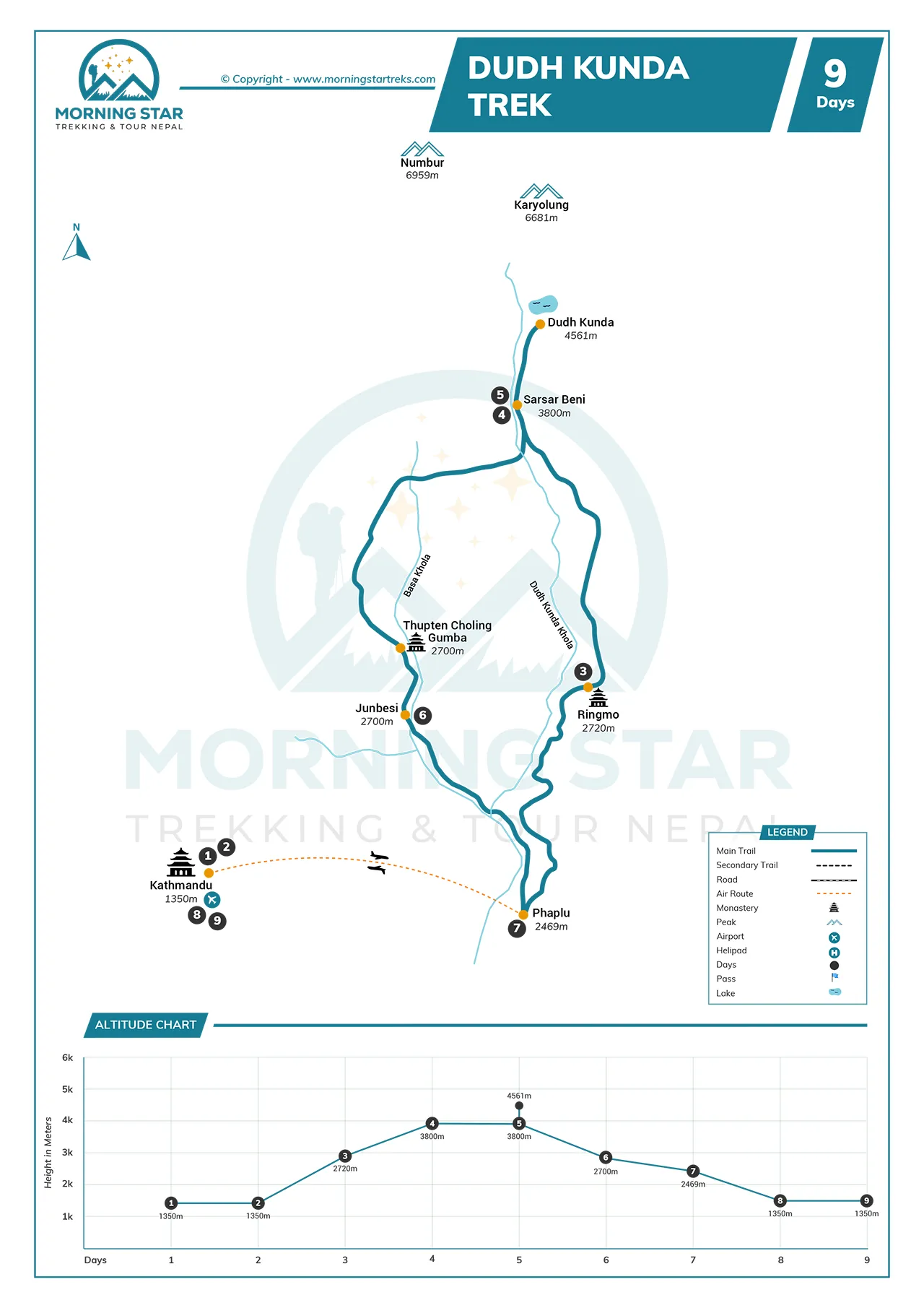
Trip Information of Dudh Kunda Trek
Best season and weather
The best seasons for trekking the Dudh Kunda Trek are autumn and spring. These seasons are the 2 most popular options since they offer the best trekking conditions. For instance, autumn offers very minimal chances of rain, dry and non-slippery trails, and the best visibility in the air. Meanwhile, the spring season features great visibility, lush forests, and blooming flowers with clear skies for the most part. You can never go wrong with any of these options.
In general, we recommend not trekking this trek in the monsoon and winter seasons since those are the worst conditions to go on any trek. Monsoon is heavily leech-infested and very slippery, with increased chances of landslides. Meanwhile, winter is too cold to tolerate, and the trails are usually snow-covered, making it harder to navigate and trek.
Difficulty
This short 9-day trek is graded as moderately difficult, but our trek experts say it is actually on the easier side. Although there are steep ascents and descents that are sure to make you tired, they are actually very doable with proper rests and breaks. Except for the sharp inclines, there is not much that adds to the difficulty of this Dudh Kunda Trek. The highest elevation of this trek barely crosses 4500 meters, which is a considerable elevation, but we will spend about an hour there.
Altitude Sickness
The highest point of this trek is 4,560 meters at Dudh Kunda Lake, which is a great elevation, but we will not be spending the night there. This will be a short visit, making us climb high and sleep low, which is one of the best ways to avoid altitude sickness. Most of our nights on the trek will be spent below 3500 meters of elevation, the starting elevation of altitude sickness. We will only spend 2 nights at 3800 meters above sea level at Sarsar Beni.
Preparation and Fitness
Preparing for this trek takes about 6 to 8 weeks of physical training. We recommend trekkers, cardio, running, cycling, swimming, jogging, and other exercises that engage the whole body and increase your endurance. Strengthening your legs with lunges and squats is a great way to prepare, along with using a treadmill and ladder machine at the gym. You do not require prior trekking experience for this trek; you just have to be physically capable of walking 5 to 6 hours per day without any problem.
Food and Accommodation
Dal Bhat, momo, thukpa, rildok, syaphaley, veg stew, dry aged meat, etc, are the popular dishes in the region. You can also get western options such as pancakes, pasta, noodles, etc. At most of the tea houses, you will get to taste traditional Nepalese dishes and local dishes more than western ones, which is a good thing since tasting the local delicacies is a part of the trekking experience.
When it comes to accommodation, tea houses are the best options since they have grown to be a part of the trekking experience itself. They offer a bedroom, blankets, food, and a communal washroom. The living standard is very basic, which is expected in remote areas. Your accommodation expenses will be covered by the trek package, and 3 meals per day will be provided during the trekking days.
Transportation
All ground transportation will be covered by the trek package, along with a flight to and from Phaplu, the starting point of the Dudh Kunda Trek. You do not have to pay extra for transportation, and we will also pick you up and drop you off at the airport.
Communication
Unfortunately, you will not be able to communicate much during the trek since cell phone network reception is very poor in the region, and WiFi availability is not a luxury provided by the tea houses or eateries. If you really need to communicate back home or somewhere important, you can use the satellite phone to make a call. The guide keeps a satellite phone to contact the emergency services in case anyone needs immediate medical attention.
Permit
Trekkers need to have a TIMS (Trekkers’ Information Management System) card and a Gaurishankar Conservation Area Entry Permit to do this trek legally. The fees related to these permits will be covered by our trek package, and the guides will help you obtain these permits.
Visa
Upon your arrival at the Tribhuvan International Airport, you are expected to apply for a tourist visa at the immigration booth. Only after you get your visa will you be allowed to leave the airport premises. Depending on the intended duration of your stay, you will be charged a certain amount as visa fees. For this particular trek, a 15-day visa should be enough, which will cost you USD 30.
The banking counter beside the immigration booth accepts card payments, but it can sometimes take a long time to process or just not work at all because of maintenance issues. In such cases, you must have cash to pay your visa fees.
Travel Insurance
Travel insurance is a must for this trek since we will be reaching over 4500 meters, which might induce altitude sickness. Realistically, the chances of you having to be evacuated from any point of the trek are very, very low. But it is always better to be safe than sorry. Your travel insurance fee is not a part of the Dudh Kunda Trek package.
Extra Expenses
The extra expenses that you must pay separately are extra meals, sightseeing entrance fees, additional night stays, lunch and dinner during your time in Kathmandu, visa fees upon entry, travel and medical insurance fees, international flight to and from Nepal, any kind of beverages, etc.
Private vs. group trek
Group treks are supposed to be for random trekkers who want to do the Dudh Kunda Trek at around the same time. This group is a bunch of random trekkers who have the same availability. Meanwhile, a private trek only has people whom you know and whom you want to invite. This can be more exciting for you since you enjoy the serene hills and exciting mountains with your loved ones and close ones. A private trek will cost your more in comparison.
Most Asked Questions
 General
What makes the Dudh Kunda Trek different from other treks in the Everest region?
The main difference can be singled out as crowd density. The Dudh Kunda Trek itinerary is much less crowded and more remote.
How remote is the Dudh Kunda Trek, and what level of infrastructure can I expect?
In comparison to other Everest region treks, this trek is much more remote. However, you can expect basic infrastructure, but no internet.
What kind of wildlife might I encounter on the trail, and are there any specific precautions to take?
You might encounter blue sheep, wild cats, Himalayan Thar, and more. There are no precautions to take as these animals tend to stay away from humans when approached or encountered.
How crowded is the Dudh Kunda Trek compared to more popular routes, and will I need to book teahouses in advance?
Even though the Dudh Kunda Trek itinerary is less crowded, the tea houses can be booked fully because there are not many tea houses in the region. You do not have to worry about booking them, we will take care of this hassle.
Is the Dudh Kunda Trek suitable for solo trekkers, or is it better to join a group?
Solo trekking is not a possibility in the Everest region; you must be accompanied by a licensed guide at all times.
What is the significance of Dudh Kunda Lake for local Sherpa and Hindu communities?
The lake is considered sacred by Hindu followers and the local people as well.
 Preparation & Fitness
What level of physical fitness is required for the steep ascent to Dudh Kunda on Day 5?
An average fitness level is required for the steep ascent to Dudh Kunda Lake.
Are there specific exercises to prepare for the long descents?
You can just focus on increasing your stamina and strengthening your leg muscles.
How many hours of daily trekking should I expect?
On average, you will have to walk about 5 to 6 hours daily.
Is prior high-altitude trekking experience necessary for the Dudh Kunda Trek?
It is not mandatory for trekkers to have prior experience, but it is definitely a plus point.
What type of trekking boots are best suited for the rocky and scree-laden trails?
Just the normal and sturdy trekking boots will be enough for the rocky and scree-laden trails. You do not need any kind of special shoes for it.
How much weight should I be prepared to carry if I choose not to hire a porter?
The weight depends on how much stuff you are packing for the trek. On average, trekking luggage will weigh about 7 to 8 kg.
 Insurance and Visa
Do I need a special trekking permit for the Dudh Kunda Trek?
There is no such thing as a special trekking permit; you just need to have a Gaurishankar Conservation Area Entry Permit to do this trek.
What specific coverage should my travel insurance include?
Your travel insurance package must cover medical expenses up to 5000 meters for the Dudh Kunda Trek itinerary.
Can I obtain a Nepal tourist visa on arrival at Kathmandu airport?
Yes, you can simply obtain a Nepal tourist visa on arrival at Kathmandu airport by submitting a bunch of necessary documents along with your visa application and visa fee payment receipt.
Does my insurance need to cover a helicopter evacuation?
Yes, helicopter evacuations do not come cheap, so having your travel insurance cover the costs in case of medical emergencies is a must.
Are there any visa extensions needed if I want to extend my stay in Nepal after the trek?
Yes, a visa can be extended with a simple process. You just have to visit the Immigration office in either Kathmandu or Pokhara.
Will Morning Star assist with obtaining the necessary permits for the Solukhumbu region?
Yes, our trek guides and representatives will help you obtain the necessary permits for the Dudh Kunda Trek.
 Guides & Support Staff
Is a guide mandatory for the Dudh Kunda Trek?
Yes, licensed guides are mandatory for the trek.
How much should I budget for tipping guides and porters?
There is no customary amount you are expected to tip the guides and porters, you can just tip what you’re comfortable with.
What is the typical weight limit for porters on the Dudh Kunda Trek?
Typically, porters carry around 25 kg of luggage and items on their backs throughout the trek.
Do guides on this trek speak English fluently?
Yes, guides are fully capable of speaking English, and they are knowledgeable in local culture and history as well.
Can I hire a porter for only part of the trek?
No, such arrangements can not be made since porters have to travel a long way to get there. A limited amount of work is not practical for their daily wages.
Are guides trained in first aid or altitude sickness management?
Yes, our experienced guides are trained in first aid and altitude sickness management.
 Food and Drinks
Any vegetarian options in tea houses throughout the Dudh Kunda Trek itinerary?
There are plenty of vegetarian options available at tea houses. In fact, we recommend trekkers stick to a vegetarian diet for the entire trek.
How basic are the accommodations, and should I bring my own sleeping bag?
The accommodation is quite basic in most of the villages, offering communal bathrooms, bedrooms, and food, and yes, you should bring a sleeping bag.
Are hot showers available in teahouses in villages like Junbesi and Phaplu?
Yes, hot showers are available at most of the tea houses throughout the Dudh Kunda Trek itinerary. You will be charged a couple of dollar for hot showers.
Can I expect Wi-Fi or mobile network coverage in teahouses along the trek route?
Unfortunately, Wi-Fi or mobile network coverage is not a possibility during the trekking days
Are there options to buy snacks or bottled water in remote villages, or should I carry extra supplies?
You can buy snacks and bottled water in all of the villages we visit on the Dudh Kunda Trek.
What is the quality of drinking water on the trail? Are water purification tablets necessary?
The locally available water is mostly germ-free, but some sources can be contaminated, so it’s always better to use water purification tablets.
 Weather & Seasons
How likely are flight delays or cancellations for the Kathmandu-Phaplu flight due to weather?
The weather conditions during spring and autumn are stable, which means it is less likely for flights to get delayed.
Should I expect snow or ice on the trail to Dudh Kunda in early spring or late autumn?
Yes, some icy patches are to be expected in the high elevation regions.
How cold does it get at night?
During the nighttime, it can reach around 9°C. You must have a sleeping bag to combat the cold.
Are there significant differences in trail conditions between the spring and autumn seasons for this trek?
Yes, the spring season offers a lush and humid trail, while the autumn season is on the drier side.
How does the monsoon season affect the trail?
During the monsoon season, the trails are slippery, leech-infested, and overall impractical.
 Health & Safety
What are the risks of altitude sickness on the Dudh Kunda Trek?
The chances of you getting altitude sickness are very less on the Dudh Kunda Trek.
Are there medical facilities or health posts in Phaplu or Junbesi in case of emergencies?
There are medical facilities in both villages, but they are not well equipped for emergency cases.
What precautions should I take for stream crossings?
The streams are usually very gentle, unless you trek during the monsoon season. So, there is no need for precautions.
Are there any specific vaccinations recommended for the Dudh Kunda Trek?
No, you do not need any specific vaccination for this trek.
How safe is it to trek through remote areas?
The remote highlands are very safe; there are no thefts or encounters with wild carnivorous animals.
 Booking & Payment
What is the typical deposit required to book the Dudh Kunda Trek?
We require at least 50% as a deposit to book the Dudh Kunda Trek.
Are there flexible cancellation policies if I need to cancel due to personal reasons or weather disruptions?
Yes, our flexible cancellation policies will return you a certain amount of deposit based on the time of cancellation.
Can I customize the Dudh Kunda Trek itinerary?
Yes, you can customize the standard itinerary but adding destinations or spending an extra day at your preferred stop.
What documents or information do I need to provide when booking the trek?
We will need a copy of your passport, passport-sized photo, and visa details after your arrival in Nepal.
Do trekking agencies include the cost of the Kathmandu-Phaplu flight in the package, or is it separate?
The flight expense is included in the package; you do not have to pay for it separately.
 Transportation & Flight
What happens if the Kathmandu-Phaplu flight is canceled?
In such a case, all we can do is wait for the next flight.
Are there alternative transport options to Phaplu if flights are unavailable?
Yes, a jeep ride or bus ride is a viable option, but this ride will take over 9 hours to complete.
How early do I need to arrive at Kathmandu airport for the domestic flight to Phaplu?
You can be there about 1.5 hours before the scheduled time of flight.
Are there any road sections on the trek where jeeps or local transport might be used?
No, after we leave Phaplu, there are no road sections on the Dudh Kunda Trek itinerary.
- Safety first, always
- Best prices guaranteed
- Expert travel team
- Easy booking, no extras
- Customize your journey
Based on 10 reviews
Have Questions?
+977 9767224414