
 English
 Dutch
Dutch Japanese
 Hindi
Hindi Italian
 Spanish
 French
 German
 Chinese
 Korean
 Arabic
 Hebrew
 Russian
 Portuguese
 Danish
 Czech
Czech Polish
 Swedish
Have Questions?
+977 9767224414
Unmissable holidays deals - Save up to 20%
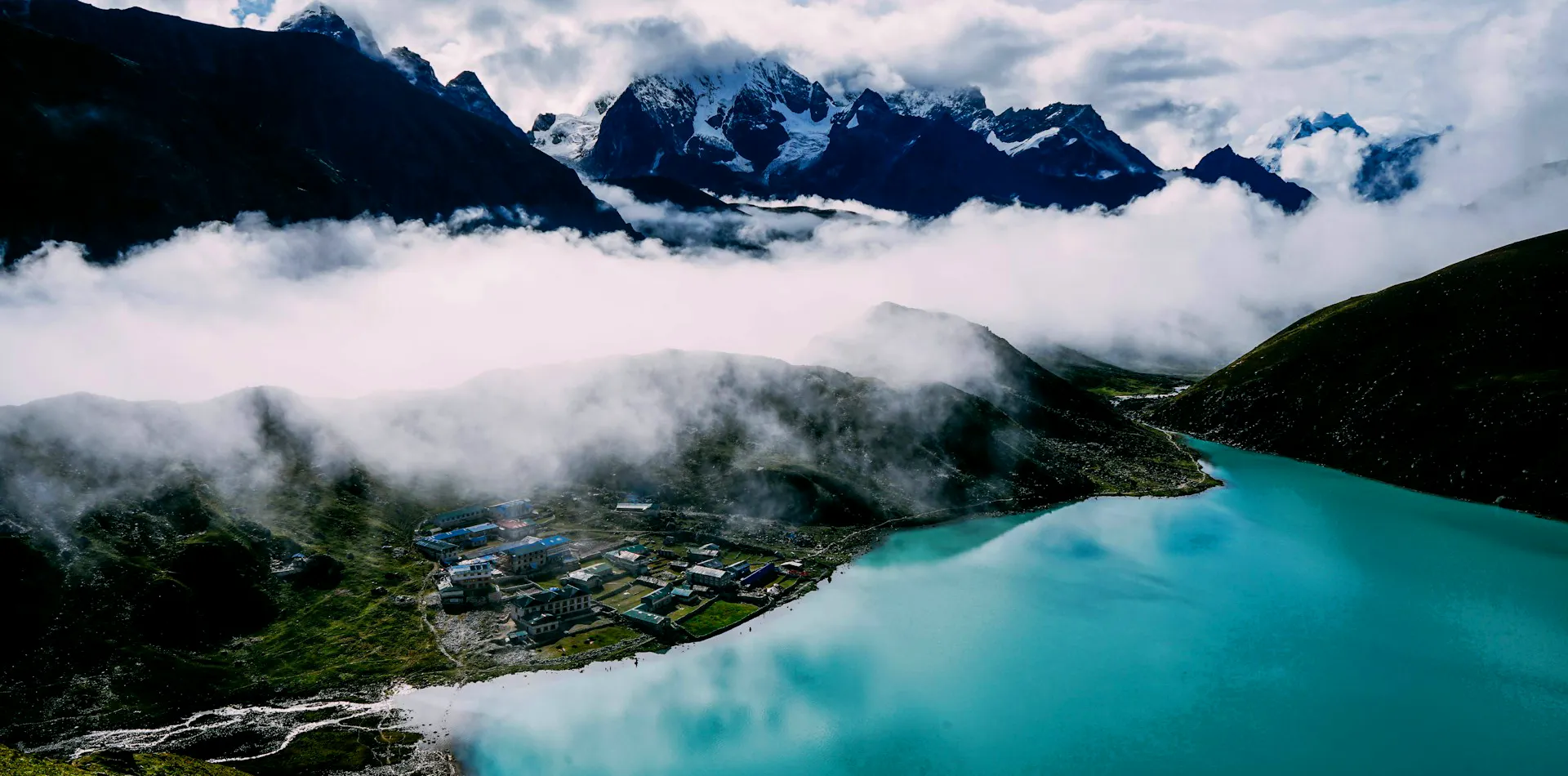
Gokyo Lake Trek

Duration
12 Days

Trip Difficulty
Moderate

Max. Altitude
5,357m

Destination
Nepal

Group Size
2-16 pax

Accommodation
Hotel, Lodge

Transportation
Bus , Flight

Meals
B L D
Explore more facts about the trip
Overview of Gokyo Lake Trek
The Gokyo Lake Trek is one of the most scenic treks you can do in Nepal. This trek usually lasts anywhere from 12 to 14 days, offering a great experience away from the popular and mostly crowded Everest Base Camp trek. The stunning views that this trek offers are on par with the scenes of the EBC trek, perhaps even better in some cases, as you can not see any lakes during the standard EBC trek.
Located in the Everest region, this trek follows the standard EBC trek for a couple of days before heading off to remote villages in the Gokyo region. En route, you will get to enjoy scenes of many peaks such as Cholatse, Thamserku, Makalu, etc., with pristine nature. You will also enter the Sagarmatha National Park, a UNESCO World Heritage Site with many wildfires and beautiful forests.
Trekking through forests, steep ascents, and mountain passes, we will eventually make it to the world’s highest freshwater lake system, the Gokyo Lakes, ranging from 4700 to 5000 meters above sea level. These lakes are sacred to the locals, and efforts for preserving their natural beauty have been made at the local and governmental levels, keeping them clean and untouched. The Sherpa villages in the region are the ones responsible for their great care.
The sacred lakes of Gokyo are turquoise blue in color and glacier-fed. Both Hindus and Buddhists consider it sacred, and you can even find a temple on the shores of a couple of lakes. Devotees usually take a plunge in the icy water to rid themselves of sins or test of faith. However, this rite of passage ritual has been declining over the years. En route, you will get to visit many other temples as well.
If you are interested in exploring a less-traveled and less-crowded part of the Everest region, this trek is just the one you need to experience.
- Safety first, always
- Best prices guaranteed
- Expert travel team
- Easy booking, no extras
- Customize your journey
Based on 10 reviews

Trip Highlights
- Enjoy a scenic flight to Lukla, offering a wide view of the entire Khumbu and Everest region.
- Witness a panoramic view of Everest, Lhotse, Makalu, and Cho Oyu, and the Ngozumpa Glacier from Gokyo Ri viewpoint.
- Visit the sacred and gorgeous lakes of Gokyo with striking alpine vegetation and scenes.
- Cross many suspension bridges to get to Namche Bazaar, a charming and vibrant town in the middle of nowhere.
- Visit the Everest View Hotel or the Khumjung monastery during the acclimatization day.
- Experience the local Sherpa hospitality along with their culture and a peek into their daily lives.
Photo and Video Gallery


Gokyo Lake Trek Detail Itinerary

Day 01: Arrival in Kathmandu
As your flight lands at the Tribhuvan Airport in Kathmandu, your first day of the Gokyo Lake Trek will begin. The flight is scenic, as you will get to enjoy an overhead view of the peaks in the north. After arriving at the airport, you will have to get a tourist visa before leaving. Visa-on-arrival is a great initiative for tourists visiting Nepal; this basically means that you do not have to apply for a visa beforehand, you can just get a visa after arriving in Nepal.
To get a tourist visa, you must have your passport, two passport-sized photos, return tickets, and proof of accommodation. You must also fill out a visa application form that you can get at the immigration desk. After paying your visa fees at a nearby counter, you must submit all the aforementioned papers to the immigration officer.

Max. Altitude: 1,400m/4,593ft. (Kathmandu)

Accommodation: Hotel
Day 02: Kathmandu to Lukla (Flight) and trek to Phakding
On the very next day of the Gokyo Lake Trek, we will head out to the airport again. After screening, we will get on the plane to Lukla, a short 35-minute flight. Arriving at Lukla, the immediate hilly landscape will set the tone for the day. Once everything is set, we will begin the trek to Phakding.
Our trek distance of the day is around 8 km with an elevation loss of 230 meters, taking us to 2610 meters above sea level. This trek will take about 3 to 4 hours to complete, starting off with a gentle downhill section. Trekking alongside the Dudh Koshi River, the trail is well-defined and passes by many forested sections with Rhododendron trees.
Passing by Chheplung, Thado Koshi, Chauri Kharka, and many other Sherpa villages, we will reach the destination of the day. Thus ends the first trekking day on the Gokyo Lake Trek. We will spend the night at a local tea house, which is the standard accommodation for the rest of the trekking days.
Max. Altitude: 2,610m/8,563ft. (Phakding)
Accommodation: Lodge
Day 03: Phakding to Namche Bazaar
Today’s trek is a bit longer than the previous day, extending a bit over 11 km with an estimated trek duration of 5 to 6 hours. The elevation gain of the day is 830 meters, taking us to 3440 meters above sea level. The trek starts alongside the Dudh Koshi River, entering the Dudh Koshi River valley. Soon after, we will enter a forest with occasional clearings, offering views of the landscape.
We will cross the river a couple of times over swaying suspension bridges, including the Hillary bridge, the highest one on the Gokyo Lake Trek. Passing by Samphute and Toktok, we will reach Monjo, the entrance to Sagarmatha National Park. After having our permits checked at the gate, we will enter the national park with chances of encountering wildlife.
Soon after, we will reach Jorsale village, where our lunch will be served. Post-lunch, the trail is plain for a while, taking us to the base of Namche Hill. This is where our ascent begins, a 600-meter high climb to reach Namche Bazaar.
Max. Altitude: 3,440m/11,286ft. (Namche Bazaar)
Accommodation: Lodge
Day 04: Acclimatization Day in Namche Bazaar
This is the one and only acclimatization day on the Gokyo Trek in Nepal. To make the most of our time and acclimate well, we will go on a hike to a higher elevation. One of the best and most popular options is the hike to Everest View Hotel, reaching 3,880 meters above sea level. Alternatively, you can also choose to hike up to Khumjung village, reaching 3780 meters above sea level.
Max. Altitude: 3,440m/11,286ft. (Namche Bazaar)
Accommodation: Lodge
Day 05: Namche Bazaar to Dole
Day 5 of the Gokyo Lake Trek features a 10 km long trail with an elevation gain of 670 meters. This 5 to 6-hour-long trek starts with a sharp ascent leaving Namche, heading northwest from the village. Heading towards the Gokyo Valley, we will leave the standard EBC route and reach Mong La Pass in about 45 minutes. This pass reaches 3975 meters above sea level, taking about 1.5 to 2 hours to reach its summit.
Descending from the pass, we will head towards the village of Phortse Tenga. We will reach there in about 1.5 hours; this is the lunch spot of the day. After our meal, we will trek through a lush forest accompanied by a quaint river on the side. The trail soon turns steep, leading to Dole.
Max. Altitude: 4,038m/13,248ft. (Dole )
Accommodation: Lodge
Day 06: Dole to Machhermo
On the 6th day of the Gokyo Lake Trek, we will cover about 7 km of distance, which should take us about 4 to 5 hours. The elevation gain of the day is 360 meters. The initial portion of the trek is rather plain, heading deeper into the Gokyo Valley. Following the Dudh Koshi River once again, the trail gently ascends, and the vegetation changes to alpine.
Passing many small streams, we will reach Lhabarma village (4220 m), followed by Luza village, reaching 4360 meters. We will stop there for lunch, enjoying the views of Cholatse and Taboche peaks. Leaving Luza, the final ascent of the day starts, a gradual ascent all the way to the village of Dole.
Max. Altitude: 4,470m/14,665ft. (Machhermo )
Accommodation: Lodge
Day 07: Machhermo to Gokyo (Afternoon hike to Gokyo Ri)
Starting from Machhermo, it will take us 4 to 5 hours to reach Gokyo, covering about 7 km with an elevation gain of 320 meters. Climbing up to Gokyo Ri, we will gain an additional 548 meters of elevation. The trek starts with a gentle climb over rocky terrains, passing by many small settlements. We will soon reach Pangka village, reaching 4500 meters above sea level.
After a while, we will reach Longponga Tsho (4,710 m), the 1st Gokyo Lake. Passing the lake, we will trek to the 2nd lake, with views of Cho Oyu in the distance. We will continue the trek to Gokyo village, sitting beside the next lake in line, Dudh Pokhari, the 3rd Gokyo Lake. After checking in at our accommodation for the night, we will ascend to Gokyo Ri, reaching 5357 meters above sea level. The scene from the summit features Everest, Lhotse, Makalu, Cho Oyu, the Ngozumpa Glacier, as well as the Gokyo Lakes.
Max. Altitude: 4,790m/15,715ft. (Gokyo)
Accommodation: Lodge
Day 08: Gokyo to Machhermo (Morning hike to Gokyo 4th Lake)
Day 8 of the Gokyo Lake Trek starts with an early morning hike to the 4th Lake. The total distance is around km round trip, with an estimated trek duration of 2 to 3 hours round trip. Following the Ngozumpa Glacier’s edge, the trail remains relatively flat with rocky terrain. The serene scene of the lake is one of the best scenes you will see on this Gokyo Trek in Nepal. If you are feeling more adventurous, you can also visit the 5th lake.
After returning to the village, we will have a filling lunch and begin our 7 km long trek to Machhermo. It will take us 3 to 4 hours to complete the trek, losing about 320 meters of elevation. This descent is probably the easiest part of the Gokyo Lake Trek.
Max. Altitude: 4,470m/14,665ft. (Machhermo )
Accommodation: Lodge
Day 09: Machhermo to Namche Bazaar
Descending further, we will trek about 13 km, with an elevation loss of 1030 meters. We should be able to cover this distance in about 5 to 6 hours. Heading south from Namche, the trail descends steeply over a hill. Soon after, we will pass Luza, Lhabarma, and other Sherpa villages to reach Pangka village. From there, we will descend to Phortse Tenga, followed by an ascent to Mong La Pass. Crossing this pass, we will reach Namche Bazaar; it is going to be an exhausting day.
Max. Altitude: 3,440m/11,286ft. (Namche Bazaar )
Accommodation: Lodge
Day 10: Namche Bazaar to Lukla
Today is the longest trekking day of the entire Gokyo Trek in Nepal. We will cover about 19 km with an estimated trek duration of 6 to 7 hours. This will lose us 600 meters of elevation, taking us back to the starting point of the trek. Leaving Namche Bazaar, we will go down the Namche Hill, cross the Hillary suspension bridge, cross the Dudh Koshi River multiple times, and pass Jorsalle to reach Monjo.
Leaving the Sagarmatha National Park, the trail is plain with some ups and downs. Following the Dudh Koshi River, we will pass Toktok and Zamphute to reach Phakding. From there, it will not take us long to reach Lukla.
Max. Altitude: 2,860m/9,383ft. (Lukla )
Accommodation: Lodge
Day 11: Lukla to Kathmandu (Flight)
The next morning, we will take a flight back to Kathmandu. From the plane, you can somewhat visualize the route you trekked, seeing an overhead view of the Everest region. After arriving at Kathmandu, you will be escorted to the accommodation for the night.
Max. Altitude: 1,400m/4,593ft. (Kathmandu )
Accommodation: Hotel
Day 12: Final Departure
Today is the last day of the Gokyo Trek in Nepal. You will be transferred to the international airport at your preferred time after we are done with the final procedures. We will also have a short farewell ceremony before dropping you off at the airport.
If our standard itinerary doesn't fully meet your needs, we are happy to tailor it to your specific preferences and requirements.

Includes and Excludes
What’s Included?
- Airport transfers in Kathmandu, including pickup on arrival and drop-off on departure
- Round-trip domestic flight between Kathmandu and Lukla
- Hotel accommodation in Kathmandu before and after the trek
- Comfortable teahouse or lodge accommodation during the trek (twin-sharing)
- Breakfast in Kathmandu hotel, and three meals (breakfast, lunch, dinner) each day during the trek
- Professional, English-speaking trekking guide and required porters
- Trekking guide salary, insurance, meals, accommodation, equipment, transportation, etc.
- All necessary trekking permits and national park entry fees
- Basic medical kit and safety equipment during the trek
- Sleeping bag, down Jacket, walking poles, duffel bags (you have to return after the trek)
- Certificate of achievement at the end of the journey
- Government taxes and agency service charges
What is not Included?
- International flights to and from Nepal
- Nepal entry visa fees upon arrival
- Lunch and dinner in Kathmandu
- Personal expenses such as drinks, snacks, hot showers, Wi-Fi, and device charging
- Travel insurance that covers medical emergencies and helicopter evacuation
- Tips for guides, porters, and drivers
- Extra hotel nights caused by flight delays, early arrival, or late departure
- Personal Travel insurance and emergency rescue evacuation
- Extra cost caused by natural or political disturbances beyond our control
Route Map & Altitude Chart
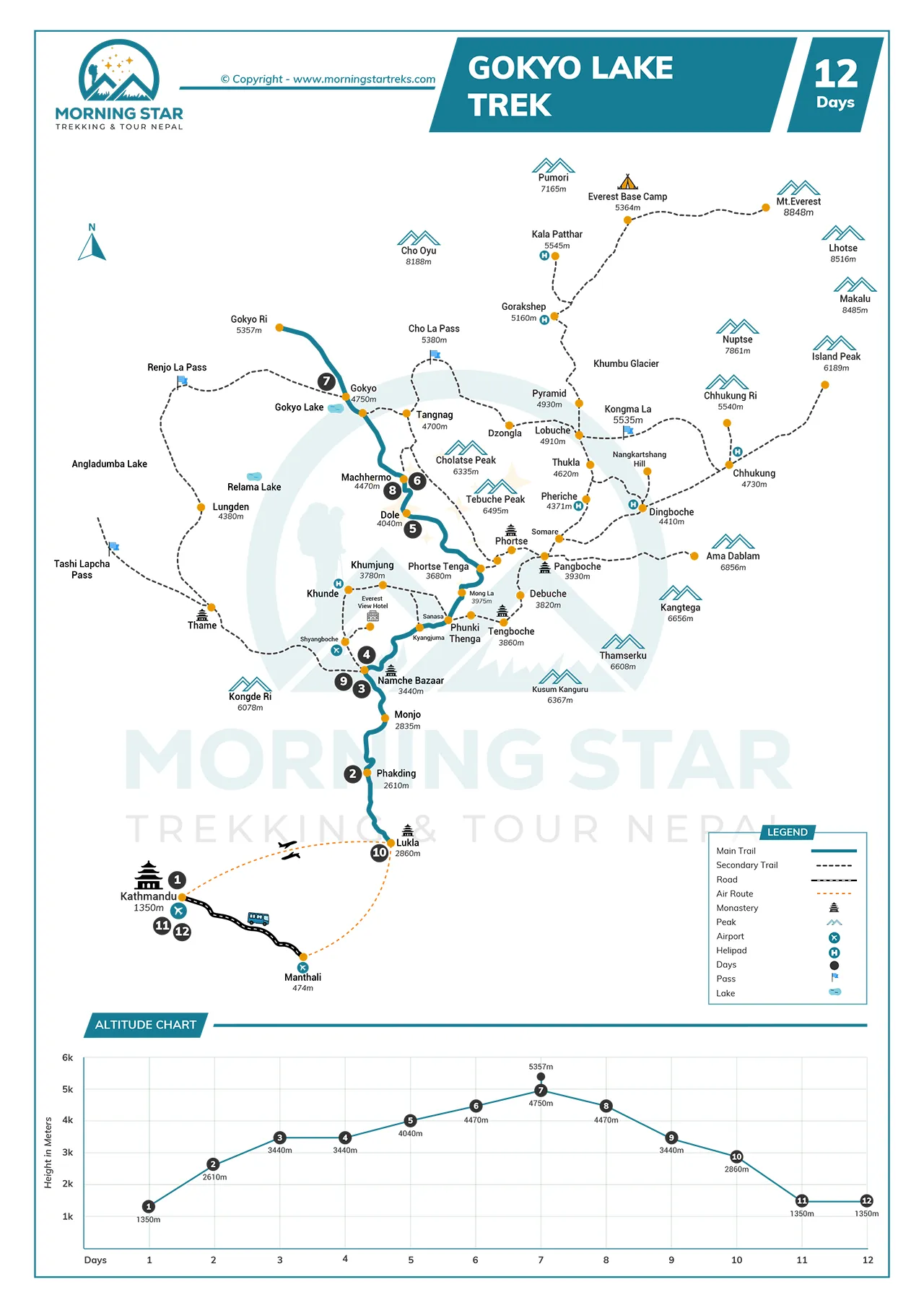
Trip Information of Gokyo Lake Trek
Best season and weather
The autumn season is generally considered the best season for this trek, along with spring. Both these seasons offer great scenes of the landscape, especially spring, when flowers bloom and forests appear lush. Autumn is chosen for its dry period, very low chances of rainfall, and clear skies. Meanwhile, spring is usually a moist period with a bit higher chances of rainfall in comparison.
Difficulty
Our trek experts and trek guides have given this trek a solid 8 out of 10. This trek is not meant for beginners and first-timers; you need to have at least some level of trekking experience to join this journey. The ascents are steep and long, which is the main aspect of difficulty.
Altitude Sickness
Altitude sickness starts from 3500 meters above sea level and gets progressively harmful as we gain elevation. In total, we will only spend 4 nights above 3500 meters, but we will not cross the 4000-meter mark. Altitude sickness is a possibility in this trek, but the chances are pretty low since we will acclimate well.
Preparation and Fitness
Preparing for this trek requires 8 to 10 weeks of physical training. You need to increase your stamina and do cardio exercises. You can also train your leg muscles so you will be able to trek long distances with ease.
Food and Accommodation
Food options during the trekking days will be a mix of Western, local, regional, and traditional Nepalese dishes. The trek package will provide 3 meals per day (BLD) during the trekking days. In the city area, you will only be provided with breakfast. Accommodation expenses will be covered by the package as well, for the entire journey.
Transportation
A flight to and from Lukla, along with the road transportation required by the itinerary, will be covered by the trek package. We will also drop you off and pick you up from the airport.
Communication
The only reliable communication device on the trek will be a satellite phone that the trek guide will keep. Your personal phones will not have network connectivity for the most part since the place is remote. However, you can access WiFi at times.
Permit
To do this trek, you need to have the Sagarmatha National Park Entry Permit and the Khumbu Pasang Lhamu Rural Municipality Permit as per the rules. All your permit expenses will be covered by the trek package.
Visa
Once you arrive at the Tribhuvan International Airport in Kathmandu, you must obtain your tourist visa before leaving. For this, you will need to present a couple of documents, submit a visa application, and pay your visa fees.
Travel Insurance
Travel insurance is not a part of the package; this is considered a personal expense that you should pay for separately. While selecting the insurance, make sure that it covers medical expenses and evacuation services up to 5500 meters.
Extra Expenses
Your extra expenses are things like visa fees, travel insurance, additional meals, extra nights in certain places, international flight expenses, tips for the guides and porters, lunch and dinner in Kathmandu, etc.
Private vs. group trek
A private trek to Gokyo is one of the best options since you can enjoy the intimate beauty of the region with your close ones. Meanwhile, a group trek to Gokyo is done with complete strangers who happen to be interested in the trek at the same time you are. Both options are exciting and fun, to say the least.
Most Asked Questions
 General
What is the best time of year to undertake the Gokyo Lake Trek?
The best time of the year to undertake the Gokyo Trek in Nepal is definitely the spring season. The autumn season is yet another great option since it shares familiar traits.
How difficult is the Gokyo Lake Trek compared to the Everest Base Camp Trek?
Compared to the standard EBC trek, the Gokyo Lake Trek is almost on the same difficulty level. Perhaps, slightly difficult since it features crossing a high mountain pass.
Can I combine the Gokyo Trek in Nepal with other treks, like Cho La Pass or Everest Base Camp?
Of course, we promote a flexible itinerary so that you can enjoy the trek the way you want to. However, every modification might not be doable since there are many factors to consider.
Are there any cultural or religious customs I should be aware of in the Sherpa villages?
No, there are no such cultural or religious customs you should be aware of in the Sherpa villages. However, they do not like public affection and short dresses showing skin.
What kind of wildlife might I encounter on the Gokyo Lake Trek?
The Gokyo Trek in Nepal passes by the Sagarmatha National Park, where you might encounter Himalayan tahr, musk deer, red panda, and other alpine wildlife.
Is there mobile network coverage or internet access along the trek route?
While mobile network coverage is not available in most parts of the trek, you can find Wi-Fi connectivity at most villages.
How crowded are the trails during peak trekking seasons?
During peak trekking seasons, you can expect to meet a couple of other groups passing by the same routes we trek.
 Preparation & Fitness
What level of physical fitness is required for the Gokyo Lake Trek?
An average physical fitness should be enough for the Gokyo Trek in Nepal.
How many weeks should I train before attempting the trek?
On average, we recommend people train for about 8 to 10 weeks.
Do I need prior trekking experience to complete the Gokyo Lake Trek?
Yes, prior trekking experience is required to complete the Gokyo Trek in Nepal.
What type of footwear is best for the rocky and uneven trails on this trek?
You can wear any sturdy trekking boots, but make sure that they are waterproof as well.
How much water should I carry daily?
You don’t have to carry your water all at once; there are many water sources en route every day.
Are trekking poles necessary for the steep ascents and descents on the trail?
Yes, trekking poles are necessary for the steep ascents and descents as they help your upper and lower body.
 Insurance and Visa
Do I need a special visa for trekking in the Everest region, or is a standard Nepal tourist visa sufficient?
You do not need to have any kind of special visa for trekking in the Everest region. However, you must obtain trekking permits in Kathmandu.
What specific permits are required for the Gokyo Trek in Nepal, and how are they obtained?
A Sagarmatha National Park Entry Permit and a Khumbu Pasang Lhamu Rural Municipality Permit are required for this trek. You can obtain these in Kathmandu; the trek guide will help you.
Does travel insurance need to cover high-altitude trekking up to 5,357 m (Gokyo Ri)?
Yes, your travel insurance package must cover medical expenses up to 5500 meters. In the rare case of emergency evacuation, the insurance package will cover the cost.
What documents should I carry for permit checkpoints in Sagarmatha National Park?
You should carry your passport, a copy of your insurance, and the permits. You do not need any other papers.
Can I purchase travel insurance in Kathmandu if I don’t have it before arriving?
Yes, you can purchase one in Kathmandu, but make sure that your provider covers medical expenses at high altitude.
How do I ensure my insurance covers emergency helicopter evacuation from remote areas?
You can ask our trek experts or go to their recommended providers. They will let the provider know about your particular trek and the type of insurance package that is best for it.
 Guides & Support Staff
Is it mandatory to hire a guide for the Gokyo Trek in Nepal?
Yes, it is completely mandatory to have a licensed trek guide if you want to do the Gokyo Trek in Nepal.
How much should I tip my guide and porter?
There is no standard tipping amount; you can just tip the amount you are comfortable with.
What is the typical weight limit for a porter?
The standard weight limit is 8 kg per person; one strong porter will be assigned to every two trekkers in the group.
Are guides trained in first aid and altitude sickness management?
Yes, our experienced guides are well-trained to handle minor medical cases.
Can I request a guide who speaks fluent English?
At Morning Star, our trek guides are capable of speaking English fluently.
What happens if my guide or porter falls ill during the trek?
We will have them replaced as soon as possible. However, they rarely fall ill during the trek.
How do I communicate with my guide about pacing during the trek?
The trek guide will set a safe ascending pace; if you feel like it’s too fast, you can ask him to slow down.
 Accommodation and Facilities
Are teahouses in Gokyo and Machhermo equipped with heating for cold nights?
No, tea houses in the highlands are not insulated or heated; it’s just not a thing in any Nepalese villages.
Can I expect hot showers at every teahouse, and what is the typical cost?
Yes, hot showers are usually available at most teahouses, costing about $2 USD.
Are there options for private rooms in teahouses, or is it mostly shared accommodation?
Options for private rooms are rarely available since the teahouses are in high demand in trekking season.
 Food and Drinks
What types of meals are typically available at teahouses along the Gokyo Lake Trek?
Along the Gokyo Lake Trek, you will get to taste a bunch of local and regional dishes, along with traditional Nepalese dishes and a few Western options.
Are vegetarian or vegan food options readily available at teahouses?
While vegan options are not a thing in the highlands, vegetarian meals are a staple.
How much should I budget for meals and drinks not included in the trek package?
You can budget about a couple of hundred USD for extra meals and drinks.
Is it necessary to bring my own food or snacks for the trek?
No, you do not have to bring any food along with you.
 Weather & Seasons
How likely are flight delays to Lukla due to weather?
During the peak trekking seasons, the chances of flight delays are pretty low.
What kind of weather conditions should I expect at Gokyo Ri during the afternoon hike?
You can expect it to get a little windy as we climb up the Gokyo Ri, and the weather is usually clear in the spring, summer, and autumn seasons.
How does the weather affect the visibility of peaks like Everest and Cho Oyu from Gokyo Ri?
Usually, the weather is clear throughout the year, even in winter. So, the weather does not do much to block the scene from Gokyo Ri.
Should I prepare for snow or ice on the trail to Gokyo in late November?
Yes, the trail will be icy and slippery in late November.
What clothing layers are recommended for the varying weather conditions on the trek?
In the lower region, you can just have an inner insulating layer with a thin weatherproof jacket. In the higher villages, you must wear a moisture-wicking inner, insulating layer, and a down jacket.
 Health & Safety
Are there medical facilities or clinics available in Namche Bazaar or Gokyo?
Yes, there are medical facilities in Namche, but Gokyo is a remote village with only a small health post.
How safe is it to drink water from teahouses, and should I bring purification tablets?
It is generally safe to drink water from the taps, but you should not take any risks, just use purification tablets.
Are there risks of yak or porter collisions on narrow sections of the trail?
No, Yaks are gentle creatures; they will not collide with you. Even the narrowest trail is wide enough to fit a human and a Yak side by side.
What precautions should I take to avoid sunburn or snow blindness at high altitudes?
You can simply use sunscreen and sunglasses to avoid such things.
How can I prepare for the physical strain of long descent days, like Namche to Lukla?
You can start by stretching your joints and muscles, and also by keeping a slow pace.
 Booking & Payment
Are there any hidden costs in the trek package, like permit fees or teahouse charges?
No, there are no hidden costs in our trek package; we promote 100% transparency.
What is the cancellation policy if I need to cancel due to personal or medical reasons?
If you need to cancel the trek, your initial deposit for booking will be deducted, as we have already spent resources preparing for your trek.
Can I get a refund if the trek is disrupted by weather or flight cancellations?
No, we cannot refund you fully if the trek is disrupted by things that we have no control over.
How far in advance should I book the Gokyo Lake Trek for peak season availability?
You should book it 2 to 3 months in advance so that you have enough time to prepare as well.
Are there discounts for group bookings or off-season treks?
No, there are no discounts for group bookings; however, trek packages will cost you a little less in the off-season.
 Transportation & Flight
How reliable are flights from Kathmandu to Lukla?
The flights are very reliable during the seasons of spring and autumn.
Are there alternative transportation options to Lukla if flights are canceled?
If flights are cancelled from Kathmandu, we will drive to Ramechhap and get on the first available flight.
How early do I need to leave Kathmandu to catch a flight from Ramechhap to Lukla?
It takes about 5 to 6 hours to reach Ramechhap, so we will have to make plans accordingly.
Is it possible to book a helicopter to Lukla instead of a fixed-wing plane?
Of course, booking a helicopter is a popular alternative, but it will not be covered by the trek package.
What happens if I miss my flight back from Lukla to Kathmandu due to delays?
In such cases, there is nothing we can do instead than wait for the next day.
Are there any road transfers included in the trek package for getting to Ramechhap?
Getting to Ramechhap will not cost you a penny; it will be covered by the trek package.
- Safety first, always
- Best prices guaranteed
- Expert travel team
- Easy booking, no extras
- Customize your journey
Based on 10 reviews
Have Questions?
+977 9767224414