
 English
 Dutch
Dutch Japanese
 Hindi
Hindi Italian
 Spanish
 French
 German
 Chinese
 Korean
 Arabic
 Hebrew
 Russian
 Portuguese
 Danish
 Czech
Czech Polish
 Swedish
Have Questions?
+977 9767224414
Unmissable holidays deals - Save up to 20%
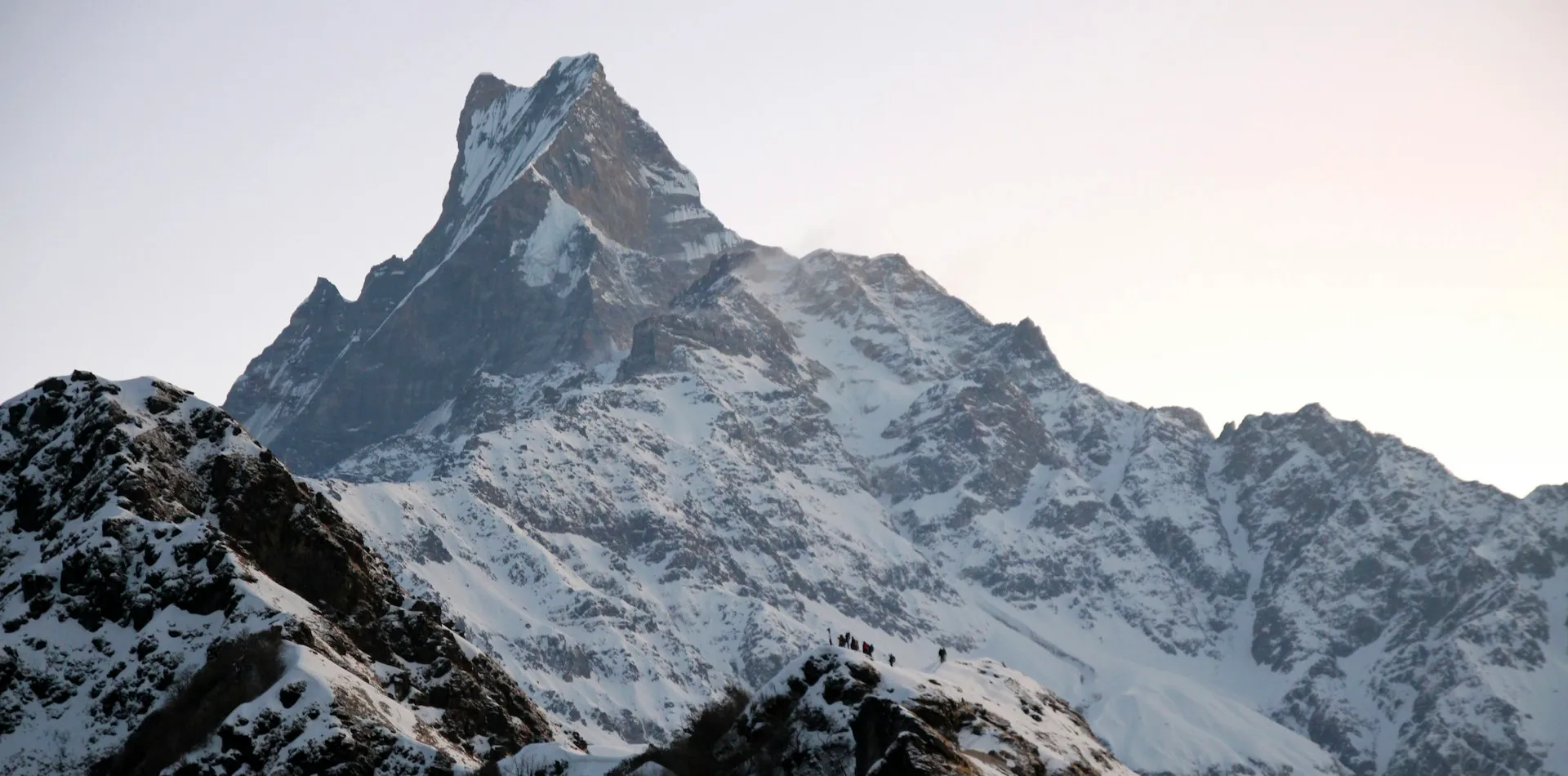
Mardi Himal Trek

Duration
9 Days

Trip Difficulty
Moderate

Max. Altitude
5,500m

Destination
Nepal

Group Size
2-16 People

Accommodation
Hotel, Lodge

Transportation

Meals
B L D
Explore more facts about the trip
Overview of Mardi Himal Trek
The Mardi Himal Trek is beautiful, simple, and an adventure in itself, and one of the hidden gems amongst various treks in Nepal. This trail is nestled in the Annapurna and provides a viewer with an unequivocal sight of the Machhapuchhre, Annapurna South, and Mardi Himal itself. It has rapidly gained popularity, as it is not as congested as other well-known treks but is equally as content on scenic beauty and experience.
The trail was not open to trekking till a few years ago but has become a popular route to be taken by people that wish to have a more peaceful adventure. Mardi Himal is calm, unlike the footpaths inhabited by a host of tourists on their way to appreciate the beautiful views, its rhododendron forests, village-like settlements, and grassy passages. The landscape change is stupendous as trekkers transition within a week, starting in the lowland farmlands and moving to the alpine zones, which appear unspoiled and untarnished.
Mardi Himal, in comparison to the Annapurna Base Camp Trek, is shorter and more intimate. Thousands of people visit Annapurna Base Camp during every season, while Mardi Himal retains the same charm of having fewer tourists around the trail. On the road, there are tea houses, which are straightforward yet homely and serve basic food and shelter with an overall effect of a true locality feel. It is a personal touch and makes the journey homely.
It is also different as compared to Ghorepani Poon Hill, which is reputed to have cultural villages and panoramas of the sunrise. Mardi Himal, on the other hand, engages trekkers more into the high alpine nature to a base camp of 4500 meters. It has close-up views of Machhapuchhre and the surrounding mountains, which makes the climbing worth it.
Within a mere itinerary, Mardi Himal has variety, calmness, and adventure, which is hardly found in many trails. The Mardi Himal Trek is accessible to newcomers to reasonable fitness as well as old trekking hands that want something a little more commercial. Its combination of nature and cultural friendliness makes it an extremely special experience in the Annapurna area.
- Safety first, always
- Best prices guaranteed
- Expert travel team
- Easy booking, no extras
- Customize your journey
Based on 10 reviews

Trip Highlights
- Panoramic Machhapuchhre, Annapurna South, Hiunchuli, and Mardi Himal.
- An alternative to the usual popular treks in the Annapurna.
- Walk through the trails of rhododendron, oak, and pine.
- Discovery of the local culture and Nepali villages.
- Alpine walks and ridges overlooking clear mountains.
- Comfy teahouses that provide a local experience and cozy atmosphere.
- Varied terrain in the form of subtropical forests, terraced fields, and elevated altitude.
Photo and Video Gallery


Mardi Himal Trek Detail Itinerary

Day 01: Arrival in Kathmandu
It begins by landing you in Kathmandu, the colorful capital of Nepal, at Tribhuvan International Airport. Once you are through the different corridors in the airport, you will be received by a representative and taken to your hotel in the urban area.
The day at large is available to relax and adapt to the new environment. One can walk through the busy streets of Thamel, shop at the numerous small shops, or just relax in the hotel. The evening will be spent giving a short trek briefing to prepare for the Mardi Himal Trek.

Max. Altitude: 1,400m/4,593ft. (Kathmandu)

Accommodation: Hotel
Day 02: Kathmandu to Pokhara by Tourist Bus
You leave Kathmandu after breakfast and go on a nice tourist bus to Pokhara. The highway runs along the Trishuli River and contains a beautiful landscape of mountain hills, green valleys, and small road settlements. I have seen on sunny days far-off glimpses of snowcapped mountains that gleamed over the horizon.
The trip follows a six or seven-hour trail with brief stops on the route. Towards late afternoon, you are in Pokhara, a tranquil waterside metropolis. Once checked into the hotel, you can unwind, take a walk around Phewa Lakes, and then embark on your next Mardi Gras Trek.

Activity: 6-7 hours drive
Max. Altitude: 822m/2,697ft. (Pokhara)

Meal: Breakfast, Lunch & Dinner
Accommodation: Hotel
Day 03: Pokhara to Kande by Drive and Trek to Deurali
You start your trek by first driving a short distance in Pokhara to Kande. Here, the path starts in green forested lanes, with rhododendron, which have oak trees nearby. You are delivered through small villages, and you are spotted in Gurung and Magar houses so much on the way.
The climb progresses slowly up the mountain, giving a periodical view of Machhapuchhre and Annapurna South. After approximately five hours of walking, you will be in Deurali at 2,100 meters. This is where the trekkers will have their first overnight to rest and acclimatize.
Accommodation and warm meals are provided here in the teahouse, making this a comfortable place where you will go to rest before proceeding with the Mardi Himal Trek.
Activity: 5 hrs trek
Max. Altitude: 2,100m/6,890ft. (Deurali)
Meal: Breakfast, Lunch & Dinner
Accommodation: Lodge
Day 04: Trek from Deurali to Low Camp
The walk between Deurali at Low Camp starts with a slow walk-through rhododendron, oak, and pine thick forests. The path is ascending slowly and pleasantly, inspecting the previous hills and snow-topped mountainous landscapes in the distance. You can find tiny streams and suspension bridges on your way that will also make the journey pretty.
Low camp is a place reached after an approximate duration of five hours of trekking; it is located at 2,970 meters above sea level. It is a place where you first get the main ridge views of Machhapuchhre and Mardi Himal. This teahouse has simple basic accommodation and meal arrangements, and this makes it the best place to rest and have a beautiful experience of the peaceful tour of the Alps before the impending climb the following day.
Activity: 5 hrs trek
Max. Altitude: 2,970m/9,744ft. (Low Camp)
Meal: Breakfast, Lunch & Dinner
Accommodation: Lodge
Day 05: Trek from Low Camp to High Camp
On this day, the trek is more difficult, with you having to climb from Low Camp to High Camp which is between 3500 to 3,900 meters, vary on the lodge you stay. This is a steeper road, with its twists and turns at alpine meadows, and elsewhere among the scattered pine trees. On the route, the panoramic views of Machhapuchhre, Annapurna South, and Hiunchuli, among the surrounding mountainous views, are rewarded on the way.
There is also the ridge walk, which overlooks dramatic scenery and is ideal for taking photo shots and to get the additional benefit of the high-altitude nature. You were able to join High Camp after five to seven hours of walking, and the teahouse offers simple accommodation, infrastructure, and food.
This is the last point before the Mardi Himal Base Camp, and hence sufficient time to take a break, acclimatize, and prepare for the adventure the next day.
Activity: 6–7 hrs trek
Max. Altitude: 3,900m/12,795ft. (High Camp)
Meal: Breakfast, Lunch & Dinner
Accommodation: Lodge
Day 06: Explore Mardi Himal Base Camp and Return to Badal Danda
The most memorable moment of the Mardi Himal Trek is on Day 6. Trekkers begin at early hours in the morning, and this time they follow the path up alpine meadowland and rocky areas. Each step is a step closer to the abundance of the views of Machhapuchhre, Annapurna South, Hiunchuli, and Mardi Himal.
You can rest at the base camp, taking photos, experiencing the cool mountain air, and immersing yourself in the serene environment. Spending some time at the camp, the journey is now made back to Badal Danda. The ridges and the forests provide a new point of view of the mountains along the way. On arrival, there is a nice tea house where one can have a meal and stay.
Max. Altitude: 4,500m/14,764ft. (Mardi Himal Base Camp)
Meal: Breakfast, Lunch & Dinner
Accommodation: Lodge
Day 07: Trek from Badal Danda to Sidhing, Drive to Pokhara
Day 7 starts with a slowdown of the trek through Badal Danda into quiet forests and tiny villages. During the ride, you may witness the local lifestyle and observe the traditional Nepali culture, which is an addition to the journey.
On reaching Sidhing, you use a jeep or other local vehicle to go back to Pokhara. The commute is approximately two hours, which brings one to the city near the end of the afternoon. The rest of the evening is spent in solitude at Phewa Lake, taking in the scenery of the lakes and getting ready to move out of Kathmandu.
Max. Altitude: 822m/2,697ft. (Pokhara)
Meal: Breakfast, Lunch & Dinner
Accommodation: Hotel
Day 08: Drive Back to Kathmandu by Tourist Bus
In the morning, you have a pleasant ride on a tourist bus back to Kathmandu after breakfast. The road will lead through picturesque scenery along rivers, terraced fields, and hilltop villages, with a final experience of the country, Nepal.
There can be a few breaks along the way to get refreshments and take photos. And in the late afternoon, you arrive at Kathmandu, where you are escorted to the hotel. The evening is yours to relax, have a brisk walk around the city, or prepare to make a way the next day.
Max. Altitude: 1,400m/4,593ft. (Kathmandu)
Accommodation: Hotel
Day 09: Departure from Nepal
On the last day of your travel, the hotel transfers you to the Tribhuvan International Airport in Kathmandu at the airport. This is the end of your expedition in Mardi Himal. Farewell to the employees and guides who facilitated your trek.
You will remember Nepal upon your trip back home as you travel via the beautiful mountain valleys, the peaceful villages, and the new experiences, as you return home.
If our standard itinerary doesn't fully meet your needs, we are happy to tailor it to your specific preferences and requirements.

Includes and Excludes
What’s Included?
- Airport pickup and drop in Kathmandu by private car
- Ground transport from Kathmandu to Pokhara and back (tourist bus or private jeep depending on group size)
- Hotel accommodation in Kathmandu before and after the trek (standard hotel, twin sharing)
- Tea house, local lodge, and homestay accommodation during the trek
- Three meals per day during trekking (breakfast, lunch, dinner)
- Breakfast included in Kathmandu hotel
- Licensed and experienced trekking guide for the entire trek
- Porters as required for your group size
- Guide and porter salary, meals, accommodation, insurance, and transport
- Annapurna Conservation Area Permit (ACAP)
- Trekkers’ Information Management System (TIMS) card
- Basic first aid kit carried by the guide
- Trekking equipment if needed (sleeping bag, down jacket, duffel bag, trekking poles – must be returned after trek)
- Trek completion certificate
- All government taxes and company service charges
What is not Included?
- International flights to/from Nepal
- Nepal entry visa fee
- Lunch and dinner in Kathmandu
- Personal expenses such as bottled drinks, snacks, hot shower, Wi-Fi, and charging devices
- Alcoholic drinks and extra beverages
- Personal trekking gear not mentioned above
- Travel insurance (must cover high-altitude trekking and helicopter rescue)
- Tips for guides, porters, and drivers
- Extra accommodation or transport due to road closures, weather, or itinerary changes
- Expenses caused by natural disasters, political issues, strikes, or other unexpected events
- Any service not mentioned in the “What’s Included” section
Route Map & Altitude Chart
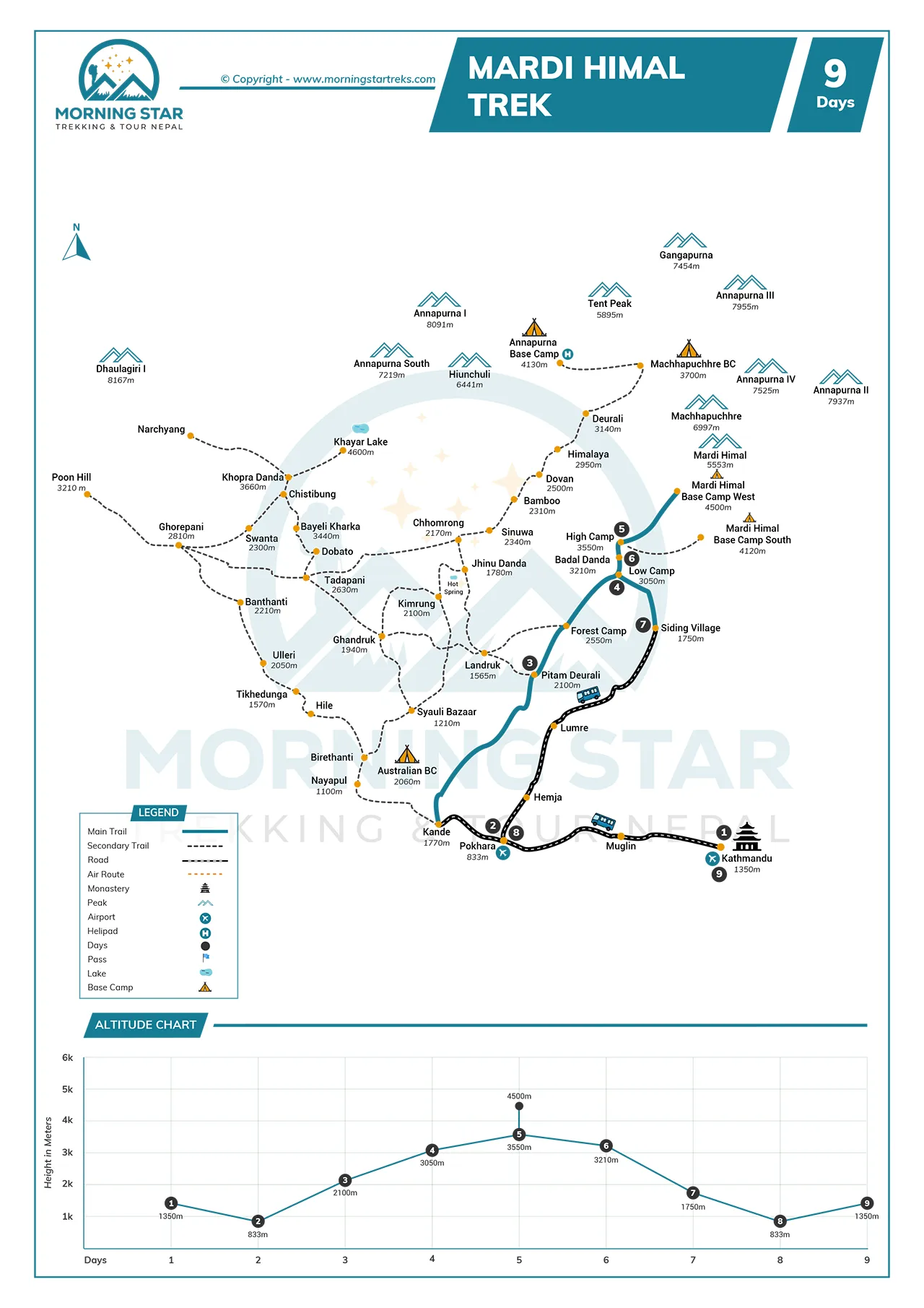
Trip Information of Mardi Himal Trek
Best Time
The ideal season to support the Mardi Himal trek is the spring (March to May) and fall (September to November). The spring is clear, sunny, and the rhododendron forests are bloom in exquisite colors, enhancing the landscape. Machhapuchhre, Annapurna South, Hiunchuli, and even the Mardi Himal have a great view during the season. To trek during the day, the temperatures are comfortable, with nights being chilly in high altitudes.
The other season that is ideal is the autumn season. The atmosphere post-monsoon is crystal clear, and the overheads are light blue colors and offer some of the best panoramic mountain views in the Annapurna region. The trails are dry and not slippery, and the temperatures are pleasant. Another reason why trekkers enjoy autumn is that it offers them the best weather, besides the local festivals that one can witness along the path.
The Mardi Himal Trek should not be done during the monsoon season (June to August). Excessive rain may turn trails muddy and augment the potential risk of landslides, and lower the visibility of mountains.
It may include winter (December to February); however, the temperature falls quite severely above 3,000 meters, and some higher parts could be covered with snow. When it consists of clear skies, good trails, and pleasant conditions, spring and autumn are preferred seasons to choose the Mardi Himal Trek.
Elevation and Distance
Mardi Himal Trek begins at Kande, already at an altitude of about 1,400 meters, and continues to rise up to the base camp, 4500 meters, which is marked by the Low Camp and High Camp. It is also a gradual hiking experience, and this enables trekkers to have adequate time to acclimatize as they witness the various sceneries in the process.
The overall trek distance can be different according to the specific path taken, but often it ranges between 50-65 kilometers. This is because it is done in 7- 8 days of extensive trekking covering distances between 4 and 7 hours each day.
Through the path, the trekkers trek through the thick trees, terraces, traditional villages, and alpine fields. The topographical difference gives the challenge as well as the scenic satisfaction at each point of the expedition.
The highest point will be the base camp of Mardi Himal, 4,500 meters, where you are guaranteed a panoramic view of Machhapuchhre, Annapurna South, Hiunchuli, and other peaks in the area. The transition of the altitude low to high altitude allows them to minimize the risks of altitude sickness and provides trekkers with an opportunity to appreciate the evolving landscapes.
Altogether, the Mardi Himal Trek is a moderate but highly satisfying Himalayan adventure due to the altitude gain and the trekking distances.
Difficulty and Altitude Sickness
Mardi Himal Trek can be regarded as a moderate trek. It is less crowded than Annapurna Base Camp and more demanding than Ghorepani Poon Hill Treks, but still, it has some steep aspects and tough parts. The trail runs mostly in forests, village areas, and terraced fields, which provide gradual climbs. The most difficult one is the drive from Low Camp to High Camp, and the next is to the Mardi Himal Base Camp, which requires stamina, trekking poles, and a slow pace.
The problem of altitude sickness may be experienced above 3,500 meters. The symptoms usually encountered are headache, nausea, dizziness, shortness of breath, and fatigue. Less severe cases may be treated using rest, hydration, and slow walking. Symptoms are severe and need to be given immediate descent and treatment. To trekkers, it is recommended that they observe the nature of their bodies and that of their friends in the process of walking.
Avoiding altitude sickness means that one has to ensure that he/she adequately acclimate, consume plenty of water, eat light and nutritious foods, and avoid overexertion. A night stay on High Camp is one way of acclimatizing the body to the elevation level of the base camp. Slow paces, frequent pauses, and paying attention to your body reduces the risks.
Given due preparations, the majority of healthy visitors can conquer the Mardi Himal Trek. This trek is very rewarding due to the moderate level of the climb, breathtaking mountain sceneries, the variety of landscapes, and the encounter with some of their local culture. Beginners and veteran hikers can have an enjoyable experience in the Himalayas by being safe and comfortable on the way.
Maximum and Minimum Walk per Day
Daily hours of walking on the Mardi Himal Trek will differ each day based on the part of the path and the altitude. Trekking days mostly comprise shortest 3 to 4 hours and longest 7 to 8 hours of hiking in the forests, ridges, and alpine meadows. These medium pacing times enable the trekkers to appreciate the view and also take their time to acclimatize.
The trek’s longest day is between High Camp and the Mardi Himal Base Camp and may require around seven hours to get through. There are more climbs and rocky routes on this day, and it demands more effort and energy. On shorter days, especially arrival days, transfer days, or departure days, trekkers spend minimal time walking, hence rest and have time to recuperate.
All in all, the trekking program will create a balance between difficult and easier days so as to be comfortable and safe, and give enough time to appreciate the nature of the Annapurna area.
Accommodation
The Mardi Himal Trek is a teahouse-based trekking area, where trekkers do not camp and instead spend the night in small lodging areas. These teahouses offer simple and comfortable rooms that have beds, blankets, and pillows. There are common rooms in most of the rooms, and the hot showers in some lodges can be taken at an extra cost, particularly at lower elevations.
Teahouses are small to large in size, depending, and mostly well-maintained. Popular eating places enable the hikers to have meals, relax, and interact with other hikers. There is a wide availability of traditional Nepali foods like dal bhat, noodles and soups, and momos. Hot drinks such as tea, coffee, and chocolate are also useful in making you feel warm after hours of rigorous trekking.
The advantages of staying at teahouses are that they provide the trekker with protection, plus an opportunity to enjoy the hospitality of the locals. Mardi Himal Trek offers an easy, secure, and hassle-free teahouse trek that is beginner-friendly having average fitness.
Food and Drink
On the Mardi Himal Trek, Trekkers have little choice but to use teahouses to take their meals and refreshments. Dal bhat, a combination of rice and lentil soup as well as vegetables, is the most popular and classic meal, which is usually served with pickles or meat. In other dishes, a particular favorite is noodles, soups, and momos that bring about warmth and energy during long trekking days.
Hot chocolate, tea, and coffee are highly accessible, and they are more used in cold weather or in the mornings. Such hot drinks aid trekkers to keep themselves warm and quicken their speed, besides taking in the mountain scenes. To maintain the levels of energy between meals, most teahouses provide snacks such as biscuits, chocolate, and fruit as well.
Trekking is important for safe drinking water. A lot of the teahouses will offer either boiled or filtered water at a small fee. One should also be advised to carry a personal water/ bottle or use purification pills as a measure to make water safe. It is important to ensure that one remains hydrated, especially at higher altitudes where the chances of dehydration are greater.
In general, food and drinks on the trek are basic, healthy, and specific to satisfy the needs of trekkers. Spicy meals, warm drinks, and clean water are some factors that make the trekking experience pleasant and easy.
Alternative Routes
Mardi Himal Trek has several possible alternative tours, which can be utilized by the trekkers and customize their individual trek. One alternative is to go down through Sidhing to Pokhara, which is the normal route. The route goes to the villages and through woodland, making it a cultural experience as the trek is not too long. It provides an easy way to go back to Pokhara, where trekkers can rest beside Phewa Lake after a few days of trekking.
The other option is to go down through Landruk, and this makes the landscape more varied and also offers a bit of diversity of route through terraced fields and ancient villages. This road is not as well-travelled; hence it is silent and peaceful. The trekkers also get a chance to have more interactions with the local communities and see the varied landscapes other than the main route.
To have the extended adventure, the Mardi Himal Trek may be extended to be performed with the Annapurna Base Camp trek. The increase in the number of trekking days and distance compensates this alternative by providing trekkers with panoramic mountain observation and the possibility to see all the iconic parts of the Annapurna region.
Can a Beginner Join This Trek?
Mardi Himal Trek is an adventure that can be taken by a beginner with fair fitness and a willingness to do moderate intensity trekking. The route is well-established, and the path has teahouses located on the route, which contributes to making the first-time trekker. Even though parts of it are steep, the hike is accompanied by slow ascents that enable one to get used to the changes in altitude.
Beginners must be properly prepared. This involves easy cardio exercise, walking exercises, and leg and core weight exercises. The use of trekking poles and carrying a daypack with ease should also be learned by trekkers.
The itinerary also facilitates easy acclimatization, where the overnights are at gradually rising altitude, including Low Camp and High Camp. This will prevent altitude sickness as well as guarantee a safer experience of trekking. Things are not complex, with the correct planning, first timers can enjoy the magnificent sceneries, the forest and mountains without the feeling that they are more than overpowered.
Preparation and Fitness
The Mardi Himal Trek can be done in a good and safe environment with proper preparation. Hiking at a moderate altitude requires moderate cardiovascular fitness, stamina, and endurance. Cardio exercises like running, cycling, or fast walking should be done daily in order to increase heart and lung capacity. Power conditioning of legs, core, and back will help in making uphill climbs and carrying backpacks easier.
It is also necessary to pack the appropriate gear. Such must-haves are layered clothing due to the weather changes, a warm jacket, trekking boots, socks, gloves, a hat, a water bottle, and personal hygiene supplies. A first aid kit, trekking poles, and a headlamp are also suggested to be taken in small amounts. Light and efficient packing makes it comfortable for the trekking days.
Gadget Charging, Internet, and Communication
In the Mardi Himal Trek, the majority of the teahouses also offer charging of electronic gadgets, often at a minimal charge. It is also advisable to pack a power bank as an alternative, just in case of places where the power is erratic, such as High and Base camp.
There are mobile networks like NTC and NCELL which operate variably along the grade and are available in villages and low altitudes. In many teahouses, Wi-Fi is provided, primarily in Pokhara or elsewhere where one has to pass by it, although it is slow or untrustworthy at higher altitudes. The trekkers are advised to plan on that fact and to notify family or friends of low connectivity in remote areas.
Permit
To do the trek in the Mardi Himal Trek, we need two primary permits: the Annapurna Conservation Area Permit (ACAP) and the Trekkers Information Management System (TIMS) card. An ACAP permit is compulsory for all trekkers approaching the Annapurna region. It helps in protecting and in local communities along the trail.
The TIMS card is a card that registers trekkers in Nepal, and it enables authorities to track the safety in trekking areas. The two permits can be obtained either in Kathmandu, Pokhara, or by authorized trekking agencies that are authorized. An ACAP permit is USD 30, and the TIMS card is USD 20 for international trekkers. lower fees for SAARC and Nepali trekkers.
At different checkpoints on the trail, permits are checked, such as at entry points, including Kande, and close to the boundaries of the Annapurna Conservation Area. Trekkers shall have genuine identification with them when trekking, like a passport.
Such permits are required to enter legally to the region, register properly, and promote conservation activities in the entire area of Annapurna.
Transportation
Mardi Himal Trek will use transportation, starting from Kathmandu to Pokhara. Trekker also has an option of a tourist bus: it is taken on a scenic highway that takes 6 or 7 hours, and passes rivers, hills, and villages. Instead, there is a quicker and more customized alternative: one of the private jeeps. There are domestic flights also between Kathmandu and Pokhara, which take approximately 25 minutes, but this can vary depending on the weather conditions.
Pokhara also has its own vehicles in the form of local jeeps or taxis that can be used to deliver trekkers to the trailhead at Kande. The drive generally lasts ~1 hours, other than in cases of bad roads and stopovers. The vehicles are very frequently shared among other trekkers, or private arrangements are made by other agencies or hotels.
In the trekking region, the main means of transport is walking, as the trekking trails are found between the villages, camps, and the base camp. The ways of reaching the starting point are good and can ensure that the Mardi Himal Trek can be reached by independent trekkers as well as those on an organized tour.
Insurance
The Mardi Himal Trek involves a high-altitude trek that necessitates high-altitude travel insurance covering medical emergencies, accidents, and evacuation. Regular travel insurance might not be adequate, because the trail goes up to 4500 m.
Even in cases such a case as sickness or high altitude, medical evacuation cover is needed. In the Annapurna region, helicopter rescue services are accessible but may cost a lot when one is not insured. A majority of insurance companies demand evidence of cover for trekking above 3,000 meters.
Trekkers would need to make sure it is covered by an emergency medical treatment policy, evacuation policy, and trip interruption policy. Leaving a copy of the insurance policy and emergency contacts’ phone numbers in the trail should also be considered a good idea. Good insurance is a way of being secure and relaxed during travels.
What to Expect
The Mardi Himal Trek can give close-up mountain views together with forest lands and village stays. Rhododendron and oak woodlands are some of the locations in which Trekkers will walk through without having to worry much to ensure a peaceful walk. There are good chances of experiencing local culture and traditional ways of life, hospitality, and villages located on the path.
The trail is not congested as compared with other Annapurna trekking trails, and one is therefore guaranteed a peaceful and truly immersive experience. Alienation is mainly that in teahouses whereby basic facilities and supplies are provided, serving as a means through which the trekkers have a chance of socializing with locals and other hikers.
Note: It is a slow, though average pace with gradual ascents up to the Mardi Himal Base Camp, where one is likely to see panoramic views of Machhapuchhre, Annapurna South, and Hiunchuli, along with others. The weather is variable and could turn cold in the morning and evenings; therefore, trekkers must be ready to face cold weather, particularly at the high altitudes.
Most Asked Questions
- Safety first, always
- Best prices guaranteed
- Expert travel team
- Easy booking, no extras
- Customize your journey
Based on 10 reviews
Have Questions?
+977 9767224414