
 English
 Dutch
Dutch Japanese
 Hindi
Hindi Italian
 Spanish
 French
 German
 Chinese
 Korean
 Arabic
 Hebrew
 Russian
 Portuguese
 Danish
 Czech
Czech Polish
 Swedish
Have Questions?
+977 9767224414
Unmissable holidays deals - Save up to 20%
Mera Peak Climbing

Duration
18 Days

Trip Difficulty
Moderate

Max. Altitude
6,654m

Destination
Nepal

Group Size
2-16 People

Accommodation
Hotel, Lodge

Transportation
Flight

Meals
B L D
Explore more facts about the trip
Overview of Mera Peak Climbing
Mera Peak Climbing is considered one of the most fulfilling journeys in Nepal, which is the highest trekking mountain in Nepal, reaching a summit of 6,476 meters. Being in a very isolated area, Khumbu, this climb features the excitement of climbing over 6,000 meters which includes technical skills like use of crampons, rope work and involves glacier travel. Mera Peak is the ideal one to suit those trekkers whose hearts yearn to be standing on the summit of a Himalayan peak with the most imposing views of the tallest mountains of the world are fulfilled.
The trek is a blend of an old-fashioned trek and an adventure of climbing. There are lush forests and traditional Sherpa villages, high altitude glaciers and icy ridges, and at every step, something new can happen. Not all technical expeditions are as available to fit trekkers with little training as is the case with the Mera Peak Climbing, a great introduction to the Himalayan climb.
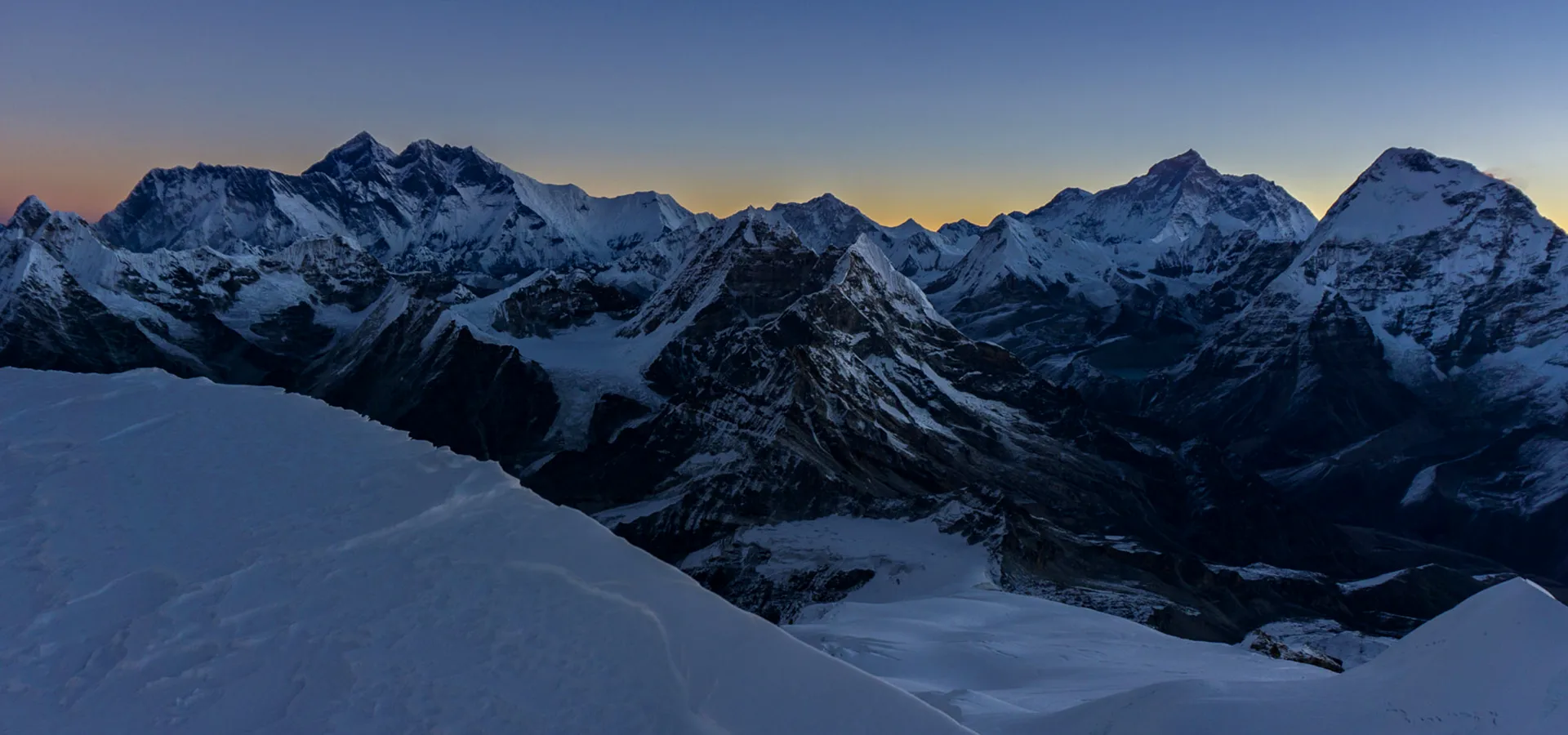
The view from the top is among the largest appeals of this adventure. Climbers get a view of five of the highest mountains in the world, Everest, Lhotse, Makalu, Cho Oyu, and Kanchenjunga, which line up horizontally on a transparent day. Such unparalleled scenery is the major factor that Mera Peak has grown to be one of the most popular peaks among first-time climbers and experienced adventure seekers who wish to avoid the crowds.
It is not only an ascent to the top of Mera Peak. It involves a slow acclimatization schedule, days of hiking around the Hinku Valley, and an up-close experience of the Sherpa culture. The trekking-to-climbing ratio renders the climb achievable and difficult at the same time. Gradually, with training and a guide, the summit is a really life-altering adventure.
Morning Star Trek is a company that is focused on the organization of Mera Peak Climbing expeditions and guarantees you the safety, the right acclimatization, and support during the journey. Their seasoned guides and thoughtfully crafted routes allow the climb to be available to people who are willing to train and take on the challenge.
Mera Peak Climbing is the ultimate Himalayan experience, providing a mountaineering challenge at a high altitude and with the cultural and natural beauty of this great range. It is an adventure that nourishes the body and soul and sets memories in the minds of the climbers that they will never forget.
- Safety first, always
- Best prices guaranteed
- Expert travel team
- Easy booking, no extras
- Customize your journey
Based on 10 reviews

Trip Highlights
- See the fabulous mountains of the highest mountains in the world-Everest, Makalu, Cho Oyu, Kanchenjunga, and Lhotse.
- Experience and climb the Himalaya with highly trained Sherpa mountaineers in a seamless mountainous environment.
- Pass through some ancient mountain villages to witness their rich culture of the Sherpa.
- Take a hike in the picturesque Hongu and Hinku Valleys.
- Observe a diversity of vistas, including the dense woodlands and rolling streams, alpine meadows, and ice.
- By doing acclimatized ascents, it is safe and at the same time offers a fun Himalayan experience.
- Make memorable photos, have nice moments in the peaceful mountains, and see wildlife in the process.
Photo and Video Gallery


Mera Peak Climbing Detail Itinerary

Day 01: Arrival in Kathmandu
When you arrive at Tribhuvan International Airport, you will check into the hotel in the centre of Kathmandu; the company representative will meet you at the airport and accompany you to the hotel. Streets filled with people, prayer flags, and their vivid atmosphere provide one with the initial experience of Nepalese culture.
There is a long flight and the remainder of the day off to relax and recuperate. Operational briefing on the trek will be done in the evening with a welcome dinner in a Nepali traditional restaurant. It is an ideal means to get acquainted with your group and get ready for the adventure shortly.

Max. Altitude: 1,400m/4,593ft. (Kathmandu)

Accommodation: Hotel
Day 02: Free day in Kathmandu
It is a preparation day before going into the mountains. In the morning, the group will inspect your equipment to ensure that everything is prepped to climb. Any missing gear is easily available by renting or buying in Thamel, the crowded tourist centre of Kathmandu.
A detailed trip briefing will follow later with your guide covering the route, safety tips, and programme each day. Time permitting, it is also possible to enjoy the cultural highlights of the city, including the Kathmandu Durbar Square or the Swayambhunath Stupa.
It is the last day of preparation before going to Mera Peak Climbing.
Max. Altitude: 1,400m/4,593ft. (Kathmandu)
Accommodation: Hotel
Day 03: Fly to Lukla and trek to Paiya
The journey starts with a small yet magnificent flight into Lukla, with a view of the impressive views of Himalayas. Once acquainted with the trekking crew, the trail starts through the forest, between small streams, and over suspension bridges.
You will see peaceful towns and have first access to Sherpa culture on the way. Usually, the trek goes down steeply to Surke and then climbs up to Paiya. You proceed on the walk that has smooth ups and downs until you reach Paiya, which is a minor settlement within piling hills.
The village is the initial overnight stay, and it is the thrilling start of the journey of Mera Peak Climbing.

Activity: 5–6 hrs trek
Max. Altitude: 2,860m/9,383ft. (Paiya)

Meal: Breakfast, Lunch & Dinner
Accommodation: Lodge
Day 04: Trek from Paiya to Panggom
The trail between Paiya and Panggom passes a picturesque, lush green forest of rhododendron, oak, and pine trees. The path starts with a moderate uphill slope, and you can admire the quiet atmosphere and clean mountain air. In between, there are small streams and rickety wooden bridges to interrupt the walk, so it is not boring and keeps some variety in the walk.
Another of the current-day hike is to cross a suspension bridge over a gushing river that provides amazing views of the valley beyond. North of the bridge, the trail proceeds with steady uphill climbs with clearings that make it possible to get a wide scenic view of local hills and far-off mountains.
In the mid-afternoon, you arrive at Panggom, a typical Sherpa village built on a peaceful hillside. The stone houses and the waving prayer flags provide an insight into the local life. An overnight stay here would provide a rest and also an experience of the serene mountainous air before proceeding with Mera Peak.
Activity: 5–6 hrs trek
Max. Altitude: 2,846m/9,337ft. (Panggom)
Meal: Breakfast, Lunch & Dinner
Accommodation: Lodge
Day 05: Trek from Panggom to Ningsow
The trek between Panggom and Ningsow is on narrow ridges and winding paths through quiet forests. It is shrouded with vegetation that makes the trail calm and quiet in contrast with the more hectic paths in the Everest Base Camp. Wildlife such as occasional birds, and the feasts of the Himalayan small mammals in the scene, as well as small streams, add to the pleasure and make the walk interesting.
A less steep path leads through forested hills as you continue, and is dotted with spots of high mountains just appearing through the trees. The route is not only beautiful but also leaves time to enjoy the peace and solitude of this area.
When you finally arrive in the small mountain settlement of Ningsow, you get a simple welcome of stone buildings and prayer flags waving in the breeze. Spending the night here assures a stress-free night before the following day’s hike.
This day is another Mera Peak Climbing adventure, as this day allows climbers to acclimatize and relax in the beauty of the Hinku valley and its serenity.
Activity: 4–5 hrs trek
Max. Altitude: 2,863m/9,393ft. (Ningsow)
Meal: Breakfast, Lunch & Dinner
Accommodation: Lodge
Day 06: Trek from Ningsow to Chhatra Khola
A trek between Ningsow and Chhatra Khola is a day longer, but you are still further in the Himalayan wilderness. The trail slowly climbs through lush forests of pine and rhododendron, where one can see some birds and wildlife on the way. Crossing small rivers and wooden bridges would be a variation of the route.
Even clearer is the landscape when you get to the edge of Makalu Barun National Park. It is also equipped with exotic flora and fauna and trekkers could view wildflower and Himalayan birds along the route.
Several hours of gradual walking take you to Chhatra Khola, a small hamlet by the river with basic accommodation and apparently a quiet overnight place. The village offers a resting time, an opportunity to experience the natural surroundings, and the days of a higher altitude trek yet to come.
This part of the trek is also a significant portion of the Mera Peak Climbing process as it allows climbers to adjust to the altitude, taking in sights of the isolation and tranquility of the backside Hinku Valley.
Activity: 7–8 hrs trek
Max. Altitude: 2,800m/9,186ft. (Chhatra Khola)
Meal: Breakfast, Lunch & Dinner
Accommodation: Lodge
Day 07: Trek from Chhatra Khola to Kothe
The trek above Chhatra Khola to Kothe mostly flows along the beautiful Hinku Valley with alpine meadows, small streams, and rocky trails. The relaxed conditions enable trekkers to appreciate the landscape and come in readiness of higher heights in front.
One of the high points now is that we got the first clear sight of Mera Peak, which makes the challenge of the summit more inspiring and encouraging. Kothe provides simple teahouses, stone-built houses, and prayer flags, providing a flavor of the Sherpa culture. At this phase, the beauty of trekking is integrated with the excitement of getting nearer to the adventure of Mera Peak Climbing.
Activity: 6–7 hrs trek
Max. Altitude: 3,691m/12,110ft. (Kothe)
Meal: Breakfast, Lunch & Dinner
Accommodation: Lodge
Day 08: Trek from Kothe to Thaknak
This day, it is a fairly easy hike between Kothe and Thaknak, which will give climbers time to adapt to the elevated altitude levels. The river path is an open valley with yak grazing patches to be met on the way. The nature of flowing waters and the vision of grazing yaks form a beautiful surrounding.
During the trek, trekkers come across basic tea houses that may be utilized to rest, take warm drinks, and eat light meals. The stops would provide an opportunity to put the body and mind at ease after seeing the mountains and having a look at the mountains around us to get prepared for the days to come.
The afternoon arrival in Thaknak should leave you sufficient time to rest and acclimatize. The village is a quiet place but provides simple accommodation with views of the mountains close by, and is thus an ideal one-night stay before heading up to Khare and higher altitudes.
Activity: 3–4 hrs trek
Max. Altitude: 4,358m/14,298ft. (Thaknak)
Meal: Breakfast, Lunch & Dinner
Accommodation: Lodge
Day 09: Trek from Thaknak to Khare
This is the day when the journey from Thaknak to Khare brings you to heights along rocky moraine valleys. The topography turns harsher, and the glacier begins to appear in sight, creating beautiful views of the Himalayan mountains. The path continuously climbs upwards and thereby enables the trekkers to get acclimatized, along with the breathtaking experiences on the way.
Khare is a base for Mera Peak Climbing. Climbers in this case are resting and getting ready to make the peak attempt, which includes checking gear and acclimation procedures. The quiet village is engulfed by the snow-capped mountains and presents a feeling of seclusion, and is like a real high-altitude experience before the tougher days to come.
This is a critical milestone day of the Mera Peak Climbing.
Activity: 3–4 hrs trek
Max. Altitude: 5,045m/16,552ft. (Khare)
Meal: Breakfast, Lunch & Dinner
Accommodation: Lodge
Day 10: Acclimatization and Pre-Climb Training at Khare
Today is a day of acclimatization in Khare at 5,045 meters, and the climbers are allowed to acclimatize as they enjoy amazing views of the other mountains around. Proper acclimatization will introduce the body to the challenges at higher altitudes experienced in the Mera Peak Climbing trip.
Guides organize practical training in the use of ropes, crampons, and axes. Frozen and low-angle terrains also allow climbers to build confidence, experience with safety procedures, and practise movement in steep terrain.
The day also talks about emergency measures, weather awareness, and avoiding altitude sickness. The objective of these sessions is to get the climbers fit both physically and mentally prior to the summit push.
Trekkers are well rested, confident, and well versed in those climbing techniques by the evening. This basic training equips the team to ascend safely the next day to Mera High Camp and make it to the summit successfully.
Meal: Breakfast, Lunch & Dinner
Day 11: Trek from Khare to Mera High Camp
The climb between Khare to Mera High Camp is generally considered a 5–6-hour gradual but exposed glacier climbs on snow. Thin cold air is challenging to endurance and concentration with each step.
On the route, the mountains impress visitors with beautiful Himalayan views, glittering glaciers, and the feeling that they are somewhere at the end of the world. The physical game is challenging yet very satisfying and makes one feel incredibly accomplished with every meter.
Mera High Camp has basic facilities and simple tents that make a comfortable place to take rest before the final summit push. This is the significant phase of the Mera Peak Climbing experience, which is both a trek at high altitude and a preparation stage for the ascent.
Max. Altitude: 5,780m/18,963ft. (Mera High Camp)
Meal: Breakfast, Lunch & Dinner
Day 12: Summit Day – Mera Peak and Return to Khare
The main day of the Mera peak climbing is summit day, which starts with an early start around 2am to 3am in the early morning. The icy slopes and glaciers present a magic, silent moment in your pre-dawn trek. Basic Crampons, Ice axe and Rope skills are used with the help of instructors experienced in traversing across crevasses and steep areas.
Hiking is an extended and challenging phenomenon that needs endurance, attention, and pace. The horizon is filled with spectacular views of Everest, Lhotse, Makalu, and Kanchenjunga, creating unforgettable Himalayan scenery.
The summit at 6,461 meters is a life-changing experience full of victory and amazement. Following photographs and after enjoying the panoramic views, climbers go through the glacier to Mera High camp and down to Khare to rest, which is a long 10-12 hours day.
Max. Altitude: 6,461m/21,198ft. (Mera Peak)
Meal: Breakfast, Lunch & Dinner
Accommodation: Lodge
Day 13: Reserve Day for Contingency
It is during this day that climbers take a reserve day at Khare, which acts as a cushion in the event of weather hold-ups or health-related revisions. The high altitude may be unpredictable, and the additional day will guarantee some time off to rest and acclimatise either ahead of or subsequent to the summit bid by all.
This day may be spent on light walks around the village, training in climbing techniques, or just the enjoyment of the snow-topped mountains around. The mild and gentle area gives the climbers time to rest after delays on the way or regain ground in case the mountain was delayed.
It is important to incorporate a reserve day in the process of successful Mera Peak Climbing, since it enhances the likelihood of hitting the summit safely and with minimum risks of altitude sickness.
Max. Altitude: 5,045m/16,552ft. ()
Meal: Breakfast, Lunch & Dinner
Day 14: Trek from Khare to Kothe
Today, you walk down the valley back from Khare to Kothe, which is a pleasant way to spend the day, to follow up after the difficult summit bid. The path continues to a lower altitude, leading through alpine meadows and rocky landscapes, thus, easier to breathe at such a level.
As you move across, the landscape diversifies as you get other views of the surrounding mountains and glaciers. The silence provides trekkers with time to think about the experience that they have had so far and enjoy the beauty of the Hinku Valley.
When you reach Kothe, you are greeted back into the tiny village with its bare stone buildings and wavering prayer flags. The overnight lodging offers a good rest and an opportunity to regenerate to face the next day of the trek to Thuli Kharka.
Activity: 4–5 hrs trek
Max. Altitude: 3,691m/12,110ft. (Kothe)
Meal: Breakfast, Lunch & Dinner
Accommodation: Lodge
Day 15: Trek from Kothe to Thuli Kharka
During this day, there is a gradual ascent through the forests and undulating ridges on the way. It is good to note that trekking from Kothe to Thuli Kharka would be very interesting on this day. The road follows the silent valleys, yak pastures, and the streams, and the trail landscapes provide some appealing views to relax within the scenic walking surroundings.
Along the trek, there are small tea houses that offer hot beverages and snacks, where the trekkers get time to enjoy their environment and rest. On the gradual ascent of the day, the gradual ascent also assists in acclimatizing the body, making it ready to reach the end of the pass to Lukla.
The phase is a significant portion of the Mera Peak Climbing trip, which involves scenic walking with a moderate rise in altitude. The very peaceful environment enables trekkers to absorb the beauty of the Himalayas as they move very slowly to the final stages of the expedition.
Activity: 5–6 hrs trek
Max. Altitude: 4,300m/14,108ft. (Thuli Kharka)
Meal: Breakfast, Lunch & Dinner
Accommodation: Lodge
Day 16: Trek from Thuli Kharka to Lukla via Zatrwa La Pass
This day, you trek out of Thuli Kharka and Lukla, crossing the highest stretch of the Zatrwa La Pass. The climb up to the pass is steep and rocky, presenting a good view of the peaks and glaciers surrounding the pass. The climb is paid off by spectacular views of the Himalayas and the valleys in the region.
Leaving the pass behind, the path rolls down the alpine meadows and small villages where the trekkers are given a last look at the traditional mountain life. Along the way, the trail is stippled with streams and yak pastures, which form pretty rest stops on your way.
Lukla is the end of the trekking part of the Mera Peak Climbing adventure. In this scene, climbers have a farewell dinner in the mountains and discuss the experience and celebrate finishing a difficult but enjoyable journey. The village consists of basic teahouse accommodation where we stay the night, as preparation for a scenic flight back to Kathmandu the next day.
Activity: 6–7 hrs trek
Max. Altitude: 4,650m/15,256ft. (Zatrwa La Pass)
Meal: Breakfast, Lunch & Dinner
Accommodation: Teahouse
Day 17: Fly from Lukla to Kathmandu
Today, a scenic flight back kits you Lukla to Kathmandu. The Himalayas are also viewed from the air, and thus leave the last opportunity to view the grand mountainous beauty.
Getting there, you are taken to the hotel, where the rest of the day and night can be spent at leisure. It is the best period to relax, go shopping in Thamel, or have a traditional Nepali meal with introspection of the amazing Mera Peak climbing.
Max. Altitude: 1,400m/4,593ft. (Kathmandu)
Accommodation: Hotel
Day 18: Final Departure
On the last day, you will get breakfast at your hotel, and Morning Star Trek will transfer you to Tribhuvan International Airport to be dropped off to take another flight. It is a convenient and on-time transfer, giving you a comfy way out of the Himalaya adventure.
It is the end of an amazing adventure across the Khumbu region, beginning in a tropical forest and remote hamlet with the indigenous Sherpa, to the mountaineering escapades of Mera Peak. Long after leaving Nepal, you will still have pictures of mountainous sceneries, glaciers, and the sense of achievement.
The day has been the final day of a memorable Mera Peak Climbing.
Max. Altitude: 1,400m/4,593ft. (Kathmandu)
If our standard itinerary doesn't fully meet your needs, we are happy to tailor it to your specific preferences and requirements.

Includes and Excludes
What’s Included?
- Airport pick up and drop in Kathmandu
- Domestic flight from Kathmandu to Lukla and back
- All transport during the trek as mentioned in the itinerary
- Accommodation in hotels in Kathmandu, teahouses along the trek, and camping at Mera High Camp
- Daily breakfast, lunch, and dinner during the trek
- Experienced English-speaking Sherpa guides and support staff
- Porters to carry your trekking gear
- Guidance and training for climbing, including ropes, crampons, and ice axes
- All necessary permits: Khumbu Pasang Lhamu Rural Municipality, Makalu Barun National Park, and Mera Peak climbing permit
- Pre-trek briefing, daily safety instructions, and summit preparation
- Scheduled acclimatization to help your body adjust to high altitude
- Emergency support during the trek
- Government taxes and service charges
What is not Included?
- International flight tickets
- Nepal visa fee
- Meals or drinks outside the itinerary
- Personal expenses such as snacks, Wi-Fi, hot showers, phone charging, or laundry
- Travel insurance, including rescue and medical evacuation
- Tips for guides, porters, or support staff
- Extra nights in hotels due to early arrival, late departure, or flight delays
- Extra costs caused by bad weather, natural disasters, political issues, or other unavoidable situations
- Personal climbing gear not included in the package (can be rented locally if needed)
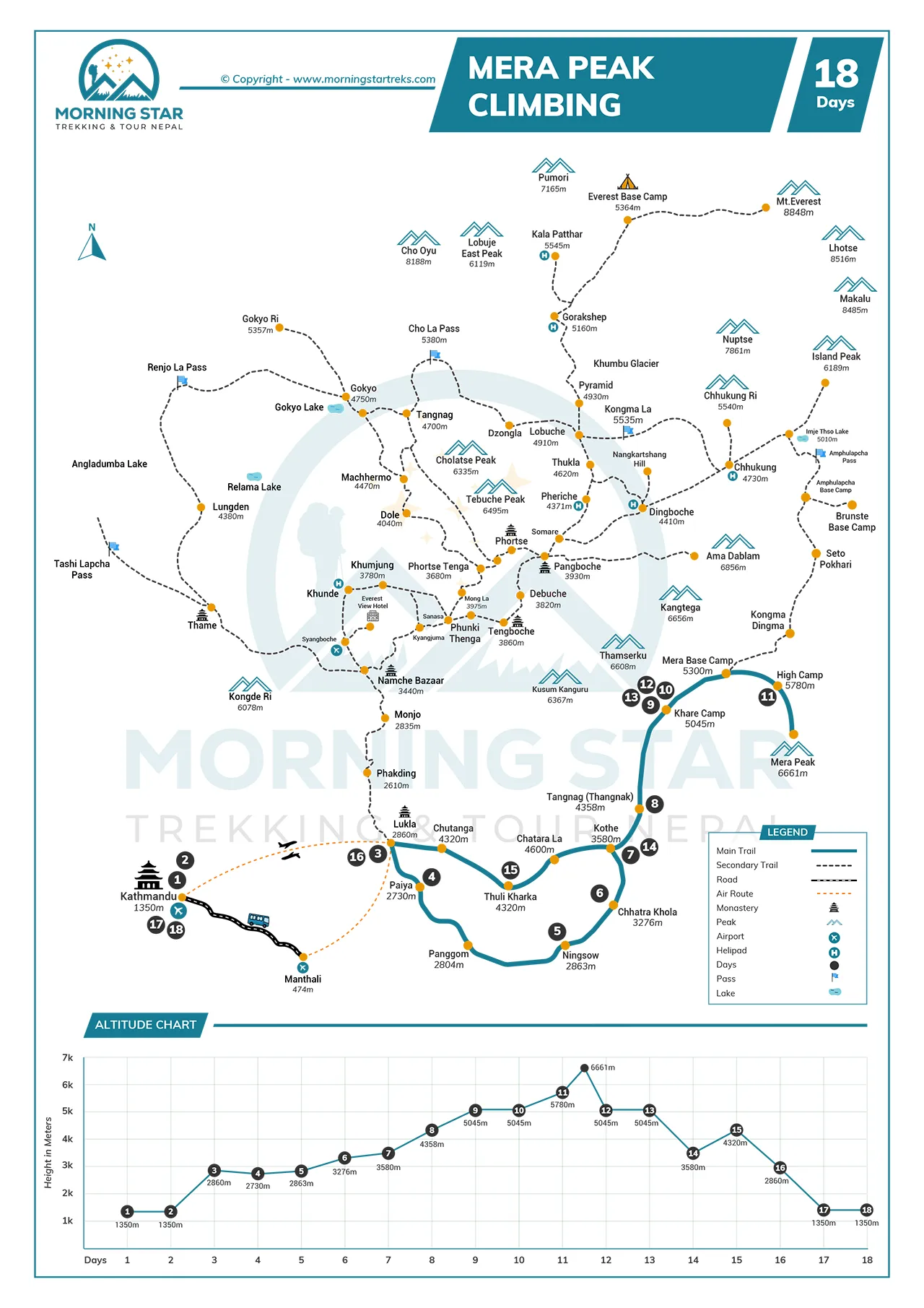
Route Map & Altitude Chart
Trip Information of Mera Peak Climbing
Best Time
The spring (March to May) and autumn (September to November) seasons are the best times for Mera Peak Climbing. These are the months when the weather is mostly stable, skies are clear and moderate, trekking and climbing are also safer and enjoyable.
Autumn usually has stable snow, while spring can have deep snow and higher risk of avalanches on the upper slopes. The weather is good with plenty of snow up the higher slopes, with the best of the Himalayan view in sight.
Spring means blooming rhododendrons and alpine flowers on the trails, which add bright colors to the landscape. Autumn has clear air and good visibility of the mountain and mountains Everest, Lhotse, Makalu, and others. Both seasons can be best used to take photographs, wildlife observation, and explore the local culture in the mountain villages.
However, winter can be very cold, with high technical difficulty due to snow and icy paths, though climbing is possible for experienced climbers. Heavy rain, landslides, and slippery paths may disturb the trek and make it risky during the monsoon season (June to August).
Timing is of the essence to anyone considering taking up a Himalayan adventure. Select either spring or autumn, because in this case, the selected period will not only be safe, but will also be the greatest experience and the most scenic. Mera Peak Climbing can be a wholesome experience only when it is planned properly in these seasons.
Elevation and Distance
The overall altitude gain involved in the Mera Peak Climbing adventure begins at Lukla at 2,860 meters (9,187 ft.) to the peak at 6,461 meters (21,199 ft.). This implies that, during the climb and trek, climbers have to gain about 3,600 meters in altitude. The slow climb will enable an appropriate acclimatization and will prevent serious risk of altitude sickness.
The trekking trail is about ~125 km across as a two-round-trip trip (base villages approach, high camp, climb to the summit). The walking distances are varied daily, with shorter and steeper routes at high camps and longer, moderate, lower valley walks. These trails will have forests, rivers, suspension bridges, moraines, and open alpine ridges that will provide climbers with a variety of different landscapes.
The amount of elevation gain is moderate during trekking from Lukla to Paiya, Panggom, and Ningsow, whereas the amount of elevation gain becomes dramatic during the stretch from Thaknak to Khare and Mera High Camp. Gradual ascending and acclimatization enable the climber to have a safe summit.
Having the knowledge of the altitude and distance gives the trekkers an opportunity to prepare themselves physically and mentally for the journey. Proper information on the topographical and complete ascent represents a path to successful Mera Peak Climbing.
Difficulty and Altitude Sickness
The Mera Peak Climbing can be classified as moderate to strenuous, with the trekking days being long and with a technical top. The trails become considerably more difficult as you approach the higher elevation areas with rocky moraines, glaciers, and steep climbs. One needs to be in good physical shape, have strength, as well as be acclimated well to actively go through these passages safely.
The condition is known as Acute Mountain Sickness (AMS) and takes place in individuals over 3,000 meters of the altitude. The prevalent signs and symptoms are headache, nausea, dizziness, weakness, and lunglessness. On Mera Peak, the initial signs should be noted and precautionary steps followed, like climbing slowly, taking up lots of water, avoiding alcohol use, and a rest day should be part of the steps.
The guides oversee climbers during the expedition and might recommend extra acclimatization or drugs in case of AMS manifestations. Measuring the oxygen saturation using a pulse oximeter may be used to monitor the acclimatization process of the body to the increased altitude.
Although the most challenging aspect of the climb is the summit push, with proper advice and enforcement of high-altitude safety precautions, Mera Peak can be a successful task for prepared climbers. Understanding the dangers associated with altitude and acting suitably to protect against them can contribute to high safety and success rates.
Maximum and Minimum Walk per Day
In the climb of Mera Peak, the walking hours differ each day depending on the nature of the ground, as well as altitude. The days that are usually shorter, like arrival or acclimatization days, average take 3-4 hours and give the trekkers time to relax and acclimatize. The days of moderate treks vary by 5-6 hours in forests, ridges, and valleys.
Longer days, including the day to Khare, Mera High Camp, and the summit day, may take 10-12 hours; good stamina and pacing are essential. By scheduling walks about hardship and elevation, climbers have likelihood of saving energy, acclimatization, and enjoy the unmatched Himalaya beauty as they walk their way to the peak.
Accommodation
In the process of Mera Peak Climbing, the accommodation is altitude-based. At the lower altitudes, trekkers book rooms in those typical teahouses, which provide simple rooms, communal toilets, and hot food. These teahouses are friendly and accommodating places where one can rest after a day’s hike.
At a higher altitude, you can find teahouses up to Khare which offer basic rooms and simple meals and at High Camp, camping is required.
The use of teahouses, as well as tented camps, combines the elements of local societal hospitality with that of the safety and the convenience of accommodation along the way towards the peak using tented accommodations, creating a more enjoyable trip experience, and all the better to be able to cope along the way.
Food and drink
In this trek, the meals are mostly provided in teahouses and lodges on the trail. There are many local Nepali food options available in the low areas, which include dal bhat (rice with lentils), momo (dumplings), and noodles. Pasta, eggs, and soups are available in simple lodge menus to meet tastes.
At higher altitudes, food is simpler yet healthy, aimed at providing trekkers the required energy to face the rigorous heights. There is also boiled water readily accessible, and trekkers are encouraged to purify their drinking water with the help of purification tablets or filters.
Chocolate, nuts, and energy bars are also considered to be used as snacks to get energy in between treks. Generally, the food is hearty, cozy, and adequate to satisfy the energy requirements of the climbers in the region, with a hint of the Khumbu region taste.
Alternative Routes
Mera Peak Climbing can be approached in a few ways, so you have flexibility in time and experience. The normal trek passes over the Zatrwa La, and is a shorter, steeper trail with fabulous alpine and yak meadow views.
Otherwise, trekkers have longer options through Paiya, Panggom, and Ningsow, which take less rapid ascent and spend more time in forested valleys and other traditional Sherpa villages. This path will be more acclimatizing and will provide a more cultural experience.
The decision on the route to be taken depends on physical condition, acclimatization requirements, and time at hand. Both venues give access to Khare and Mera High Camp, which gives climbers the opportunity to safely reach the summit. Right Planning is the key to a secure and pleasing Mera Peak Climbing adventure.
Can a Beginner Join?
Yes, first-timers can take Mera Peak Climbing, as long as you are fit, prepared, and guided as well as should have basic mountaineering skill. It is a high-altitude trek, which demands stamina and slow acclimatization.
The pre-trek training should target cardiovascular, leg strength, and endurance to cope with long days of pacing and supporting a backpack. Regular hikes and small treks at intermediate elevations may allow the body to adapt.
Morning Star Trek guides will explain and teach their basic skills of climbing, rope work, and glacier travel so that even first-time climbers have a good opportunity to reach the peak safely. Prepared and dedicated beginners can have fun and get the satisfying experience of Mera Peak Climbing.
Preparation and Fitness
Mera peak climbing preparation involves cardio, strength, and endurance training. Running, cycling, or swimming exercises enhance long-distance trekking stamina as well as lung capacity.
The strength training must target legs, core, and upper body to deal with steep climbs, a hip pack, and climbing gear. Activities such as squats, lunges, and weighted hikes work.
The body adapts with endurance training, i.e., long hikes, preferably at higher and higher altitudes. Backpack hikes are quite similar to the conditions and instill confidence in trekking. A safe and enjoyable Mera Peak Climbing requires proper preparation, acclimatization, and adherence to advice by professionals.
Gadget Charging, Internet & Communication
During the Mera Peak trek, there may be a restriction on charging electronic devices, particularly in higher-altitude camps such as the Khare and Mera High Camp. Phones, cameras, and GPS devices are highly recommended to be charged using solar chargers or power banks. Teahouses in lower areas have a simple charging service, but there might be power interruptions.
Above Lukla, internet connectivity is intermittent. Some lodges might have Wi-Fi, but it is slow and not one you can use for a video call or download heavy files. Mobile coverage is patchy; therefore, plan communication accordingly.
When limited connectivity is available, trekkers must warn family and friends and have offline maps or an emergency device to be safe and navigate accordingly.
Permit
Climbers wishing to undertake Mera Peak Climbing are required to get permits. First one is Khumbu Pasang Lhamu Rural Municipality entry permit. Second one is Makalu Barun National Park entry permit that controls conservation and guarantees the safety of natural resources and wildlife.
There is also Mera Peak Climbing Permit that should be obtained from the Nepal Mountaineering Association. In order to begin the trek, permits have to be booked in advance, usually with trekking agencies such as Morning Star Trek.
It is important to have valid identification and keep permit documents on hand, as the checks might be made at the entry to the trail. Effective permit management means that the climbing process is legal and devoid of any hassles.
Transportation
The most common and efficient method of starting the trek is by flight from Kathmandu to Lukla. They include these short mountain flights that offer breathtaking views of the Himalayas, but are weather-dependent.
Road transport to the trail head can also be done in the event of cancellations caused by poor weather, but this route is also quite taxing on the system, as it is full of rough terrain, takes much longer.
Proper transport planning and the provision of buffer days before the expedition starts will help the expedition get off smoothly. Trekking agencies book flights, transfers, and backup plans, thereby making the trek safe, convenient for climbers on their trip to Mera Peak Climbing.
What to Expect
Mera Peak Climbing is a combination of a cultural and high-altitude adventure. Trekkers encounter the culture of the Sherpa people, dense forests, and magical water rivers, and later are changed to the alpine environment and glaciers.
Be prepared to walk long hours and climb steep slopes, sleep in tents or in small lodges, and get used to the effects of the altitude with time. The summit packing is a tough yet very rewarding journey.
Good planning, endurance, and patience are essential. Mera Peak Climbing is an unforgettable experience with its mixture of natural beauty, cultural experiences, and the success of reaching the peak. Each step one takes towards the peak reinstates why it is regarded as one of the most iconic trekking peaks that Nepal has to offer.
Most Asked Questions
- Safety first, always
- Best prices guaranteed
- Expert travel team
- Easy booking, no extras
- Customize your journey
Based on 10 reviews
Have Questions?
+977 9767224414