
 English
 Dutch
Dutch Japanese
 Hindi
Hindi Italian
 Spanish
 French
 German
 Chinese
 Korean
 Arabic
 Hebrew
 Russian
 Portuguese
 Danish
 Czech
Czech Polish
 Swedish
Have Questions?
+977 9767224414
Unmissable holidays deals - Save up to 20%
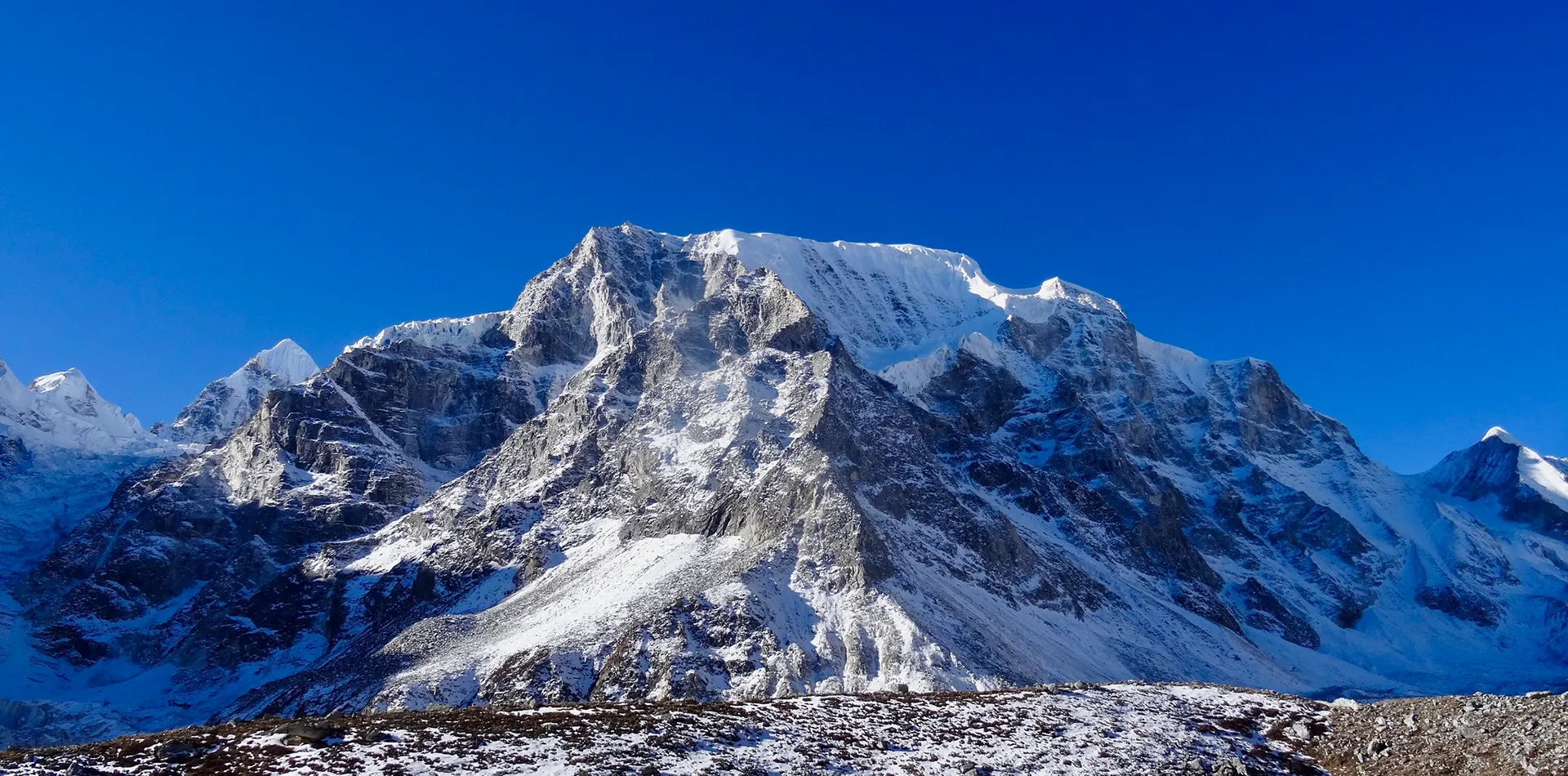
Nar Phu Valley Trek

Duration
14 Days

Trip Difficulty
Moderate

Max. Altitude
5,315m

Destination
Nepal

Group Size
2-16 pax

Accommodation
Hotel, Lodge

Transportation
Bus , Flight, Jeep

Meals
B L D
Explore more facts about the trip
Overview of Nar Phu Valley Trek
The Nar Phu Valley Trek is a 12 to 17-day journey to the Himalayas of central Nepal. Exploring the Annapurna highlands, this trek is a combination of rugged Himalayan trails, remote trekking trails, and an immersive Tibetan cultural showcase. This trek is the ideal option for those who are interested in a less-crowded and intimate trekking experience in the Annapurna region of Nepal.
Located northeast of Pokhara, the Nar and Phu valleys are sitting between the Manaslu and Annapurna Himalayan massifs. This makes them a part of the Annapurna Conservation Area, a great preservation effort that has saved many local species. You might even encounter some of the wildlife while doing this trek.
The Nar and Phu valleys were a part of the Forbidden Kingdom of Tibet, which explains why the region is highly influenced by Tibetan culture and religion. The valleys are sometimes called Little Tibet since they resemble traditional Tibetan villages so much. The region is very lightly populated, with only 300 permanent residents accounted for by the 2011 census. Recent data suggests that the number is now around 700.
This trek is highly praised for its cultural immersion and religious experiences. You will get to visit many monasteries along the way, including Sartek Thrangu Choepel Ling Gompa, Nar Phedi Monastery, and more. In addition to that, you get to experience many stunning scenes throughout the trek, featuring peaks such as Annapurna II, Himlung Himal, Gangapurna, Pisang Peak, and Tilicho Peak.
Overall, the Nar Phu Valley Trek offers a unique trekking experience within the Annapurna region. This circuit itinerary passes through deep and high-altitude gorges, lush forests, alpine meadows, snow-covered trails, and many remote villages. The experience is one of the most remote and least crowded you can have in Nepal. Learn more about this trek below, as we will discuss all of its aspects, starting with the highlights.
- Safety first, always
- Best prices guaranteed
- Expert travel team
- Easy booking, no extras
- Customize your journey
Based on 10 reviews

Trip Highlights
- Cross the Kang La Pass, with a panoramic view of Annapurna II, Pisang Peak, Tilicho Peak, and Gangapurna.
- Explore the village of Phu and wander around the ancient Tibetan village with traditional houses, monasteries, and old fortresses.
- Experience the way of Tibetan Buddhism in the village of Nar.
- Visit a riverside hot spring and take a relaxing break by it.
- Witness gorgeous views of the Himalayas, the valleys, glaciers, and the hills.
- Trek through alpine meadows, terrace farmlands, and rhododendron forest, experiencing scenic trails.
Photo and Video Gallery


Nar Phu Valley Trek Detail Itinerary

Day 01: Arrival at Kathmandu
Your flight to Kathmandu is going to be a memorable ride, as it is your first day on the Nar Phu Valley Trek, and you get to see many giant peaks in the distance. After you reach the Tribhuvan International Airport in Kathmandu, you will have to get to the immigration section and get your tourist visa before you leave the airport. As you exit the terminal, you will see one of our representatives waiting for you. He will greet you and transfer you to the accommodation for the night.

Max. Altitude: 1,400m/4,593ft. (Kathmandu)

Accommodation: Hotel
Day 02: Sightseeing in Kathmandu
The next day on the Nar Phu Trek itinerary, we will go on a full-day sightseeing tour around Kathmandu Valley. It is honestly one of the best ways to start your journey in Nepal. Throughout the day, you will get to visit sites such as the Kathmandu Durbar Square, Patan Durbar Square, Taragaon Museum, Garden of Dreams, Pashupatinath Temple, Bouddhanath Stupa, and more. You can also add sites you want to visit to the itinerary of the day.
Max. Altitude: 1,400m/4,593ft. (Kathmandu)
Accommodation: Hotel
Day 03: Drive to Dharapani/Syange/Jagat
On the 3rd day of the Nar Phu Trek itinerary, we will be driving around a lot. Leaving Kathmandu, we will head east and drive over the Prithvi Highway to get to Besi Sahar. This drive will take us about 5 to 6 hours, covering 125 km of distance. Next up, we will change our vehicle from a bus to a jeep and head towards Dharapani. The next leg of the drive takes about 3 to 4 hours, covering almost 60 km. We will pass by Bhulbhule, Ngadi, Syange, Jagat, Chamje, and Tal to reach Dharapani village.
Max. Altitude: 1,860m/6,102ft. (Dharapani)
Accommodation: Lodge
Day 04: Trek to Koto
Today is the first trekking day of the Nar Phu Trek itinerary. This day features a 10 km long trail with an elevation gain of 710 meters, which can be covered in about 5 to 6 hours. Starting off from Dharapni, we will head to Bagarchhap village, passing by the Marsyangdi River and mani walls. From there, we will head to Danakyu village, reaching 2300 meters above sea level. Our next stop is Timang village, where we will have a filling lunch before hitting the last leg of the trek and reaching Koto.

Activity: 5 to 6 hours trek
Max. Altitude: 2,600m/8,530ft. (Koto )
Accommodation: Lodge
Day 05: Trek to Dharamshala
The following day, on the Nar Phu Trek itinerary, we will trek for 5 to 6 hours, cover about 8 km, and gain a net elevation of 630 meters. The initial part of the trail is steep and narrow, going alongside the Nar Phu River. Entering the Nar Phu Valley, the trail turns rugged and goes into a deep gorge before rising back up. Soon enough, we will cross a suspension bridge over the Phu River and reach a riverside hot spring. After about an hour from there, we will reach Dharamshala (3300 m).
Activity: 5 to 6 hours trek
Max. Altitude: 1,457m/4,780ft. (Dharamshala )
Accommodation: Lodge
Day 06: Trek to Kayang
Today’s Nar Phu Trek itinerary features the same traits as the previous day, with 5 to 6 hours of trek duration and about 8 km of trek distance. The trek gains us 260 meters of elevation, starting with a rugged trail ascending towards Meta village. Sitting at 3700 meters above sea level, this village offers a great view of the Nar Phu Valley. From there, the trail opens up wide as we make our way to Jhunam village (3640 m). Soon enough, we will reach Chamakh (3800 m), the last stop before we reach Kayang village.
Activity: 5 to 6 hours trek
Max. Altitude: 3,880m/12,730ft. (Kayang)
Accommodation: Lodge
Day 07: Trek to Phu village
Day 7 of the Nar Phu Trek itinerary calls for a 7 km trail with an estimated trek duration of 4 to 5 hours. The elevation gain of the day is 640 meters, starting with a dry and arid trail alongside the Phu River. Following the trail along the river, we will get into a high-altitude gorge. From there, we will cross many small streams and rest at a small campsite. Soon enough, we will make it to our destination of the day, reaching 4200 meters above sea level. You can explore an old dzong there and walk around the village as well.
Activity: 4 to 5 hours trek
Max. Altitude: 4,100m/13,451ft. (Phu village )
Accommodation: Lodge
Day 08: Acclimatization day in Phu village
Phu village is a great place to acclimate ourselves to the high altitude. This Tibetan-influenced village offers a great chance to experience the culture of the locals. There are many traditional stone houses, a couple of chortens, and a monastery. You can often find locals herding yaks and weaving wool from sheep since they are the two most common jobs there. We will spend the day exploring the village, walking around the outskirts, and enjoying the scenery of the landscape. Spending the night in Phu, we will end the only acclimatization day on the Nar Phu Trek itinerary.
Max. Altitude: 4,100m/13,451ft. (Phu village )
Accommodation: Lodge
Day 09: Trek to Nar
Today’s trek features 6 to 7 hours of duration, around 10 km of distance, with a net elevation loss of 90 meters. The trek starts with an arid trail heading back to Phu River, passing one of the dzongs of the village. This trail leads us to the village of Khyang, where a dramatic scene of mountains and gorges awaits us. From there, we will head towards the village of Charkha, crossing many small streams. After lunch at Charkha, we will get on the last part of the trek and reach Nar.
Activity: 6 to 7 hours trek
Max. Altitude: 4,200m/13,780ft. (Nar )
Accommodation: Lodge
Day 10: Trek to Kang La Phedi
Day 10 of the Nar Phu Trek itinerary is the shortest trekking day of the journey. Today we will trek for about 3 hours, covering about 4 km of distance. The elevation gain of the day is 490 meters, reaching 4600 meters above sea level at the end of the trek. Initially, we will pass by meadows and cross small streams with a view of Pisang Peak. Following a wide trail, we will gradually climb over a rocky terrain to reach Kang La Phedi. This camping site is the base of the Kang La Pass.
Activity: 3 hours trek
Max. Altitude: 4,530m/14,862ft. (Kang La Phedi )
Accommodation: Lodge
Day 11: Trek to Pisang via Kang La Pass
The following day on the Nar Phu Trek itinerary is the longest trekking day of the journey. Today we will be on the trails for about 7 to 8 hours, covering about 12 km of distance with a net elevation loss of 2115 meters. We will begin the climb to the pass early in the morning to witness a stunning sunrise scene from the top. Reaching the summit, we will be at 5315 meters above sea level with a dramatic view of Pisang Peak, Tilicho Peak, Gangapurna, Annapurna II, and more.
After taking the scene and spending some time resting at the summit, we will begin the descent to Pisang. The trail first leads us to Ngawal, reaching 3660 meters of elevation. This will be our lunch spot of the day. Post-meal, we will continue the descent through the Marsyangdi River valley and reach Pisang. This marks the end of the trekking day on the Nar Phu Trek itinerary.
Max. Altitude: 3,250m/10,663ft. (Pisang )
Accommodation: Lodge
Day 12: Drive to Besi Sahar
From Pisang, we will drive for about 5 to 6 hours and cover about 65 km to reach our destination of the day, Besi Sahar. The net elevation loss of the day is 2440 meters. After a lovely breakfast at Pisang, we will leave the village and take in the final scenes of the peaks and valleys. The road is bumpy and dusty for the most part.
Max. Altitude: 760m/2,493ft. (Besi Sahar)
Accommodation: Lodge
Day 13: Drive to Pokhara and sightseeing
The following day is yet another driving day on the Nar Phu Trek itinerary, with a day tour around Pokhara. Beginning the drive in the morning, we will reach Pokhara in just 3 to 4 hours. Throughout the day, we will visit sites such as the World Peace Stupa, Pumdikot Shiva Statue, Sarangkot View Point, Tal Barahi Temple, Bindabasini, and more. Our evening hours will be spent by the Phewa Lake.
Activity: 3 to 4 hours drive
Max. Altitude: 822m/2,697ft. (Pokhara )
Accommodation: Hotel
Day 14: Drive to Kathmandu
This is the last day of the Nar Phu Trek itinerary. We will drive all the way back to Kathmandu from Pokhara, which takes about 8 hours to complete. After we reach the capital, one of our reps will drop you off at the accommodation for the night.
Max. Altitude: 1,400m/4,593ft. (Kathmandu)
Accommodation: Hotel
If our standard itinerary doesn't fully meet your needs, we are happy to tailor it to your specific preferences and requirements.

Includes and Excludes
What’s Included?
- Airport transfers in Kathmandu, including pickup on arrival and drop-off on departure
- Tourist bus transport from Kathmandu to Besisahar and Pokhara to Kathmandu
- Local jeep transport from Besisahar to Dharapani and Besi Sahar to Pokhara
- Hotel accommodation in Kathmandu before and after the trek
- Comfortable teahouse or lodge accommodation during the trek (twin-sharing)
- Breakfast in Kathmandu hotel, and three meals (breakfast, lunch, dinner) each day during the trek
- Professional, English-speaking trekking guide and required porters
- Trekking guide salary, insurance, meals, accommodation, equipment, transportation, etc
- All necessary trekking permits and national park entry fees
- Basic medical kit and safety equipment during the trek
- Sleeping bag, down Jacket, walking poles, duffel bags (you have to return after the trek)
- Certificate of achievement at the end of the journey
- Government taxes and agency service charges
What is not Included?
- International flights to and from Nepal
- Nepal entry visa fees upon arrival
- Lunch and dinner in Kathmandu
- Personal expenses such as drinks, snacks, hot showers, Wi-Fi, and device charging
- Travel insurance that covers medical emergencies and helicopter evacuation
- Tips for guides, porters, and drivers
- Extra hotel nights caused by flight delays, early arrival, or late departure
- Personal Travel insurance and emergency rescue evacuation
- Extra cost caused by natural or political disturbances beyond our control
Route Map & Altitude Chart
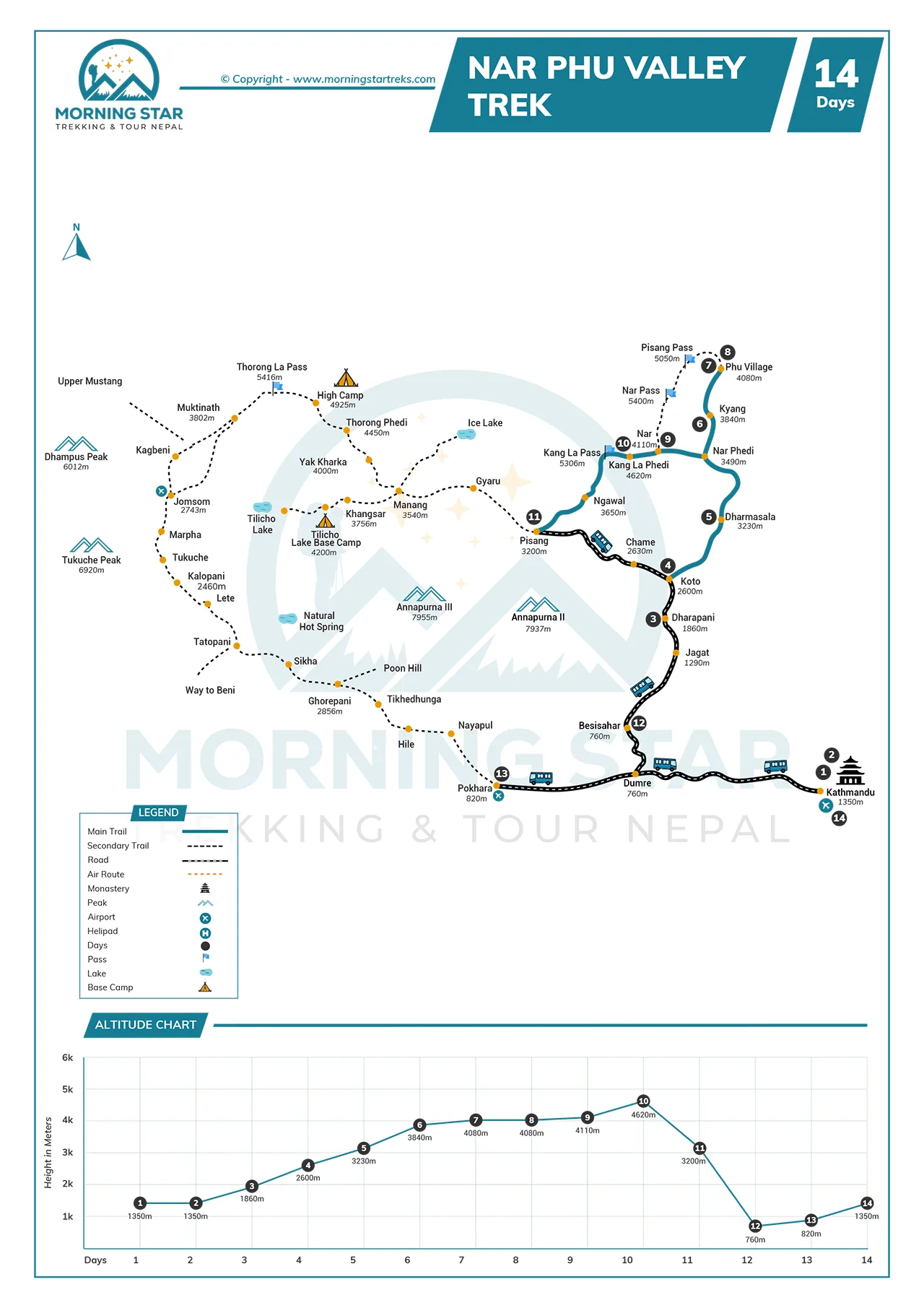
Trip Information of Nar Phu Valley Trek
Best season and weather
One of the best seasons for the Nar Phu Valley Trek is autumn. This season offers great traits such as very minimal chances of rainfall, clear skies, peak visibility, mild daytime temperature, and more. The other best season for this trek is spring, when the Rhododendron flowers bloom and the entire Annapurna region comes to life. The animals are more active during this season, increasing the chances of encountering them.
Difficulty
This trek has been officially graded as strenuous by the NMA. Featuring many ascents and descents, this trek has been rated an 8.5 out of 10 by our guide and trek experts. The high altitude also adds to the difficulty, making it unsuitable for beginner trekkers.
Altitude Sickness
Altitude sickness is not a highly likely condition during this trek since we will practice all the preventive measures and also spend a whole day acclimating. Morning Star’s trek guide will measure your blood oxygen levels to see for any early signs of altitude sickness so we can take the necessary steps in advance.
Preparation and Fitness
To prepare for this trek, you have to get on a physical preparation plan that includes doing cardio and endurance training. These exercises will get you ready to take on the rugged and steep trails of the trek. The recommended preparation period is 10 to 12 weeks before the start of the trek.
Food and Accommodation
Dal Bhat, Tibetan dishes, different types of potato dishes (stew and soup), noodles, thukpa, yak meat, etc., are the common options. You can also get a couple of Western foods throughout the trek. The trek package provides 3 meals per day during the trekking days, while your lunch and dinner in city areas will not be covered by the package. Similarly, accommodation fees will be covered by the package for the entire journey.
Transportation
All the ground transport required by the Nar Phu Trek itinerary will be included in the trek package. You do not have to pay separately. We do not cover any flight expenses.
Communication
Unfortunately, you will not receive mobile networks for a few days after we cross Dharapani on the 5th day. However, you will get to connect to Wi-Fi at certain tea houses along the way. At the end of day 10, you might receive some mobile network. For emergencies, the trek guide will have a satellite phone.
Permit
Trekkers are required to have a Restricted Area Permit (RAP) and an Annapurna Conservation Area Permit (ACAP) in order to do this trek. The permit fees will be covered by the package.
Visa
Upon arrival in Kathmandu, you will have to work out your tourist visa and pay your visa fees as per the intended duration of stay. This will not be a part of the trek package as it is a personal expense.
Travel Insurance
If you are not insured, we can not take you on this trek; it’s a policy we follow strictly. Your insurance must cover expenses up to 5500 meters so that you do not have to pay hefty medical bills in the rare cases of medical emergenices.
Extra Expenses
Things such as flight expense, visa fees, travel insurance fees, lunch and dinner in city areas, tips for the crew members, additional meals, extra nights, personal trekking equipment, emergency rescue expenses, any kind of beverages, hot shower and laundry fees, Wi-Fi fees, etc. are your extra expenses.
Private vs. group trek
A group trek to the Nar Phu Valley consists of pairing up with random trekkers who would like to go on the same trek at the same time as you. You will be sharing one room with one of the trekkers of the group; you can also upgrade to a private room. Meanwhile, a private trek is one with your family and friends, and anyone who is fit enough to be on the trek. This is a great option since you can enjoy the trek with your close ones.
Most Asked Questions
 General
What is the difficulty level of the Nar Phu Valley Trek compared to the Annapurna Circuit?
The Nar Phu Valley Trek is a bit easier compared to the standard Annapurna Circuit trek, which can take anywhere from 15 to 22 days.
How remote is the Nar Phu Valley, and what facilities are available in the villages?
The Nar Phu Valley is pretty remote, with only the basic facilities available at most villages, including food, lodging, and communal washrooms.
Are there any cultural or religious customs trekkers should respect in Nar and Phu villages?
Yes, you should always go around chortens from the left, in a clockwise direction. This applies to every religious site in the Buddhist religion.
What is the best group size for the Nar Phu Valley Trek, and is solo trekking allowed?
There is no such thing as “best group size”, and solo trekking is not allowed in this region.
How does the Nar Phu Valley Trek differ from other treks in the Annapurna region?
Most of the Annapurna region treks have been heavily commercialized; they are still a great trekking experience, but you will find crowds at some sites. Meanwhile, the Nar Phu Valley Trek is free from huge crowds, offering an intimate experience with nature.
What are the highlights of exploring Phu Village during the acclimatization day?
The village of Phu offers a great view of the peaks and valleys in the surrounding area. You can also visit the local monastery and ancient forts in the village.
 Preparation & Fitness
What specific training is recommended for the steep ascent to Kang La Pass?
For any steep ascents, you can hit the ladder machine at the gym or go on short hikes with similar steep climbs.
How much daily walking time should I prepare for on the Nar Phu Valley Trek?
On average, you will walk about 4 to 5 hours daily, so prepare likewise.
Are there any altitude acclimatization tips for the day in Phu Village?
Climbing high and sleeping low is proven to be the best method for acclimatization, so climb a couple of hundred meters if you can.
What type of trekking boots are best for the Nar Phu Valley Trek?
Normal trekking boots are fine for this trek; you do not need any special shoes.
Is prior trekking experience necessary for the Nar Phu Valley Trek?
Yes, tekkers must have some prior trekking experience necessary for the Nar Phu Valley Trek.
 Insurance and Visa
Do I need a special visa for trekking in the restricted Nar Phu Valley area?
No, you do not need any kind of special visa for trekking in the restricted Nar Phu Valley area. However, a couple of trekking permits are mandatory.
What type of travel insurance is mandatory for the Nar Phu Valley Trek?
Any kind of travel insurance that covers medical expenses and emergency evacuation expenses in the highlands is mandatory for the Nar Phu Valley trek.
Does my insurance need to cover high-altitude trekking up to Kang La Pass (5,315 m)?
Absolutely, your travel insurance package must cover mishappening expenses up to 5315 meters (at least). Normally, you will find packages covering up to 5500 meters or 6000 meters.
How do I ensure my insurance includes emergency helicopter evacuation for this trek?
You can simply ask the insurance provider, or you can go to one of the providers referred by our trek experts. We will let the provider know the details of the trek, and you can simply pay your insurance fees; rest assured that your emergency expenses will be covered.
Are there any visa checkpoints or permit checks during the trek?
While there are no visa checkpoints, there are a couple of permit checkpoints throughout the trek.
Can I extend my Nepal tourist visa if the trek schedule changes unexpectedly?
Yes, you can extend your Nepal tourist visa by visiting the Tourism Board Office in either Kathmandu or Pokhara. Or you can simply visit this link.
 Guides & Support Staff
Is it mandatory to hire a guide for the Nar Phu Valley Trek due to its restricted area status?
Yes, it is absolutely necessary to hire a licensed guide for the Nar Phu Valley Trek due to its restricted area status.
How many porters are typically needed for a group of 4 trekkers on this route?
For a group of 4, you will need at least 2 porters to carry your heavy bags throughout the Nar Phu Trek itinerary.
What is the standard tipping amount for the crew members on the Nar Phu Valley Trek?
There is no such thing as standard tips; you can tip the amount you are content with.
Can the guide assist with cultural explanations in the Tibetan-influenced villages?
Of course, our guides are well-experienced and knowledgeable about the villages of the Nar and Phu valley.
Are porters provided with proper gear and insurance for high-altitude sections?
Yes, both the guides and the porters are equipped with proper gear for high-altitude passes, and they are insured as well.
How experienced should the guide be for navigating the remote trails to Nar and Phu?
Having trekked the itinerary at least 10 to 15 times is enough to become a lead guide for the Nar Phu Valley Trek.
 Accommodation and Facilities
What are the sleeping arrangements like at campsites in Dharamshala and Kang La Phedi?
Even though we will be spending nights at campsites, we will not be actually camping. We will spend our night at a nearby tea house.
How basic are the teahouses in Phu Village compared to those in Besi Sahar?
Besi Sahar is a well-facilitated town, while Phu village is a remote settlement in the highlands. The facilities are very basic there, with nothing more than lodging, food, and a shared restroom.
Are there any hot showers or electricity available in the Nar Phu Valley campsites?
Yes, hot showers are available at most of the tea houses, but you will have to pay a couple of USD for them.
 Food and Drinks
What types of meals are typically served during the Nar Phu Valley Trek?
You can expect a bunch of local produce, regional dishes, western options, and traditional Nepalese meals. Vegetarian options are in abundance, while vegan or gluten-free options are hard to come by.
Is drinking water readily available, or should I bring a water purifier for the trek?
Drinking water is readily available, but some of the sources can be contaminated, so we recommend the use of water purification tablets every time you refill.
Are vegetarian or vegan food options available in the remote villages of Nar and Phu?
Yes, you can get vegetarian options throughout the trek, but vegan food is not a possibility. The resource is scarce there, and the locals use every bit of it.
 Weather & Seasons
What are the weather conditions like at Kang La Pass during the peak trekking season?
During spring and autumn, the weather conditions at Kang La Pass are great. You will experience some swift gusts, but nothing major.
How does the monsoon season affect the trail conditions?
The monsoon rain makes the dirt tracks muddy and the ascents and descents slippery, which is a big deal when you have to walk for hours daily.
Is the Nar Phu Valley Trek feasible during winter, given Phu Village’s snow-covered conditions?
We recommend not doing this trek in the winter season since the snow can be very hard to navigate and traverse.
Are there frequent weather-related delays for the jeep ride from Besi Sahar to Dharapani?
No, there are generally no delays for the jeep ride from Besi Sahar to Dharapani.
 Health & Safety
What are the risks of altitude sickness when crossing Kang La Pass?
On paper, the 5315-meter-high Kang La Pass seems like an altitude sickness-infested place, but since we will just be passing by, we are less likely to get altitude sickness.
Are there medical facilities available in the remote Nar and Phu villages?
Yes, there are medical facilities in the remote Nar and Phu villages, but they are not well-equipped.
What precautions should I take for drinking water safety in the Nar Phu Valley?
You can simply use water purification tablets every time you fill your water bottle.
How safe are the narrow, steep trails along the Nar Phu Valley Trek?
The narrow trails are very safe throughout the trek; you can trek worry-free.
What emergency evacuation options are available if injured on this trek?
A helicopter evacuation is the only option available if you are injured on the trek.
 Booking & Payment
What is the booking process for obtaining restricted area permits?
Morning Star’s trek guide will help you obtain the permits; you do not have to worry about those.
Are there any cancellation fees if I need to cancel the trek?
Yes, depending on the time of cancellation, we will charge a certain amount of cancellation fees.
How far in advance should I book the trek during peak season?
During the peak trek season, you should book the trek about 2 to 3 months in advance.
Can I get a refund in case of a natural disaster canceling the trek?
In such cases, we can not full refund to you as we have already spent a lot in preparing for your trek. However, we can offer you some similar destinations.
Are there additional costs for last-minute changes to the trek itinerary?
Depending on the type of changes, we might have to charge additional costs.
 Transportation & Flight
How reliable is the local bus service from Kathmandu to Besi Sahar?
It is pretty reliable; however, it does not leave exactly on time, and there are always some delays.
What type of jeep is used for the Besi Sahar to Dharapani route?
Any jeep with a 4WD function is used for that particular part of driving, carrying around 8 passengers at once.
Are there alternative transportation options if the road to Dharapani is blocked?
No, there are no other transportation options if the road is blocked. However, we can walk to Dharapani in such cases.
How crowded are the buses from Pisang to Besi Sahar?
There are no buses in such high-altitude remote villages; only jeeps are able to traverse the rugged terrain and sharp ascents.
Is there a direct bus option from Pokhara to Kathmandu on Day 14?
Yes, the bus from Pokhara to Kathmandu is a direct one; you do not have to change rides.
- Safety first, always
- Best prices guaranteed
- Expert travel team
- Easy booking, no extras
- Customize your journey
Based on 10 reviews
Have Questions?
+977 9767224414