
 English
 Dutch
Dutch Japanese
 Hindi
Hindi Italian
 Spanish
 French
 German
 Chinese
 Korean
 Arabic
 Hebrew
 Russian
 Portuguese
 Danish
 Czech
Czech Polish
 Swedish
Have Questions?
+977 9767224414
Unmissable holidays deals - Save up to 20%
Olangchung Gola Trek

Duration
17 Days

Trip Difficulty
Challenging

Max. Altitude
3,200m

Destination
Nepal

Group Size
2-16 Pax

Accommodation
Hotel, Tented Camp

Transportation
Tourist Bus, Flight

Meals
B L D
Explore more facts about the trip
Overview of Olangchung Gola Trek
We’ve taken many nature and trek enthusiasts on the Olangchung Gola Trek, and many travelers have walked this trail, where the rocks roll underfoot. Our trek guide knows all the ins and outs of the region offering you insights that you might otherwise miss. He knows when the wind cuts hardest over Nango La and which viewpoint you must not miss. This isn’t a crowded trekking destination full of hundreds of trekkers, this is real trekking off to the remote highlands of Kanchenjunga. It is raw, rewarding, and somewhat physically demanding.
We start the Olangchung Gola Trek in Kathmandu with gear checks and permit confirmations. On the 2nd day, we fly east to Bhadrapur on a small plane with wide views. Then, we will drive eight hours on rough and bumpy roads to Taplejung. There are some tight turns and uneven sections as you make your way past many settlements. We will camp at Taplethok the next night, accompanied by river sounds and cold air. The meals for camping nights will be cooked by our team.
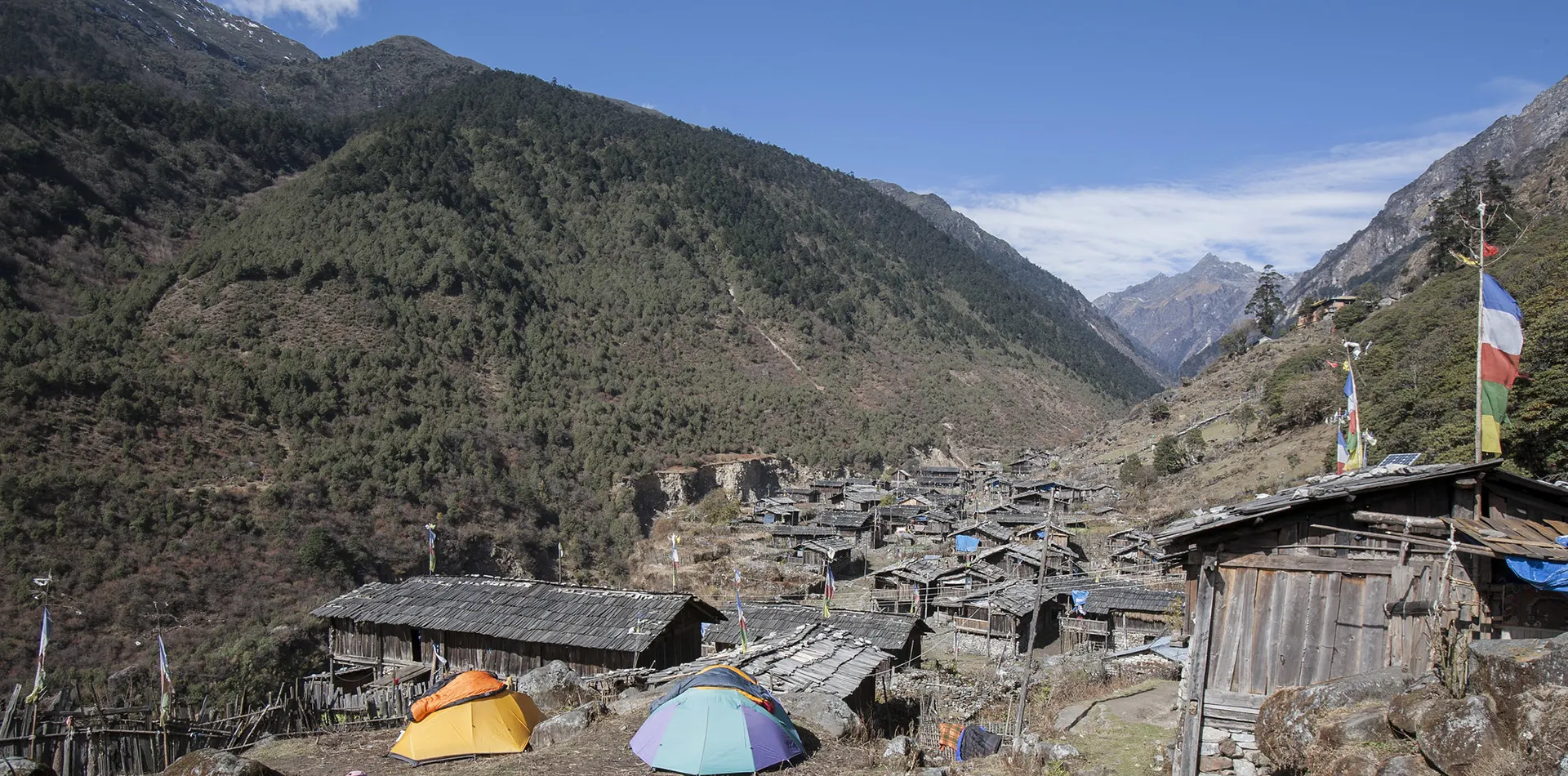
In the following days, we will walk. The main ascending days are the first five days of the trek, taking us to Olangchung Gola. Tibetan prayer flags, wooden homes with smoke rising up from chimneys, and kids waving with big smiles, the trails will feature it all. The rest days on this itinerary consist of walking up to the ridge to the viewpoint. There, you can see Kanchenjunga’s shadow stretch across the valley.
Next up on the journey, we have the high passes. Marsang La, Phurlu La, and Nango La, all of these passes are above 4,500 meters. Snow patches scatter the trails and the swift wind steals your breath. But the views will definitely steal all your attention. After crossing the passes, the village of Ghunsa waits below with its aesthetic stone streets and hot locally made soups.
We descend hard after that; eight hours to Amjilosa. This descent will have your knees shaking, but with proper breaks and a trekking guide, you will enjoy it all. After all that, the jeeps meet us at Rani Pool, where you get to see tarmac roads after days of dirt trails. Cell signal connectivity will also return fully as we make our way to Illam. Green tea fields and quiet roads are the best part of the drive.
- Safety first, always
- Best prices guaranteed
- Expert travel team
- Easy booking, no extras
- Customize your journey
Based on 10 reviews

Trip Highlights
- We cross Marsang La at 4,500 meters, Nango La at 4,750 meters, and Phurlu La at 4,580 meters.
- Sleep in tents for 12 straight nights; there will be no lodges, no hot showers, just remote hills and a living experience.
- Visit and explore Olangchung Gola, where Tibetan-style homes, intricate wooden carvings, and gompas are located.
- See Kanchenjunga’s north face from Yangma.
- Walk past rhododendron forests in spring and drive through Ilam’s tea gardens.
Photo and Video Gallery


Olangchung Gola Trek Detail Itinerary

Day 01: Arrive in Kathmandu, transfer to hotel, trip briefing
We arrive at Tribhuvan International Airport in Kathmandu on the first day of our Olangchung Gola Trek. After landing, you will follow the signs to the immigration desk. We recommend bringing cash for the visa on arrival fees, starting at 30 USD for 15 days. You can complete the visa form at the counter and submit your passport and payment afterwards. After getting your visa approved, you can leave the airport through the terminal, where one of our reps will locate you.
Morning Star’s representative will be there holding a sign with your name. He will then take you to the hotel by vehicle, a 20 to 30-minute drive, depending on the accommodation. You will check in, rest to adjust to the time zone, and join the briefing, later in the evening, or the next day. Our guide will explain the Olangchung Gola Trek itinerary, permits, packing, safety, and other aspects you need to know before you start.

Activity: 20-30 mins drive

Max. Altitude: 1,400m/4,593ft. (Kathmandu)

Meal: Breakfast

Accommodation: Hotel
Day 02: Breakfast in Kathmandu, fly to Bhadrapur, drive to Taplejung
The following day on the Olangchung Gola Trek, we will fly from Kathmandu to Bhadrapur. The flight takes 45 minutes and we land at a small airport. Usually, there are no major delays during the peak trekking season since the flying conditions are just right for the most part.
After leaving the airport, we meet our vehicle, and the drive to Taplejung starts. The road winds through hills, passing terraced farms, and crosses small rivers. The driver stops for lunch in a roadside settlement. Soon enough, we will arrive at Taplejung after 7 to 8 hours of riding and check into a basic hotel.
Activity: 7 to 8 hrs drive
Meal: Breakfast, Lunch & Dinner
Accommodation: Hotel
Day 03: Breakfast in Taplejung, drive to Taplethok, lunch at Taplethok
Day 3 of the Olangchung Gola Trek starts with breakfast, followed by a drive to Taplethok, which takes 3 to 4 hours. We have to follow the Tamor River on a rough dirt road as the track winds through pine and rhododendron forests. The trail passes terraced fields and small Gurung settlements, following narrow roads past waterfalls. Our lunch is served in Taplethok, at a quiet stop with basic teahouses. Later at night, the guides and porters will set up camp near the riverbank. The river water flows close by as we prepare to spend the night at 1,800 meters above sea level.
The temperatures drop after sunset, so we recommend packing thermal layers, especially for higher locations. The crew will prepare hot meals by 7 PM and we expect you to be off to bed by 10. Proper resting hours are just as important as your preparations for this trek.
Activity: 3-4 hrs drive
Meal: Breakfast, Lunch & Dinner
Accommodation: Tented camp
Day 04: Trek to Ela Danda
We start day 4 of the Olangchung Gola Trek early, today’s trail climbs steadily through rhododendron and oak forests. We will gain 800 meters in elevation by the end of today’s trek. The path is narrow, crossing small wooden bridges over side streams. The trek comes to a halt for lunch at a clearing near Ela Danda Base. From there, we will reach Ela Danda by late afternoon. This campsite sits at 2,600 meters above sea level with a wide open view of the snow peaks ahead.
You can refill water from a clean stream near the camp, and treat it with tablets or filters. The dinner will likely be some kind of hot soup and rice by 7 PM. You can keep snacks in your tent if you still have some appetite. Tomorrow’s trek is longer, so you must rest as much as possible.
Max. Altitude: 2,600m/8,530ft. (Ela Danda)
Meal: Breakfast, Lunch & Dinner
Accommodation: Tented camp
Day 05: Trek to Jongin
The next day on the Olangchung Gola Trek, we start early yet again. After about 2 whole hours of leaving Ela Danda, the path narrows. Then, we have to pass yak herder huts at 3100 meters above sea level. We will stop for lunch near a stone shelter. From there, the afternoon section gains us 400 meters in elevation. Throughout the day you will walk 4 to 5 hours in total, covering a total distance of about 10 kilometers. The terrain is rocky with loose gravel in sections and you will reach Jongin by 4 PM.
This tiny settlement sits on a flat ridge with views of snow peaks. There, you can refill water from a glacial stream nearby as the crew members set up tents for the night. Our dinner once again will be hot soup and rice; there are not many food options when you’re camping. However, there will be a couple of different options to keep the meals from being monotonous. You should check your legs for blisters and apply tape if you have some. The next day on the trail brings steeper climbs. Our sleeping altitude of the day is 3500 meters above sea level.
Activity: 4-5 hrs trek
Max. Altitude: 3,100m/10,171ft. (Jongin)
Meal: Breakfast, Lunch & Dinner
Accommodation: Tented camp
Day 06: Trek to Olangchung Gola
Trekking from Jongin to Olangchung Gola takes about 6 to 7 hours. This is the main day of the Olangchung Gola Trek. We start the day at 3500 meters and reach an ultimate altitude of 3200 meters.
The trail climbs through fir and birch forests and crosses stone bridges over icy streams. We will also pass by yak pastures, featuring stone chortens and prayer flags. The path narrows as we cross the tree line and snow patches begin to appear in shaded sections. We stop for lunch near a glacial moraine.
After lunch, we have to descend slightly into the valley, where Olangchung Gola sits in a wide glacial basin. There, houses have slate roofs and wooden beams and we set up our camp near the village center.
Dinner will be served by 6:30 PM as the temperatures drop below freezing at night. We recommend trekkers wear down jackets, warm gloves, and beanies. This village borders Tibet, and you can tell by their unique dialect that most locals speak the Walung language.
Activity: 6-7 hrs trek
Meal: Breakfast, Lunch & Dinner
Accommodation: Tented camp
Day 07: Rest day in Olangchung Gola, explore the village and gompa
Today is the first acclimatization day on the Olangchung Gola Trek itinerary. We will not trek much, but a short hike to a nearby viewpoint is a great way to acclimate well. After the hike, you can roam inside the village, chat with the locals, and witness their daily activities.
You can also visit the old gompaz which sits above stone houses. Prayer chants in the morning can be heard across the village. You can see carved prayer wheels and meet some local Walung people. Most of the locals trade salt, wool dried yak cheese, and other local produce.
You can charge devices in teahouses via their solar panels’ power outlets. You should dry your gear and clothes in the sun, and check your boots for wear and tear. Later in the evening, the Olangchung Gola Trek guide will map tomorrow’s route to Tasa; the trail drops 600 meters initially, then climbs 900 meters.
Our sleeping altitude of the day is 3200 meters above sea level. The nights get really cold at such high elevations so keep gloves inside your sleeping bag.
Max. Altitude: 3,200m/10,499ft. ()
Meal: Breakfast, Lunch & Dinner
Accommodation: Tented camp
Day 08: Trek to Tasa
We leave Olangchung Gola after breakfast, climbing steadily through alpine meadows. You can see prayer flags tied to chortens as we make our way further into the valley. The path narrows above 3500 meters, and soon enough, we will reach Tasa in 5 to 6 hours.
This village sits at 3700 meters above sea level. We will camp on a flat ridge, featuring views of Kanchenjunga and other nearby peaks. The wind picks up by afternoon, so we secure our tents with extra pegs. We eat lentil soup and rice for dinner along with some sides. After the meal, check your gear for tomorrow.
Activity: 5-6 hrs trek
Max. Altitude: 3,700m/12,139ft. ()
Meal: Breakfast, Lunch & Dinner
Accommodation: Tented camp
Day 09: Trek to Yangma
The following day, we start early from Tasa. The trail climbs steadily for 2 hours and crosses stone steps and landslide zones. We pass yak pastures, entering rhododendron and fir forests. The path narrows near ridges as we get closer to a stream for water refill.
Our lunch of the day will be served near a yak herder’s stone hut. Post-lunch, we descend slightly, cross wooden bridges over glacial streams, and reach Yangma by 4 PM. Sitting at 3500 meters above sea level, the crew will set up camp on flat ground near the village.
Meal: Breakfast, Lunch & Dinner
Accommodation: Tented camp
Day 10: Trek to Sum Dokma via Marsang La and Phurlu La
Today, we have to wake up before sunrise. The porters and guide will pack tents in cold air, starting trekking by 6 AM. The trail climbs steeply to Marsang La, reaching 4500 meters above sea level. Snow patches dominate the shaded zones and we get to cross Phurlu La next. The ridge offers wide views of Kanchenjunga’s north face.
Wind picks up after noon, so we have to descend into Sum Dokma before midday. The path is full of loose rock and scree, trekking poles help greatly over such trails. We stop every 45 minutes to hydrate and rest. You can have some energy bars en route. We will be moving slowly, reaching our destination of the day by 4 PM.
Max. Altitude: 4,500m/14,764ft. (Marsang La)
Meal: Breakfast, Lunch & Dinner
Accommodation: Tented camp
Day 11: Trek to Ghunsa via Nango La
On the 11th day of the Olangchung Gola Trek, we will wake up early, pack our tents, and eat our breakfast by 6.30 AM. We crossed Marsang La and Phurlu La the day before; today, we trek to Ghunsa via Nango La, the last mountain pass en route. The trail climbs steeply for 2 hours, gaining us 600 meters of elevation. We will reach the summit of Nango La at 4750 meters above sea level, offering a wide panoramic view of the valley and neighbouring peaks.
We then descend for 4 hours over a rocky path and cross moraines. The trail passes by frozen streams, leading us down to Ghunsa by afternoon. Our final altitude of the day is 3595 meters above sea level.
Max. Altitude: 4,750m/15,584ft. ( Nango La)
Meal: Breakfast, Lunch & Dinner
Accommodation: Tented camp
Day 12: Rest-explore Ghunsa
Day 12 is yet another acclimatization day on the Olangchung Gola Trek. We will spend most of our time exploring the village, but before that, we will go on a short hike to a nearby hilltop.
Sitting at 3595 meters above sea level, this village offers trekkers insights into the lives of the locals. Acclimatization matters on any high-altitude trekking journey, so take the time to rest well and adapt to the surroundings.
Max. Altitude: 3,595m/11,795ft. (Ghunsa)
Meal: Breakfast, Lunch & Dinner
Accommodation: Tented camp
Day 13: Trek to Amjilosa
The trek from Ghunsa to Amjilosa features a steep slope initially. You have to climb stone steps through a rhododendron forest, then cross suspension bridges over the Ghunsa River. The trail also features a waterfall. We will stop at small rest points every 90 minutes or so, to let our sore muscles regain strength.
Day 13 of the Olangchung Gola Trek gains us 800 meters in elevation. However, the net elevation change remains a descent of 1000 meters. We reach the village of Amjilosa by late afternoon, sitting on a flat ledge above the river. Our destination of the day sits at 2500 meters.
Max. Altitude: 2,500m/8,202ft. (Amjilosa)
Meal: Breakfast, Lunch & Dinner
Accommodation: Tented camp
Day 14: Trek to Rani Pool, drive to Taplejung
Starting off the day, we have to trek 3 hours downhill to Rani Pool, over a rocky trail. Your knees will take some strain, but it will be very manageable. After reaching Rani Pool, we will get on jeeps, load our gear and luggage, and head back to Taplejung. The drive takes about 5 hours to complete and the road is somewhat rough. This day marks the end of the trekking days.
Activity: 3 hrs trek, 5 hrs drive
Meal: Breakfast, Lunch & Dinner
Accommodation: Teahouse
Day 15: Drive to Ilam, walk through the village
On the 15th day of the Olangchung Gola Trek, we will leave Taplejung after breakfast. The drive to Ilam takes about 6 to 7 hours, following Highway 03. The road climbs through tea-growing hills, passing terraced farms. The drive takes a break at a small roadside stop for tea and refreshments.
The road then narrows near forest edges and we arrive in Ilam by late afternoon. After that, we will check into a local hotel and you can explore the streets on your own. Since we are now in the city area, there will be a lot more options for food. The beds are basic but clean and a hot shower is available 24 hours.
Activity: 6-7 hrs drive
Meal: Breakfast, Lunch & Dinner
Accommodation: Teahouse
Day 16: Drive to Bhadrapur, fly to Kathmandu, explore town
After a hearty breakfast, we will board a vehicle by 7 AM and drive to Bhadrapur, which takes about 2.5 to 3 hours. The road passes tea estates and small markets, stopping once for restrooms and refreshments. We will arrive at the Bhadrapur Airport by 10.30 AM and check in for our flight back to Kathmandu.
This flight lasts 35 to 40 minutes, taking us to the Tribhuvan International Airport. We will then transfer to our hotel, freshen up, and explore the bustling streets a little. We walk through the local streets, visit shops, perhaps have lunch at a rooftop eatery, and make the most out of our time. After you reach the city areas, the Olangchung Gola Trek package will no longer cover lunch and dinner expenses.
Activity: 2.5-3 hrs drive
Meal: Breakfast
Accommodation: Hotel
Day 17: Final departure
Day 17 is the final day of the journey. We will have you check out of the hotel in Kathmandu and be part of a short farewell ceremony before bidding you farewell. We will drop you off at the airport 3 hours before your scheduled departure.
If our standard itinerary doesn't fully meet your needs, we are happy to tailor it to your specific preferences and requirements.

Includes and Excludes
What’s Included?
- Airport transfers in Kathmandu, including pickup on arrival and drop-off on departure
- Flight from Kathmandu to Bhadrapur and return
- Road transfers by 4×4 jeep between Bhadrapur and Taplejung, and Taplethok
- Hotel accommodation in Kathmandu before and after the trek
- Comfortable teahouse or lodge accommodation during the trek (twin-sharing)
- Breakfast in Kathmandu hotel, and three meals (breakfast, lunch, dinner) each day during the trek
- Professional, English-speaking trekking guide and required porters
- Trekking guide salary, insurance, meals, accommodation, equipment, transportation, etc.
- All necessary trekking permits and national park entry fees
- Basic medical kit and safety equipment during the trek
- Sleeping bag, down Jacket, walking poles, duffel bags (you have to return after the trek)
- Certificate of achievement at the end of the journey
- Government taxes and agency service charges
What is not Included?
- International flights to and from Nepal
- Nepal entry visa fees upon arrival
- Lunch and dinner in Kathmandu
- Personal expenses such as drinks, snacks, hot showers, Wi-Fi, and device charging
- Travel insurance that covers medical emergencies and helicopter evacuation
- Tips for guides, porters, and drivers
- Extra hotel nights caused by flight delays, early arrival, or late departure
- Personal Travel insurance and emergency rescue evacuation
- Extra cost caused by natural or political disturbances beyond our control
Trip Information of Olangchung Gola Trek
Best season and weather
The Olangchung Gola Trek is best done in March to May or September to November. You can expect the daytime temperature to reach 15°C on average, while the nights drop below freezing above 4000 meters of elevation. Monsoon rains affect the trails heavily from July to August, while snow covers mountain passes until mid-April.
Difficulty
The Olangchung Gola Trek requires walking 6 to 8 hours daily on average. Trails are steep, the rocks shift underfoot, and we have to cross three high passes. At most of the villages en route, there are no lodges, our only shelter for the nights is tents. Trekkers also have to carry daypacks throughout the trek. Prior trekking experience helps a lot, but it is not mandatory. We recommend trekkers train with weighted bags. On a scale of 10, this trek deserves a 7.5.
Altitude Sickness
We sleep above 3,000 meters of elevation for 12 nights and climb over 4,700 meters at Nango La. This can induce altitude sickness, but we can avoid it with the right preventive measures. Trekkers should drink 3 liters of water daily and it is also documented that eating garlic soup helps. You should avoid alcohol completely and watch for headaches or nausea. The trek guide will help you descend if symptoms worsen. Having Diamox pills can also help turn down the effects.
Preparation and Fitness
We train for about 3 months for the Olangchung Gola Trek. You should hike with an 8 kg backpack, and go over uneven trails as well. We recommend running 5 km twice a week to strengthen knees, calves, and ankles. Break-in boots are highly recommended; fresh, new boots can get your bruises up. We also recommend packing blister tape.
Food and Accommodation
We sleep in tents for a total of 12 nights since there are no lodges on the trail. We eat mostly dal bhat twice daily or any other dishes that are easy to prepare. The crew members prepare soup, noodles, eggs, etc., for breakfast every morning. Drinking boiled water or treated water is the best way to go and avoiding raw food is very important. You can carry snacks, energy bars, nuts, etc. Trekkers can even request vegetarian meals if needed.
Transportation
We fly from Kathmandu to Bhadrapur in about 45 minutes, drive from Taplejung to Taplethok over rough dirt roads in a 4×4 jeep, and drive from Taplejung to Ilam. Lastly, we will fly from Bhadrapur to Kathmandu on the 16th day of the journey. All of these transportation expenses will be covered by the Olangchung Gola Trek package.
Communication
We lose signal after Taplejung and there is no internet past Ghunsa. The trek guide will carry satellite phones for emergencies and also check the weather reports via radio. You can update your close ones at the start of the trekking days and follow it up once we reach Taplejung at the end of the trekking days. You can not rely on mobile data as it is basically non-existent. Carrying power banks can come really handy if you want to charge your devices on the move.
Permit
Trekkers are required to have the Kanchenjunga Restricted Area Permit and a Kanchenjunga Conservation Area Permit for this trek. Visitors must go with a registered agency or a licensed guide, solo trekking is not allowed.
Visa
You must get a visa on arrival at Kathmandu airport. The cost is 30 USD for 15 days, but you need to take the 30-day package for this trek. You can even extend the visa if needed.
Travel Insurance
You need to buy insurance before leaving for the trek. The policy must cover 5,500 meters and also include helicopter evacuation. We need to carry a printed copy along the trek.
Extra Expenses
You need to budget about 30 USD per day for extra expenses. You need to pay for bottled water, tips for guides and porters, buy snacks along the route, etc. Battery charging, extra meals, any kind of beverages, etc. are not covered by the Olangchung Gola Trek package.
Private vs. group trek
You can choose private treks for a flexible pace and starting date. You can even pick out your own route as long as it is viable. Meanwhile, group treks run on fixed dates since there are other people in the group too. Regardless, you will share tents with a fellow trekker. Private tents will cost you a little extra
Most Asked Questions
 General
How many high passes do we cross, and what are their exact altitudes?
We cross three passes on the Olangchung Gola Trek: Marsang La 4500m, Phurlu La 4580m, and Nango La 4750m.
Is the Olangchung Gola Trek accessible year-round, or do winter snows block the trail?
No. The trail is closed from December to February since heavy snow blocks the passes. Permits are generally not issued during winter since the local lodges are shut down as well.
Do we need a special permit for cameras on this trek?
No, personal cameras need no permit. However, drones require a separate CAAN license, which you can apply for in Kathmandu.
Will we meet other trekking groups on the trail, or is this route truly remote?
The chances are rare. There are max 5 groups per week in peak season. There will be no teahouse crowds and you will walk alone most days.
Can we skip a day or shorten the trek if someone gets sick?
Yes, the guides will try their best to reroute and descend to Ghunsa or Taplejung, as soon as possible. Jeeps wait at Rani Pool and medical evacuation will be contacted if needed.
 Preparation & Fitness
If we can hike 10 km per day with 8 kg, is that enough for this trek?
Yes, it should be enough to prepare you for the physical demands of this trek.
Should we train on stairs or hills to prepare for the Marsang La climb?
We recommend trekkers to train on hills as stairs lack uneven terrain. We will hike steep trails and wear full boots to accommodate the rough terrain.
Is it necessary to use trekking poles on the descent to Amjilosa?
Yes, it is necessary to use trekking poles cine the trail drops 1,800 meters. Your knees will take massive pressure if you do not use trekking poles.
Can we rent down jackets in Kathmandu if ours are too heavy?
Yes, we recommend trekkers rent 800-fill down jackets, which cost about 3 USD per day. Check zippers and hoods before renting.
What does the physical preparation for this trek look like?
You have to hike or train 5 days a week and carry an 8 kg daypack. Stretching and some strength training are also recommended.
 Insurance and Visa
Can we pay for a Nepal visa in euros or only USD at Kathmandu airport?
You have to pay your visa fees in USD, EUR, and GBP, you can exchange currency at a nearby counter. Exact cash is required, card payments are not possible.
Does our insurance need to name “Kanchenjunga Conservation Area” specifically?
No, it does not have to, however, it must cover “trekking up to 5,500 meters in Nepal” and also include helicopter rescue.
What if our insurance doesn’t cover 5,500 meters, will we be turned back?
We will have your insurance checked before we hit the trails. You will not get to start the trek unless your insurance covers the necessary aspects.
Do porters and guides carry copies of our insurance in case of emergency?
Yes. We give a printed copy to the Olangchung Gola Trek guide. He will store it in a waterproof bag and contact the number on file if needed.
Is it possible to extend our visa while we’re already trekking in Taplejung?
Yes. You can extend your visa by filling out a digital form at the official website of Nepal’s immigration office.
 Guides & Support Staff
How many kilograms can each porter carry for us?
Each porter carries 25 kilograms max. We split gear between trekkers, so one porter is assigned to two trekkers.
Will our guide have a satellite phone or radio for emergencies?
The Olangchung Gola Trek guide carries a satellite phone. It will be charged daily and only used for emergencies.
Do porters sleep in separate tents or share with trekkers?
Porters sleep in separate tents along with the guide. They will not be too far from the trekker tents. They will carry their own gear and eat the same meals as us.
What happens if a porter gets injured, do we wait or continue?
We stop in case anyone gets injured, we assist the injured, and call for help. The backup porter will join us if needed.
Are guides trained in altitude sickness recognition and first response?
Morning Star’s guides hold certified altitude training, and they can recognize symptoms fast.
 Accommodation and Facilities
Are tents shared, or do we get single tents?
We assign two trekkers per tent; single tents will cost extra. You can confirm your preferred accommodation setting at booking.
Do we get hot water for washing at camps above 4,000 meters?
The teahouses provide warm water in buckets, not hot. Since fuel is limited in the highlands, they will charge you a couple of bucks for it.
Are sleeping mats included, or do we need to bring our own?
The tents will include foam sleeping mats, and you must bring your own thick sleeping bag to save you from the harsh cold.
Do teahouses in Ilam accept USD, or must we carry Nepali rupees?
Teahouses take only Nepali rupees, no USD or any other foreign currency. We recommend trekkers to exchange in Kathmandu or Ilam town.
 Food and Drinks
Do we get eggs or meat at high camps, or only dal bhat?
The eateries en route serve eggs as long as they have enough supplies. Meat is rarely served since freezers are not available at every tea house en route.
 Weather & Seasons
If we trek in late May, will Marsang La still have snow patches?
Yes, snow lingers on Marsang La until early June, you can carry microspikes if you want to. The trails stay slippery past noon.
What’s the average night temperature at Nango La base camp?
You can expect an average temp of -5 to -10 Celsius. We have to sleep in tents, so you must use -15-rated sleeping bags.
Do afternoon winds start at a predictable time on the high passes?
Winds hit at around 2 PM most afternoons, which means we have to summit the passes by noon and secure tents early.
Are there weather stations or forecasts available between Ghunsa and Amjilosa?
No, there are no weather stations, you can get forecasts on smartphones, but the weather is pretty unpredictable.
Is this trek viable in winter?
No, snow blocks pass from late March to November. Flight cancellation due to poor visibility is common.
 Health & Safety
At what altitude do we start taking Diamox, if at all?
You start Diamox at 3,000 meters if advised by our doctor. We do not recommend self-medicating; always follow the guide instructions.
Is there a hospital or clinic between Taplejung and Olangchung Gola?
No hospital exists on the trail. However, the town of Taplejung has some basic clinics. We will carry a full medical kit and descend for serious cases.
What symptoms force an immediate descent?
A headache with vomiting or dizziness forces descent. We will immediately stop climbing and go down at least 200 meters.
Are water purification tablets provided, or must we bring our own?
We will provide trekkers with chlorine tablets. We recommend you carry backup tablets, just in case we run out of them.
Can we get rehydration salts or painkillers from the guide’s medical kit?
No, the guide carries a basic first aid kit for minor injuries. The guide does not administer sensitive medications.
 Booking & Payment
Is the 2000 NPR Kanchenjunga permit fee refundable if we cancel?
No, the Nepal government does not refund TIMS or KCA permit fees after issuance. The trek package covers this non-refundable cost upfront.
Can we pay the final balance in cash upon arrival in Kathmandu?
Yes, you can pay the rest of the payment in cash at our Kathmandu office.
What if the agency cannot secure our Bhadrapur flight; do we get alternate transport?
As long as the flights are operational, we will arrange it for you. In case the flights are stopped for a couple of days, we will take a 14-hour drive instead.
Do we sign a contract that lists all inclusions and exclusions?
Yes, Morning Star has an agreement
A paper that lists all the includes and excludes of the trek package we discussed above.
Is there a discount if we book this trek plus another within 6 months?
Yes, depending on the season, we will offer a discount for early birds.
 Transportation & Flight
Is the flight to Bhadrapur reliable during the peak trekking seasons?
Flights run daily during the peak trekking seasons of spring and autumn. They are quite reliable since the weather is generally clear during those times of the year.
How many people fit in the jeep from Bhadrapur to Taplejung?
Jeeps fit six trekkers plus their luggage and gear. We will use a Mahindra Scorpio or Bolero with comfortable and sturdy seats. The jeep stops for breaks every two hours or so.
Are road transfers done in 4x4 SUVs or larger tourist buses?
We use 4×4 SUVs only, buses are not powerful and agile enough to traverse the rugged dirt trails. Roads are narrow and rough, and we prioritize your safety above all else.
If our flight back to Kathmandu is canceled, do we get hotel coverage?
No, we will not cover your extra night in Bhadrapur as flight delays are out of our control.
Can we leave extra luggage at the agency’s Kathmandu office?
Yes, we can store your extra bags for free. However, keep your valuables secure; we do not recommend leaving them at the office.
- Safety first, always
- Best prices guaranteed
- Expert travel team
- Easy booking, no extras
- Customize your journey
Based on 10 reviews
Have Questions?
+977 9767224414