
 English
 Dutch
Dutch Japanese
 Hindi
Hindi Italian
 Spanish
 French
 German
 Chinese
 Korean
 Arabic
 Hebrew
 Russian
 Portuguese
 Danish
 Czech
Czech Polish
 Swedish
Have Questions?
+977 9767224414
Unmissable holidays deals - Save up to 20%
Yala Peak Climbing

Duration
12 Days

Trip Difficulty
Moderate

Max. Altitude
5,530m

Destination
Nepal

Group Size
2-16 People

Accommodation
Hotel, Lodge

Transportation

Meals
Breakfast, Lunch & Dinner
Explore more facts about the trip
Overview of Yala Peak Climbing
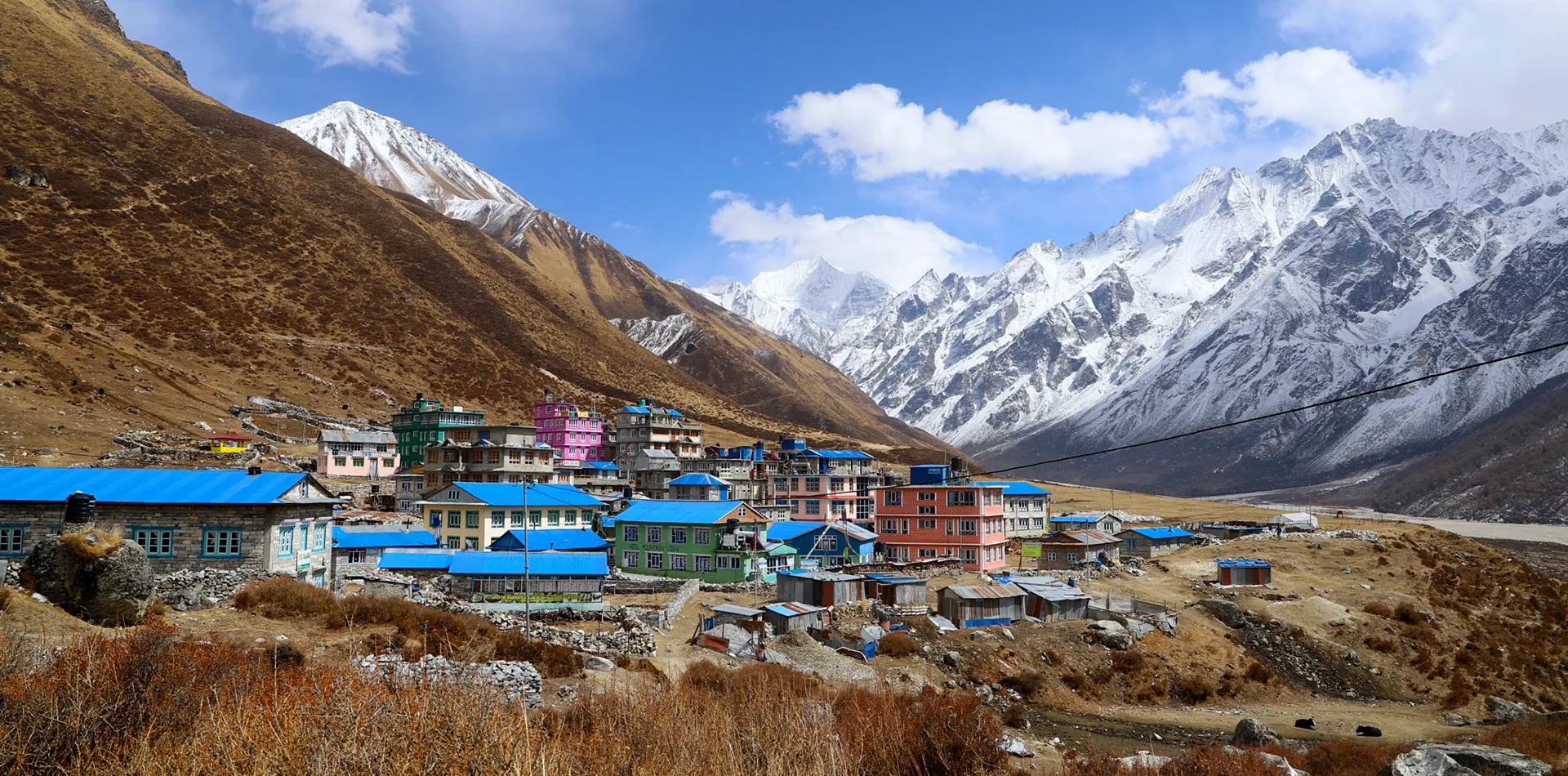
Yala Peak is among the most straightforward trekking peaks in Nepal, being 5,732 meters in the beautiful Langtang region. It is just north of Kathmandu, and just near the Tibetan border; it has an incredible Himalayan range close to Tibet without having the technical skills of mountaineering. This is why it is an ideal option for newcomers to the world of real Himalayan climbing.
The trip to the Yala Peak goes along the Langtang valley, which is home to the Tamang people, Buddhist temples, and spectacular views. Trekkers curve around forests, yak fields, and the high alpine meadows before arriving at the glaciers and mountains that enclose Kyanjin Gompa. Combining the exploration of cultural villages and viewing a Himalayan peak contributes a unique charm to this trip.
As opposed to most climbing mountains, the climbing of the Yala Peak does not need ropes or sophisticated methods. Entry-level fitness, some prior training before the trek, and appropriate acclimatization are generally sufficient to succeed. Thanks to this, it has become one of the most accessible peaks in Nepal, yet it also provides spectacular views of Langtang Lirung, Dorje Lakpa, Ganesh Himal, and even Shishapangma in Tibet.
Morning Star Treks has a good package to climb Yala Peak; the packages give a good balance of trekking days and a combination of acclimatization and summit push. They receive the appropriate support offered by their guides, such as preparing cozy teahouses in the valley and pitching tents in the base camp. These beginners with professional help can concentrate on the fun experience of climbing, knowing that all the safety and organization have been taken care of.
The Yala Peak climbing proves to be the perfect Himalaya adventure for many, an opportunity to enjoy the wonders of high altitudes, a culturally rich valley, and to be on top of a 5,700 m peak in less than two weeks.
- Safety first, always
- Best prices guaranteed
- Expert travel team
- Easy booking, no extras
- Customize your journey
Based on 10 reviews

Trip Highlights
- Breathtaking Himalayan scenic view, characterized by Shishapangma, Langtang Lirung, and Dorje Lakpa among others.
- Familiarity with a short scenic drive to Kathmandu, and the starting point of the trip is in easy reach.
- They are the ideal ones to start with, as there is a high success rate of 90-95% of reaching the peak.
- Cultural immersion along the trail with warm Tamang and Tibetan heritage experiences.
- Acclimatization days and side hikes like Kyanjin Ri or Tserko Ri for extra mountain views.
- Tent camping at Yala Peak Base Camp and a combination of comfortable teahouses in the Langtang Valley.
- A non-technical Himalayan climbing experience with all basic gear in a balanced, adventurous cultural trek.
Photo and Video Gallery



Yala Peak Climbing Detail Itinerary

Day 01: Arrival in Kathmandu
When you arrive at Kathmandu, you will have to be received at the airport and taken to your hotel. This is a day of rest following your flight. The capital city of Nepal, Kathmandu, is colorful with its blend of history, culture, and crowded streets.
With time, you can visit Thamel, which is the tourist center that sells last-minute trekking items, or you can take a hot meal. You would also take a good time to inspect your trekking equipment and ensure that boots, clothing, and climbing gear are packed.
The itinerary, safety measures, and high-altitude trekking tips will later be discussed during the briefing of the trek. This will bring everybody on par and know what to expect in the next few days.
Day 02: Drive to Syabrubesi (122 km)
The expedition starts with an official tour by a drive starting at Kathmandu to Syabrubesi, which is the entry point to Langtang Valley. The trip is approximately 8-9 hours long and traverses through terraced fields, rivers, and small villages jutting up the hillsides.
The mountains can be slowly seen upon approaching the valley. The winding roads are a combination of scenic attraction and local life, making the ride an adventure by itself.
On arrival in Syabrubesi, trekkers relax in comfortable teahouses. The trek starts with this small village, with green hills and rivers all around. It is a nice spot to have a rest, adapt to the height, and be prepared for the next day’s hike to Lama Hotel.

Activity: 8-9 hrs drive

Meal: Breakfast, Lunch & Dinner

Accommodation: Teahouse
Day 03: Trek to Lama Hotel
The current journey is starting at Syabrubesi to Lama Hotel, which is approximately a 10-kilometer journey, approximately 5-6 hours. The heavy footpath takes the Langtang even down through pine and rhododendron forest. Lacking in spur-of-the-moment measures, suspends across flowing streams and in no time creates charm and excitement in the trip.
As they travel, trekkers cross tiny Tamang villages and agricultural fields. The mountains are frequently greeted by children of the area, who greet them with a good, warm welcome. The slow increase in the number of feet above sea level can enable a gradual adaptation by your body, hence making the hike enjoyable and not strenuous.
Lama Hotel is a village where small teahouses are placed so that trekkers can have a short rest, eat, and see the hills around and the mountains in the distance. The scenic landscape has a rather picturesque mood on the journey.
Meal: Breakfast, Lunch & Dinner
Accommodation: Teahouse
Day 04: Trek to Langtang Village
The trail starts at Lama Hotel and proceeds to Langtang Village, approximately 12-14 kilometers, with trekking time taken of 5-6 hours. Through thick forests, the road passes through alpine meadows opening with fluctuations, wild flowers, and Himalayan birds.
The village of Langtang is located at an altitude of 3,430 meters and comprises stone structures surrounded by Buddhas and monasteries. The village is greater than Lama Hotel and has more options for a teahouse to eat and to sleep. An overnight stay helps in acclimatizing to gives a chance to begin further into the valley.
Trekkers are given the rare visuals of neighboring mountains and peaceful Himalayan scenery. This day is a refresher and a memory as you can walk at a very slow, accurate pace and appreciate the view.
Meal: Breakfast, Lunch & Dinner
Accommodation: Teahouse
Day 05: Trek to Kyanjin Gompa
The trail that visits Langtang Village to Kyanjin Gompa is one of the most picturesque corners of the journey. The trail is approximately 8-9 kilometers, gradual and exciting, on yak pasture and extensive high-level meadows. The spiritual presence of the region is denoted by prayer wheels, colorful flags, and chortens.
Approaching Kyanjin Gompa, the sight of Langtang Lirung, Dorje Lakpa, and other snow-white peaks becomes more gut-thunking. The village itself, which stands 3,870 meters in the air, has a centuries-old monastery and a tiny cheese factory. The hike of the day is moderate and leaves a chance to observe landscapes at length and adapt to the high altitude.

Max. Altitude: 3,870m/12,697ft. (Kyanjin Gompa)
Meal: Breakfast, Lunch & Dinner
Accommodation: Teahouse
Day 06: Rest & Acclimatization in Kyanjin Gompa
It is a day of acclimatization, and it is an important preliminary to increased elevation. The surrounding viewpoints are visited by the majority of the trekkers, with the most popular one being Tserko Ri (4,984 m). The climb provides a panoramic view of the Langtang range, glaciers, and the untamed Himalayan ridges.
Others can opt to make a smaller climb of close peaks or just get lost in the village and be welcomed by the locals. The speed at which one walks and being hydrated make the body acclimatize to thin air. One more day here strengthens and gives confidence for the climb to Yala Peak.
Max. Altitude: 3,870m/12,697ft. (Kyanjin Gompa)
Meal: Breakfast, Lunch & Dinner
Accommodation: Teahouse
Day 07: Trek to Yala Peak Base Camp
After Kyanjin Gompa, the road to the Yala Peak Base Camp elevates you further into rough alpine country. The walk is not very long as compared to the past days and is approximately 4-5 hours, but the elevation makes it appear more ordeal. There is a grassy meadow on the way, and yaks are feeding, and slowly it turns to rocky moraines and a wilder scene with mountain backdrops that are marvelous.
Base Camp, at an approximate 4,800 meters, is an open plain area that is surrounded by giant mountainous ranges and icecaps. The teahouse items of the valley are increasingly replaced, here, by tents. Spreading gear, checking crampons and rope, and having a briefing on the safety guidelines by the guides normally takes up the evening. There is a strong need to have an early dinner and some rest before the summit push starts before dawn.
Activity: 4-5 hrs trek
Max. Altitude: 4,800m/15,748ft. (Yala Peak Base Camp )
Meal: Breakfast, Lunch & Dinner
Accommodation: Teahouse
Day 08: Summit Yala Peak & Return to Kyanjin Gompa
The most challenging and the most rewarding experience of the trek is the summit day. Climbers begin as early as 2-3 a.m., and with headlights illuminating the path, they climb steadily upwards. The ascent is deemed to be non-technical, although there are snow and ice sections that demand the use of crampons, an ice axe, and a rope. The air becomes thinner and the step slows, but the adventure height increases with every meter gained.
The magnificence of the peak heights of 5,732 meters, believe me. Such a panorama consists of Langtang Lirung, Shishapangma, and a myriad of Himalayan mountains that stretch throughout Nepal and Tibet. Once a small celebration is done at the summit, one starts the process of descent by reversing the path back to the Base Camp. After a rest and packing, the group sets out to Kyanjin Gompa, finishing an 8–9-hour day with a very long distance.
The accomplishment at the end of the day renders the challenge worth having.
Max. Altitude: 5,732m/18,806ft. (Yala Peak)
Meal: Breakfast, Lunch & Dinner
Accommodation: Teahouse
Day 09: Trek back to Lama Hotel
The adventure starts to unwind after the exhilaration of climbing Yala Peak, as a trail starts inversely through Langtang Valley. The trail is generally a downhill trail going between Kyanjin Gompa and Lama Hotel and takes 6-7 hours. Going back on the same path, trekkers stop at Langtang Village and Ghodatabela, wading in forests of pine and rhododendron, which start slowly reappearing.
The walk down may be easier on the lungs but tough on the knees, so poles in hand come in handy. As you go, the snow-capped mountains become invisible behind the horizon, and there are waterfalls and rivers, and thick kinds of vegetation. The altitude is easier by now one reaches Lama Hotel, and the cooler air is a relief. The night is devoted to resting in the teahouse and thinking about the adventure of high altitude already accomplished.
Activity: 6-7 hrs trek
Meal: Breakfast, Lunch & Dinner
Accommodation: Teahouse
Day 10: Trek to Syabrubesi
Another descent, covering 5-6 hours, is the final trekking day between Lama Hotel and Syabrubesi. The path goes on through woodland with its birdlife, and over bridges across the Langtang Khola and through small Tamang village communities. Each descent sees an increase in the vegetation cover, indicating a move towards low valleys.
Syabrubesi, the opening town of the Langtang area, seems vibrant in contrast with the mountain villages. Now, the journey has been completed, and Trekkers can have a good feast and probably a toast over it. The feeling of achievement is far-reaching, with visiting the Langtang Valley and scaling the Yala Peak, the journey has integrated the culture, nature, and climbing into a pleasant experience.
Activity: 5-6 hrs trek
Max. Altitude: 2,380m/7,808ft. (Syabrubesi)
Meal: Breakfast, Lunch & Dinner
Accommodation: Teahouse
Day 11: Drive to Kathmandu
The back trip to Kathmandu starts early with a long drive to Syabrubesi. The highway runs along a wavy Trishuli River over hills, small towns, and terraced fields. It can be reached within 7-8 hours (depending on traffic and road conditions).
After days in the mountains, the buzz of the capital feels both familiar and overwhelming. In Kathmandu, trekkers may take a hot shower back, stay in the hotel, and browse the busy streets of Thamel to get some final Safari experience as well as local cuisine.
Activity: 7-8 hrs drive
Max. Altitude: 1,400m/4,593ft. (Kathmandu)
Meal: Breakfast
Accommodation: Hotel
Day 12: Departure
It is time to say goodbye on the last day. The city can have some quiet time to reflect, or even stroll, using a little bit of time before travel, depending on the flight times.
Trekkers leave Kathmandu with memories of mountain journeys, Tamang hospitality, and the achievement of the Yala Peak summit, to take both their success and tales to their lifetimes.
If our standard itinerary doesn't fully meet your needs, we are happy to tailor it to your specific preferences and requirements.

Includes and Excludes
What’s Included?
- Airport pickup and drop in Kathmandu
- Transportation from Kathmandu to Syabrubesi and back by private vehicle
- Accommodation in hotels in Kathmandu
- Teahouses during the Langtang Valley trek
- Tent accommodation at Yala Peak Base Camp
- Daily breakfast, lunch, and dinner as mentioned in the itinerary
- Experienced English-speaking trekking and climbing guide
- Support staff for luggage, meals, and camping at Base Camp
- All guide and staff salaries, food, accommodation, and insurance
- Trekking and climbing equipment guidance, including basic mountaineering gear (helmet, crampons, ice axe, ropes if needed)
- Langtang National Park entry permit and TIMS card
- Basic first aid kit with the guide
- Trip completion certificate
- Government taxes and service charges
What is not Included?
- International flight tickets to and from Nepal
- Nepal visa fee
- Personal meals, snacks, or drinks outside the itinerary
- Personal expenses such as Wi-Fi, phone charging, or laundry
- Personal travel insurance including emergency evacuation and medical coverage
- Tips for guides, drivers, and support staff
- Extra nights in hotels due to early arrival, late departure, or flight delays
- Additional costs caused by bad weather, natural disasters, political issues, or other unforeseen events
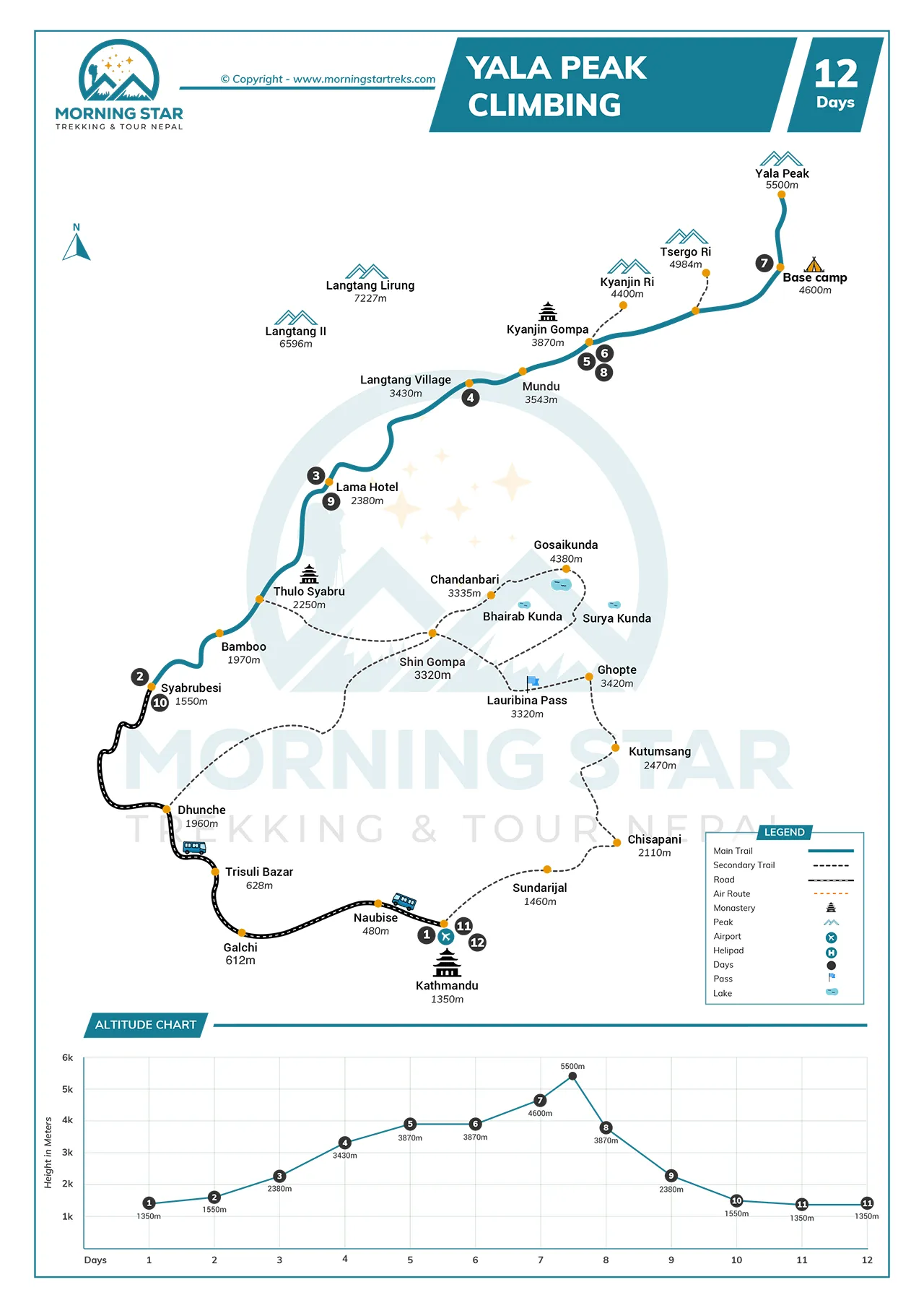
Route Map & Altitude Chart
Trip Information of Yala Peak Climbing
Best Time
Timing is everything when you plan Yala Peak. Climbing the Yala Peaks is most advisable in spring (March to May) and in autumn (September to November). These are the seasons when the Himalayas are at their best, the weather is stable, the visibility is good, and the trekking conditions are favorable.
Many climbers like spring. The Langtang Valley is a flower-filled and green tundra, so the walk itself is picturesque and filled with bright colors. The weather is warmer, and a walk is comfortable, and the sight of snow-capped mountains will be magnificent. The trail is also more energetic in spring since a lot of groups venture into the mountains in spring.
Autumn is just as rewarding. When the monsoon blows out, the skies are as clear as crystal, and the mountains look sharper and nearer than ever. It is warm during the day and cold at night, making it ideal for trekking and climbing at the summit. Autumn has earned a lot of confidence among many trekkers; this can be attributed to its predictable weather and amazing scenery.
Summer, on the other hand, is characterized by heavy rain, trails slippery, and clouds that obscure the views. Winter is quite chilly at higher elevations, and heavy snow usually overlays paths in a base camp. Such factors render the two seasons impractical for the majority of trekkers.
Morning Star Treks suggests the spring and autumn period to go since the weather is stable and climbers have the highest probability of casual trail making for a bright summit morning and enjoying the most rewarding Himalayan sights.
Elevation and Distance
The fact that Yala Peak rises in gradual steps from the initial point of Kathmandu to the peak is one of the interesting aspects of this peak. It starts in Kathmandu at an altitude of approximately 1,400m. A long drive can take you up to Syabrubesi at 1,550 meters, where you start the trek.
Altitude continues to rise gradually as you pass the Langtang Valley. Lama Hotel is at 2,470 meters, and Langtang Village is at 3,430 meters. The final pre-climb settlement is Kyanjin Gompa, 3,870 meters. At this point, trekkers head to Yala Peak Base Camp, which will be positioned approximately at 4800 meters. The last climb to the top brings to 5,732 meters, the ultimate of the tour.
Overall, the hiking is approximately 65 to 70 kilometers. The distances fluctuate depending on the preferred trail, but usual days comprise five to six hours of walking. The increase in altitude is gradual and therefore gives sufficient time to acclimatize. Such a gradual increase makes Yala Peak climbing a most reliable springboard to high-altitude trekking and climbing in Nepal.
Difficulty and Altitude Sickness
Yala Peak peers a non-technical trekking peak, and in climber terms, it is given a grade of F (Facile/Easy). This implies that the route is not in any way requiring high levels of climbing skills or vertical rock work. Most of the trip is a typical Himalayan trek, giving a slow climber on through forests, valleys, and alpine meadows, until they reach the glacier later on the summit.
Nonetheless, the last part is snow and ice walking. Climbers have simple mountaineering equipment, including crampons, an ice axe, and a rope (sometimes). Tools are not so complex and can be taught, and novices can easily learn. That is why Yala Peak climbing is often offered as a first Himalayan peak, not too difficult and technical to be an adventure at the same time.
More difficult is altitude. In Kathmandu, where the altitude is 1,400 meters, there are trekkers who go up to 5,732 meters to the summit. There is much less oxygen in the air at this altitude, and the chances of getting Acute Mountain Sickness (AMS) are also higher. Symptoms may consist ofHeadache dizziness, fatigue, and lack of appetite. Decentralized, AMS may turn very serious.
In order to minimize the risks, the itinerary will incorporate acclimatization days, particularly at Kyanjin Gompa. Slow movement, lots of fluids, and nutritious meals are also helpful. The guides of Morning Star Treks keep track of the health of climbers all the way to the top, keeping an eye on whether their trekkers are safe, and correcting if necessary.
Finally, Yala Peak climbing is a moderate amount of physical work with the added difficulty of high elevation. When well prepared and aided, the majority of the trekkers find the climb challenging yet very rewarding.
Maximum and Minimum Walk per Day
In the Yala Peak Climbing expedition, the number of walking hours will be different based on the terrain and the point of the trek. On these shorter days, when acclimatizing at Kyanjin Gompa or on the last day in Kathmandu, you might only walk 3-4 hours. These easier days are tailor-made to allow the body to adapt and also to reserve energy for even greater challenges later.
Summit day is the longest period as the climbers begin it before dark, and they take 8 to 9 hours to scale the Yala Peak back to Kyanjin Gompa. It is both the toughest and most satisfying day, and the scenery is magnificent at 5,732 meters. Likewise, the return journey of Syabrubesi to Kathmandu may also require up to 8-9 hours within a vehicle.
Altogether, Yala Peak climbing has a mixture of easy, middle-level, and long days, which guarantees not only safety but steadiness when moving to the peak.
Accommodation
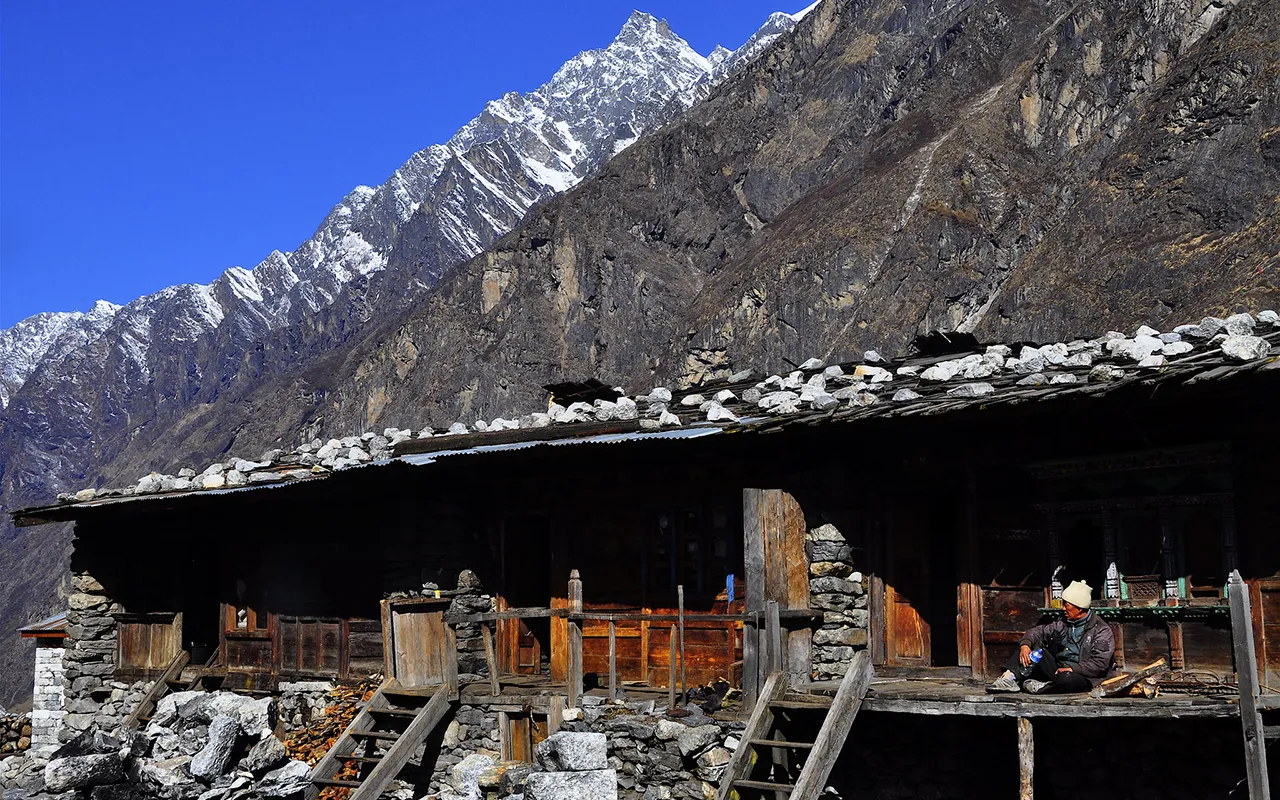
The accommodation in the Yala Peak Climbing route depends on the location. Between Syabrubesi and Kyanjin Gompa, the trekkers spend their nights in the usual teahouses. These lodges are simple yet comfortable, which include a warm room, use of shared bathroom, and simple meals. Accommodation in teahouses means the trekkers get to see the local culture, meet Tamang families, and taste freshly cooked Nepali food.
At Yala Peak Base Camp, accommodation shifts to tents. The base camp is established at about 4,800 meters, where there are no sightless lodges. Tents are used to face cold nights and wind, and during the climb to the top, before climbing the mountain heroically. Experienced guides assist in the arrangement of sleeping places, considering wise comfort and safety.
Morning Star Treks organizes a teahouse and tented stay, and thus the climbers do not need to concern themselves with logistics. They choose hygienic, well-maintained lodges and install safe tents in the base camp. The reinforcement of this nature enables the trekkers to concentrate on the climb and appreciate the beautiful environment instead of the logistical aspects of where to sleep.
All in all, teahouse comfort and high-altitude camping make Yala Peak climbing a special experience- local hospitality and Himalayan adventure.
Food and Drink
In the Yala Peak Climbing route, the travelers should anticipate plain, but nutritious meals. The typical foods are dal bhat, vegetable noodles, soups, Tibetan bread, and local dumplings. Breakfast time can include porridge, egg, or pancakes with tea or coffee to maintain the level of energy.
In high altitudes such as Base Camp on Yala Peak, the support crew prepares the food. Hot soups, rice meals, and warm beverages are eaten to keep us warm during the colder season. Carrying snacks like chocolates or nuts, or energy balls, is very advisable on the summit day.
It is always essential that one has safe drinking water. Boiled water or filtered water is normally available in teahouses, though purification pills can also be carried by trekkers in case. Hydration and eating of well-balanced meal can help to reduce fatigue and ensure the body remains strong to climb.
Alternative Routes
The trek through the Langtang valley is a good place to visit for trekkers who do not need to climb a summit. This trail goes through luxuriant forests, traditional Tamang villages, and along alpine meadows, and the spectacular view of Langtang Lirung and Dorje Lakpa. It also gives the hikers time to appreciate the beauty in the area in a relaxed fashion.
The other side trip is a smaller mountain, the Tserko Ri, reachable at 4,984 meters. The peak is shorter than the Yala Peak, but it also offers brilliant panoramic views of the Langtang valley and other valleys around. It is a one-day trek that many trekkers do during their interactions at Kyanjin Gompa.
Those who want a more difficult adventure may choose the path over Ganja La Pass to Helambu. It is a high-altitude journey, and one should be better trained on some of these longer roams and rough landforms. The treasure of the journey gives the hikers a remote nature, fewer walkers on the trail, and spectacular scenery of the Himalayas.
Can a Beginner Join this Trek?
The answer is yes; beginners can participate well in Yala Peak Climbing. It has been regarded as one of the most accessible trekking peaks in Nepal, which is why it is ideal in the scenario of novice climbers. It is non-technical, so you do not even have to have prior experience in mountaineering before you reach its peak.
Good physical shape is, however, essential. Frequent walking, hiking, or cardio before the trip is helpful as a way of preparing the body for the long days of the trek and high altitude. Although crampons, ropes, and an ice axe are involved, these are simple skills managed by professional guides.
Yala Peak Climbing is rather oriented to stamina and acclimatization than technical sense. Morning Star Treks makes sure that first-timers are properly instructed, supported, and get their pacing on the journey. This climb is not only feasible with the proper preparation but also creates an unforgettable Himalayan experience for a beginner.
Preparation and Fitness
It is safer and more enjoyable to prepare a long time before Yala Peak Climbing. Running, cycling, or swimming as cardio exercise to build stamina should be included in a good training plan. It is also wise to have practice with high altitudes with a backpack, as the experience will be close to that one in the Himalayas, which involves day-to-day trekking.
It is also important to rely on strength training. Squats, lunges, and trunk exercises equip your legs and body to walk up and downhill. Endurance should be built up over time, at least 2-3 months before the climb. This helps you be more confident with the walking paths and the push to the peak.
Having the appropriate equipment is also an issue. It is required to wear proper trekking shoes, layers, gloves, and a pair of sunglasses. Mental preparedness is equally essential; knowing how the nights are, how simple camping is, and how to breathe the thinner air in altitudes all serve to set the proper expectations.
Yala Peak Climbing is achievable even for those possessing simple fitness training and preparation; hence, it makes it a worthwhile first experience with the Himalayan peaks.
Gadget Charging, Internet & Communication
In Yala Peak climbing, tea houses in the Langtang Valley have Wi-Fi at a low charge. It is easy to pass urgent messages or check messages in the initial stages of the trek.
The network is thus extremely limited as you climb up to Kyanjin Gompa and Yala Base Camp. It is challenging to remain connected in such regions.
Bringing a power bank or solar charger is highly advised because it can be rather expensive to charge electronics in lodges as well. These will enable you to have cameras, phones, or GPS powering through the climb.
Permits
In the case of Yala Peak Climbing, the following two permits are required: Langtang National Park entry permit and the TIMS (Trekker Information Management System) card. National Park charge helps in their conservation of safaris, landscapes, and backdoor communities, and redeem trekkers via a TIMS card, which ensures their safety.
The best part of this climb is that you do not require a separate climbing permit, as in most other peaks in Nepal. This renders Yala not only inexpensive but also reachable to novice climbers. Morning Star Treks does much of the paperwork and that too so that you need not lose time in the Kathmandu line before taking the trip.
Transportation
Your trip will start with a Kathmandu Road trip to Syabrubesi, the entrance to the Langtang Valley. It is about a 6- 7 hour-long trip as well as an adventure on its own, traversing rivers, terraces, and hillside villages.
Trekkers will either use a public bus, which is cheap but can often be filled with people and sluggish, or hire a jeep. Jeep is more comfortable, secure, and time-flexible, particularly when it comes to travelling among a crowd of people. Morning Star Treks normally advises people with the preference of using a private jeep in order to have the trip reduced and smoother starting and finishing.
Insurance
Through insurance, preparing for the Yala Peak Climbing is considered one of the most important aspects. Any trekker must possess a policy that involves emergency helicopter evacuation up to at least 6000 meters, because road access to the Langtang region is highly restricted.
Another prudent thing is to make sure that your policy can cover medical care, high altitude trekking, cancellations of a trip, and baggage problems. Morning Star Treks never forgets to warn climbers to plan this prior to going to Nepal because this ensures that people have nothing to worry about on the adventure.
What to Expect
Yala Peak Climbing is not about reaching the peak; it is a combination of culture, nature, and adventure. It starts at the Langtang Valley, where you will trek through rhododendron woods, traditional Tamang villages, and monasteries, which will offer you the opportunity to experience the life of the locals. This multi-cultural depth renders the methodology as enjoyable as the ascending process itself.
The landscape changes radically the higher you get. Soaring labels such as Langtang Lirung, Dorje Lakpa, and Shishapangma take over the skyline, and every progression towards base camp widens and enhances the prospect. Summit morning is marked by the cold air being compensated for by astonishing views, which are some of the best available on a non-technical climb of the Himalayas.
Warm evenings in teahouses and simple home-cooked meals with the opportunity of hearing about other travelers make evenings carefree and cordial. In the base camp, there will be tented living, star nights, and the all-hushed enthusiasm of pre-peak preparation.
Yala Peak Climbing is not easy, but it is reachable. The days may be long, the altitude may be exacting, yet the result of the achievement, 5,732 meters above the ground, surveying endless ranges in every direction, is a memory that remains forever. It is an ideal blend of the cultural safari and mountain hike.
Most Asked Questions
 General
Can Yala Peak be a beginner peak?
Yes, it is a no-technical summit having a high response rate, the best summit to climb in case the cannon is being first-timers.
When is Yala Peak best to climb?
The months of Spring (March-May) and Autumn (September-November) are stable in terms of weather and clear visibility.
Is technical climbing experience required?
There is no prior experience required, but the simple use of crampons and an ice axe is oriented.
So, how far will the journey take to Yala Peak and back, Kathmandu?
The round trip lies between 65-70 km in 12 days, inclusive of the acclimatization days.
What type of accommodation am I to experience?
Teahouses in the valley and tents at Yala Peak Base Camp, with basic but comfortable facilities.
- Safety first, always
- Best prices guaranteed
- Expert travel team
- Easy booking, no extras
- Customize your journey
Based on 10 reviews
Have Questions?
+977 9767224414